China's Administrative Divisions (行政区划): From Qin Counties to Chinese Addresses
How has China been divided over 2,000 years? Meet the First Emperor's counties, the Yuan dynasty's "traveling" provinces and today's ladder of 省, 市, 县, 镇 and 村—then learn why a Chinese "city" can be as big as Austria, why addresses go from big to small, and what your ID number says about you.
Here is a fact that surprises almost everyone: Chongqing, one of China's cities, covers about 82,400 square kilometers. That is roughly the size of Austria. Hulunbuir, a "city" in Inner Mongolia, is even bigger—about as big as the whole United Kingdom.
How can a city be as big as a country? The answer lies in a story that starts with the First Emperor more than 2,000 years ago and ends on the delivery label of your last online order.
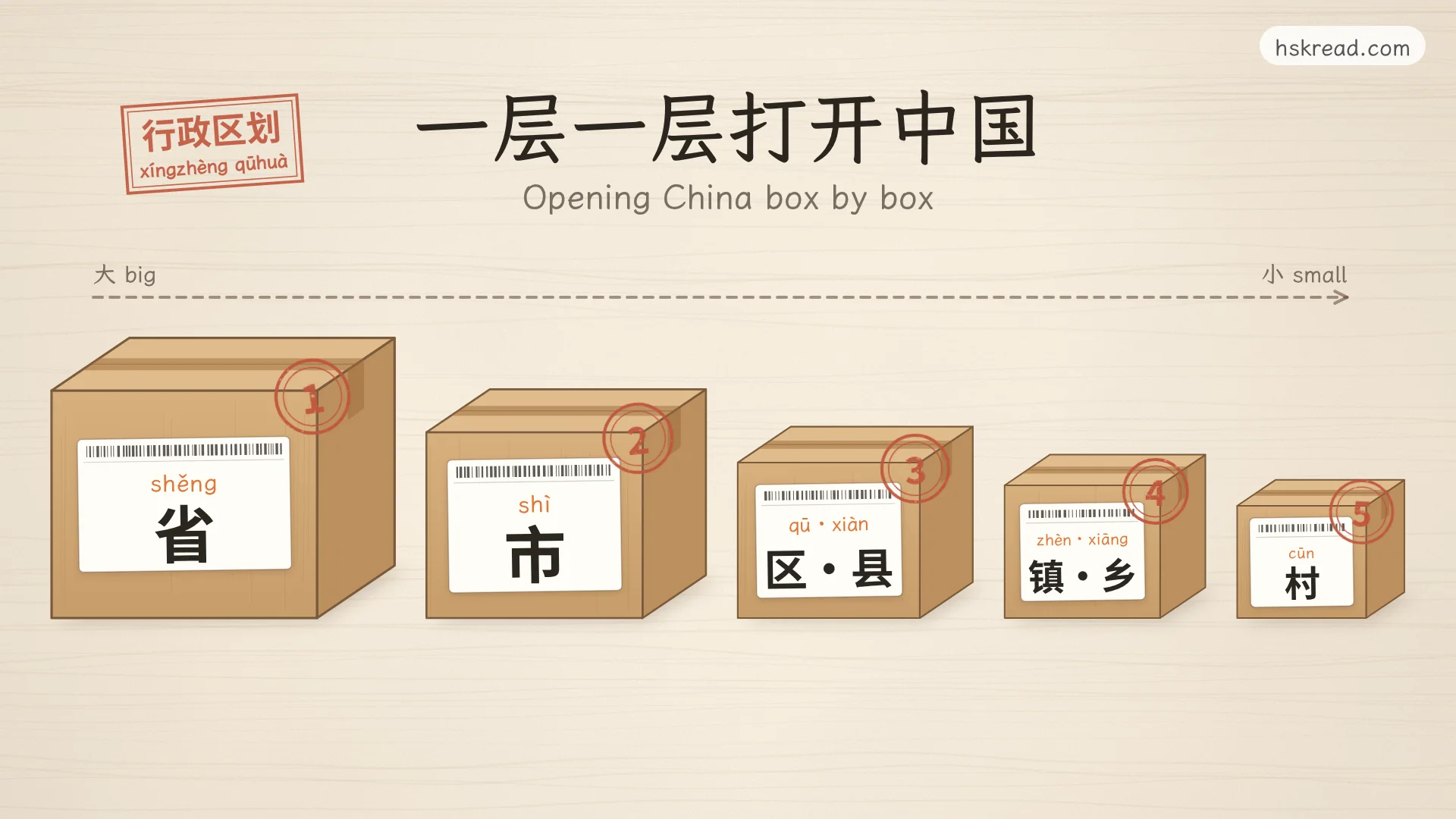
China is divided like a set of nesting boxes: a box inside a box inside a box. Once you see the boxes, a lot of everyday Chinese suddenly makes sense—maps, train tickets, ID cards and addresses. In this guide, we will open the boxes one by one, see where they hide in addresses and ID numbers, and then look back at the 2,000-year history behind them—collecting fun facts along the way.
Key takeaways
- The Chinese word for administrative divisions is 行政区划 (xíngzhèng qūhuà).
- Today's ladder, from big to small: 省 → 市 → 县 / 区 → 乡 / 镇 → 村.
- A Chinese 市 (shì, city) is a whole area, often with farms and counties inside it.
- Four cities (直辖市) skip the province box, and Hong Kong and Macao are special administrative regions.
- Chinese addresses, dates and names all go from big to small—and the first six digits of an ID number are a place code.
- The county (县) has been a basic unit of Chinese government for more than 2,000 years. Qin Shi Huang's 郡县制 made it the backbone of China in 221 BC.
- City names like 杭州 and 广州 keep 州, the name of an old prefecture.
- The word 省 (province) comes from the Yuan dynasty's 行省, a "traveling" office that settled down.
What are China's administrative divisions? A ladder of nesting boxes
China's administrative divisions work like nesting boxes, five levels deep. Picture a big box labeled with a province. Inside are smaller boxes for cities. Inside each city are boxes for districts and counties, and so on, down to the smallest box: a village or a city neighborhood.
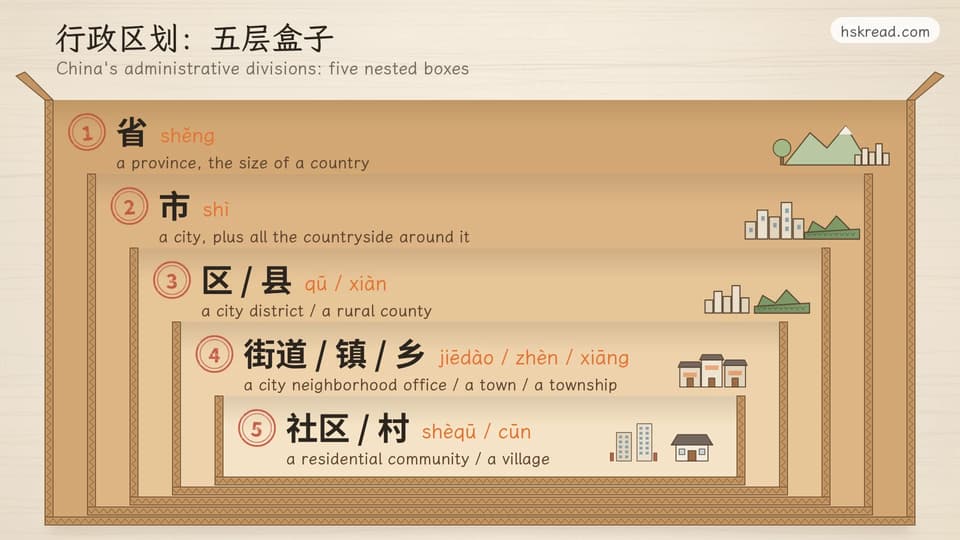
| Box | Chinese | Pinyin | Think of it as |
|---|---|---|---|
| 1 | 省 | shěng | a province, the size of a country |
| 2 | 市 | shì | a city, plus all the countryside around it |
| 3 | 区 / 县 | qū / xiàn | a city district / a rural county |
| 4 | 街道 / 镇 / 乡 | jiēdào / zhèn / xiāng | a city neighborhood office / a town / a township |
| 5 | 社区 / 村 | shèqū / cūn | a residential community / a village |
What each level means
- 区 (qū, district) is usually part of a city's urban area—Beijing's 海淀区 or Shanghai's 浦东新区. 县 (xiàn, county) is more rural, with a small town at its center called the 县城 (xiànchéng). For many Chinese people, the 县城 is "home": the place where they went to high school before moving to a big city.
- 镇 (zhèn) is a town and 乡 (xiāng) is a more rural township. In a city, the same level is the 街道, a neighborhood unit with its own office.
- 村 (cūn, village) and 社区 (shèqū, community) are not really government levels. They are run by local committees, the village committee and the residents' committee.
A city inside a city: a real example
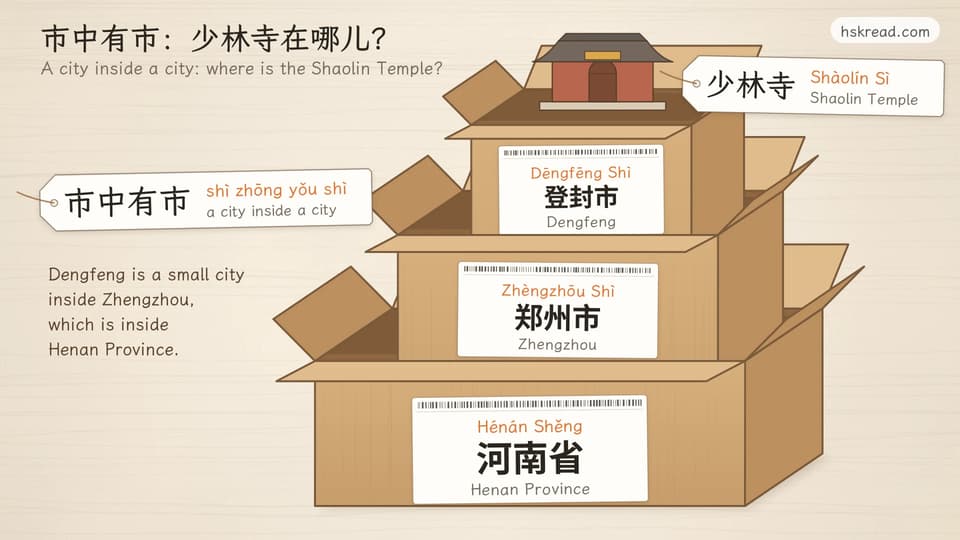
The famous Shaolin Temple is in 登封市 (Dēngfēng Shì). 登封 is a small city—but it sits inside a bigger city, 郑州市 (Zhèngzhōu Shì), which sits inside 河南省. Yes: a city inside a city inside a province. Welcome to the boxes!
Special boxes for ethnic minority areas
There are a few special boxes, too. Areas with large ethnic minority communities have "autonomous" versions of each level: 自治区 (autonomous region), 自治州 (autonomous prefecture) and 自治县 (autonomous county). You can learn more in our guide to China's ethnic groups.
Why a Chinese "city" can be the size of a small country
Chongqing is about the size of Austria, yet it is called a city. Here is why. In English, a "city" is the built-up area with streets and buildings. In Chinese, a 市 is a box on the map. It usually contains:
- the downtown districts, the 市区 (shìqū) and the 市中心 (shì zhōngxīn, city center)
- suburbs and new districts
- rural counties, small towns, villages, farms, forests and even mountains
Since the 1980s, China has followed a system nicknamed 市管县 (shì guǎn xiàn, "cities lead counties"), which put the countryside around each city under the city government. That is why one 市 can have millions of people—and also rice fields, tea gardens and water buffalo.
- Chongqing (重庆市) covers about 82,400 km²—roughly the size of Austria—and more than 30 million people live there. But most of its land is rural counties and steep green hills.
- Hulunbuir (呼伦贝尔市) in Inner Mongolia covers about 253,000 km², roughly the size of the United Kingdom, with grasslands and forests that seem to go on forever.
So when a news report says "Chongqing has 30 million people," it means the whole box, not just the skyline. If you want to say "downtown," say 市中心.
直辖市: four cities that skip a box
Most cities sit inside a province. Four do not. 北京, 天津, 上海 and 重庆 are 直辖市 (zhíxiáshì), "cities directly governed" by the central government. They have the same rank as a province, so they skip the province box entirely.
Chongqing is the youngest member of the club: it was split off from Sichuan and became a 直辖市 in 1997. Because they count as provinces, each one has its own license-plate character: 京, 津, 沪 and 渝.
特别行政区: Hong Kong and Macao
香港 (Hong Kong) and 澳门 (Macao) are 特别行政区 (tèbié xíngzhèngqū), special administrative regions. Hong Kong returned to China in 1997 and Macao in 1999, under the idea of 一国两制 (yì guó liǎng zhì), "one country, two systems."
For a visitor, the "two systems" part is easy to see: they have their own money (the Hong Kong dollar and the Macao pataca), cars drive on the left, Cantonese is the everyday language, and there is a border checkpoint when you travel from the mainland. In Macao you will also see street signs in Portuguese—and you should not leave without trying a warm Portuguese-style egg tart.
Big to small: addresses, dates and names
Here is one of the most useful things to notice in Chinese: the big part comes first. Chinese addresses open the boxes in order, from the largest to the smallest. And it is not only addresses:
- Dates: 2026年10月8日—year, then month, then day.
- Names: 王小明—family name 王 first, then the given name.
- Addresses: country, province, city, district, street, number, building, room.
Let's try a famous one. The address of the Palace Museum—the Forbidden City—is:
北京市东城区景山前街4号
| Part | Pinyin | Meaning |
|---|---|---|
| 北京市 | Běijīng Shì | Beijing (a 直辖市, so no province needed) |
| 东城区 | Dōngchéng Qū | Dongcheng District |
| 景山前街 | Jǐngshān Qián Jiē | Jingshan Front Street |
| 4号 | sì hào | No. 4 |
Most people, of course, live in apartments, so their address keeps going: 3栋2单元501室—Building 3, Entrance 2, Room 501. Here are the words:
- 路 (lù, road) and 街 (jiē, street) are the most common street words; 号 (hào) is the building number on the street, also called the 门牌号 (ménpáihào).
- 栋 (dòng) is a building, 单元 (dānyuán) is an entrance or stairwell inside it, and 室 (shì) is the apartment. Room 501 is usually on the fifth floor.
- The 邮编 (yóubiān, postal code) has six digits. A classic Chinese envelope has six little boxes for it in the top-left corner.
In English, the order is simply reversed, from small to big: Room 501, Unit 2, Building 3, … Dongcheng District, Beijing, China. Many people write the English version for the post office abroad and the Chinese version for the delivery driver in China.
The secret code in a Chinese ID number
Every Chinese citizen has an 18-digit ID number on their 身份证 (shēnfènzhèng, ID card), and the boxes are hidden right inside it:
- Digits 1–6: a code for the place where the person's household was registered—the province, the city and the county or district. 11 is Beijing, 31 is Shanghai, 44 is Guangdong and 51 is Sichuan. So 110108 means Beijing → city districts → Haidian District.
- Digits 7–14: the person's birthday, written—of course—from big to small: year, month, day.
- Digit 17: odd for men, even for women.
- Digit 18: a check number. It can even be the letter X, which stands for 10.
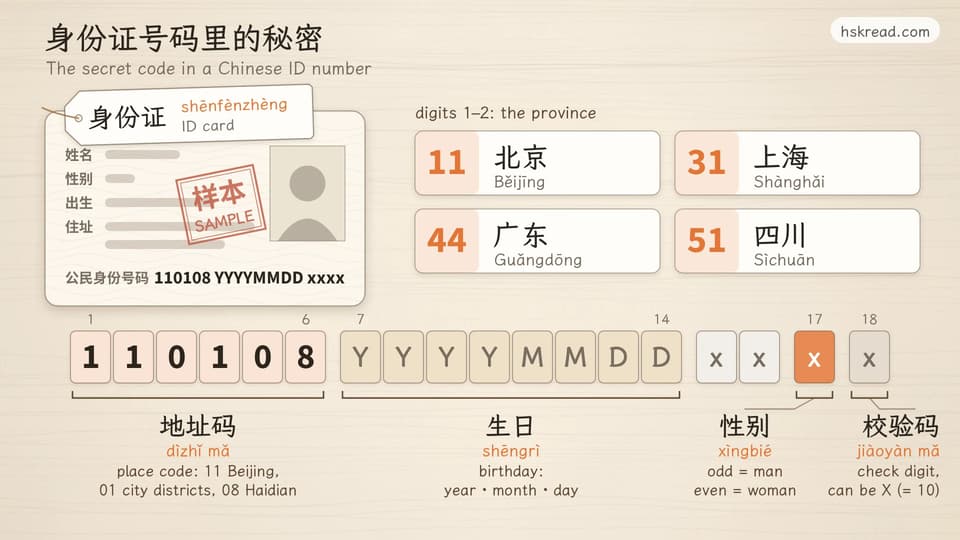
So a Chinese friend can often glance at an ID number and say, "Oh, you're from Sichuan!" before you say a word.
Words you will actually see: 街道, 小区, 胡同, 村
Forget the official charts for a moment. These are the place words you will meet on signs, in apps and in conversation:
- 街道 (jiēdào): in daily life, simply "street." On a form, it can also mean the city neighborhood unit, whose office—the 街道办 (jiēdàobàn)—handles local paperwork.
- 小区 (xiǎoqū): a residential compound, a group of apartment buildings behind one gate, usually with a guard, a delivery locker and, in the evening, a group of aunties doing square dancing. It is not an official level, but it is in almost every city address.
- 胡同 (hútòng): Beijing's old narrow alleys, lined with courtyard houses. Many scholars think the word comes from a Mongolian word for "well," from the time of the Yuan dynasty.
- 村 (cūn): a village—but not always! 中关村 (Zhōngguāncūn) in Beijing is a busy tech district often called "China's Silicon Valley," and the whole world is a 地球村 (dìqiú cūn), a "global village."
- 老家 (lǎojiā): your family hometown. Ask a friend 你老家在哪儿? and you may hear a province, a city, a 县 and a 村—all the boxes at once.
Before counties: when lords ruled the land
Three thousand years ago, during the Zhou dynasty, China was not run by officials. It was run by families. The king gave land to his relatives and allies, who ruled it as lords and passed it down to their sons. This is called 分封 (fēnfēng), "dividing and granting."
Over time, the lords grew strong, stopped listening to the king and fought each other for centuries, ending in the famous Warring States period.
Some states found a better idea. When they conquered new land, they did not give it to a lord. They made it a 县 (xiàn), a county, and sent an official to run it. According to the old history book Records of the Grand Historian, the state of Qin did this as early as 688 BC—often called the earliest dated record of a county.
(Historians still debate how much those early counties looked like later ones.)
The First Emperor's big idea: 郡县制
In 221 BC, the king of Qin conquered all his rivals and became Qin Shi Huang, the First Emperor. Some of his ministers suggested giving land to his sons, the old way. His adviser Li Si (李斯) disagreed—and the emperor took his side.
Instead, he divided the whole empire into 36 郡 (jùn, commanderies), and each 郡 into 县 (counties). He sent officials from the capital to run them, and he could move or fire them at any time. No one owned their region. This system is called the 郡县制 (jùnxiànzhì), and it became the model for Chinese government for the next 2,000 years. You can read more about the man behind it in our guide to Qin Shi Huang.
The county turned out to be amazingly tough. Dynasties rose and fell, capitals moved, borders changed—but the 县 stayed. Today, China still has about 2,800 county-level areas.
In old stories and TV dramas, the county boss is the 县官 (xiànguān) or county magistrate. Because he held only the seventh rank out of nine, people jokingly called him a 七品芝麻官 (qī pǐn zhīma guān)—a "seventh-rank sesame-seed official," an official as small as a sesame seed.
Why so many Chinese cities end in 州
Look at a list of Chinese cities and you will see the same character again and again: 杭州, 苏州, 广州, 福州, 郑州, 兰州… What is that 州 (zhōu)?
In the Han dynasty, 州 were huge inspection regions. Later dynasties made them smaller, and by the Sui and Tang dynasties, a 州 was a prefecture—a region with a city at its center. Over time, many of those prefectures changed their names or levels, but the cities at their centers kept the old title.
So when you say "Hangzhou" or "Guangzhou," you are using the name of a 1,000-year-old government unit. It is a bit like English place names that end in "-shire" or "-chester": a fossil of history hiding in a modern name.
How 省 was born: the office that never went home
The top box, the 省 (shěng, province), has the strangest story of all. 省 was first the name of an office, not a place. In the Yuan dynasty (1271–1368), the empire was run from the capital by the 中书省, the Central Secretariat. The empire was so big that the Secretariat sent out branch offices to the regions, called 行中书省—a "traveling Secretariat," or 行省 for short.
These offices were meant to come back home. They never did. They settled down, ran their regions for good, and people began using the office's name for the land itself. The Ming dynasty later tried to give provinces a long new official name, but everyone kept saying 省—and they still do. We tell the full story, with lots of fun province facts, in our guide to Chinese provinces.
Useful vocabulary
| Chinese | Pinyin | Meaning |
|---|---|---|
| 行政区划 | xíngzhèng qūhuà | administrative divisions |
| 郡县制 | jùnxiànzhì | the commandery-county system |
| 行省 | xíngshěng | Yuan-dynasty province ("traveling office") |
| 省 | shěng | province |
| 市 | shì | city (often a whole area) |
| 市中心 | shì zhōngxīn | city center, downtown |
| 区 | qū | district |
| 县 | xiàn | county |
| 县城 | xiànchéng | county town |
| 镇 | zhèn | town |
| 村 | cūn | village |
| 直辖市 | zhíxiáshì | city with the rank of a province |
| 地址 | dìzhǐ | address |
| 邮编 | yóubiān | postal code |
| 身份证 | shēnfènzhèng | ID card |
| 小区 | xiǎoqū | residential compound |
Next time you see 省, 市, 区 on a parcel, you will know exactly how many boxes the delivery driver had to open to find your door—and that the oldest box in the stack was built by the First Emperor.
Check your understanding
01What are the levels of administrative divisions in China?
From big to small, the main levels are the province (省), the city (市), the county or district (县 or 区) and the town or township (镇, 乡 or 街道). Below them are villages (村) and urban communities (社区), which are run by local committees.
02What was the 郡县制?
The 郡县制 (jùnxiànzhì), or commandery-county system, was the way Qin Shi Huang divided China after he unified it in 221 BC. Instead of giving land to lords, he split the country into commanderies (郡) and counties (县) run by officials sent from the capital. The county has survived as a basic unit for more than 2,000 years.
03Where does the word 省 (province) come from?
省 was first the name of a government office. In the Yuan dynasty, the Central Secretariat (中书省) sent out branch offices called 行中书省, or 行省. They settled in the regions for good, and the office name slowly became the word for "province."
04Why are Chinese cities so big?
Because a Chinese 市 is an area on the map, not just a built-up town. A city usually includes its downtown districts plus the counties, towns, villages and farmland around it. Chongqing covers about 82,400 square kilometers—roughly the size of Austria.
05What is the difference between a 直辖市 and a 特别行政区?
A 直辖市 (zhíxiáshì) is a city with the rank of a province that reports directly to the central government—Beijing, Tianjin, Shanghai and Chongqing. A 特别行政区 (tèbié xíngzhèngqū), or special administrative region, is Hong Kong or Macao, which have their own currency, legal system and customs border under "one country, two systems."
06How do you write a Chinese address?
Chinese addresses go from big to small—province, city, district, street and number, then building, unit and room. For example, the Palace Museum's address is 北京市东城区景山前街4号. In English, the order is reversed, starting with the smallest part.