What Does 搭子 Mean? China's “Activity Buddy” Slang Explained
Learn what 搭子 (dāzi) means, how a word for mahjong partners became 2023's hottest social trend, the most common types like 饭搭子 and 旅游搭子, and how to use it naturally.
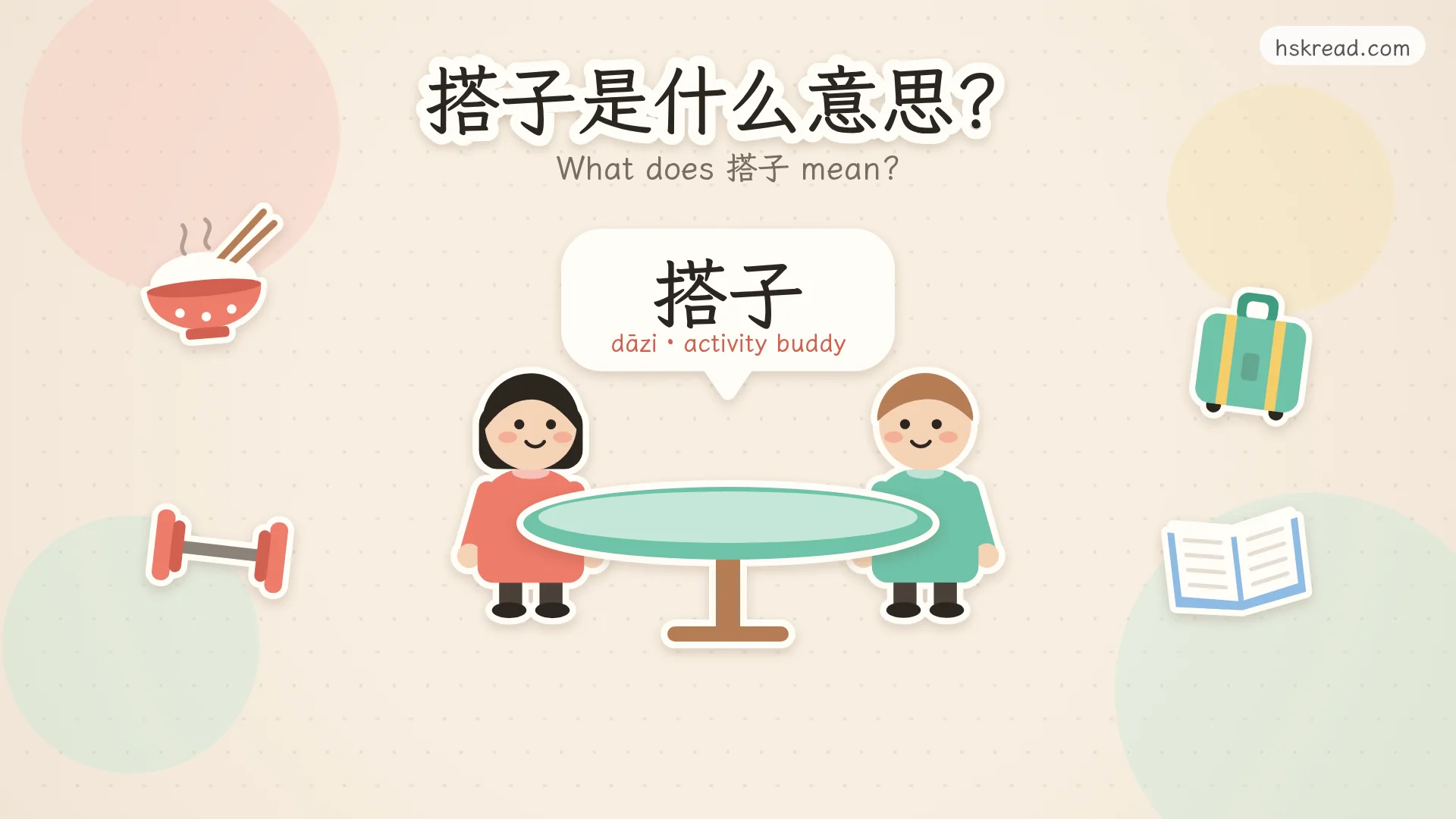
Your coworker (同事, tóngshì) eats lunch with you every day. You talk about food, work and weekend plans—but you have never met her family, and you are not sure you would call her a close friend. In English, there is no perfect word for this person. In Chinese, there is: she is your 饭搭子 (fàn dāzi), your “meal buddy.”
搭子 (dāzi) is one of the most useful words in modern Chinese. It means a partner you team up with for one specific activity: eating, traveling, going to the gym, studying, even drinking coffee. The word is old, but in 2023 it exploded across Chinese social media and became a symbol of how young people make friends today.
In this guide, you will learn what 搭子 means, where it came from, the most common kinds of 搭子 and how to use the word naturally. Each section stands on its own, so skip to whatever you are curious about.
Key takeaways
- Meaning: 搭子 means an activity partner—someone you do one particular thing with.
- Types: add an activity in front: 饭搭子 (meal buddy), 旅游搭子 (travel buddy), 健身搭子 (gym buddy), 学习搭子 (study buddy).
- Origin: it comes from Wu Chinese (especially Shanghainese), where 牌搭子 meant your card or mahjong partners. In 2023, it was named one of the year's top ten buzzwords.
- Using it: posts start with 求搭子 or ask 有没有搭子?
- 搭子 vs. 朋友: a 搭子 is lighter than a friend: you share one activity, not your whole life.
- Why it's popular: big-city life, low pressure and clear boundaries.
What does 搭子 mean?
In one sentence: a 搭子 is the person you do one thing with. Here is how the word is built.
The word has two parts:
| Part | Pinyin | Meaning |
|---|---|---|
| 搭 | dā | to put up; to join together; to team up |
| 子 | zi | a noun suffix, said in the neutral tone (as in 桌子) |
| 搭子 | dāzi | the person you team up with for an activity; your buddy |
The verb 搭 (dā) is all about putting two things together. You 搭帐篷 (put up a tent), 搭车 (catch a ride), and two colors that go well together 很搭 (“match well”). A 搭子, then, is the person who “matches” you for a certain activity.
The most important rule is that a 搭子 is usually tied to one thing. You do not just have “a 搭子”—you have a 饭搭子, a 跑步搭子 or a 追剧搭子, a buddy to binge-watch dramas with (追剧, zhuījù, “to chase a drama”).
The word in front is simply the activity: 旅游 (lǚyóu, travel), 健身 (jiànshēn, work out), 跑步 (pǎobù, run), 咖啡 (kāfēi, coffee), even 演唱会 (yǎnchànghuì, concerts). The activity is the reason the relationship exists.
Common types of 搭子
Meal buddy, gym buddy, even slacking-off buddy: almost any activity can have its own 搭子 (dāzi, activity buddy). These are the ones you will see most:
| Type | Pinyin | Meaning |
|---|---|---|
| 饭搭子 | fàn dāzi | a meal buddy; someone to eat with |
| 旅游搭子 | lǚyóu dāzi | a travel buddy |
| 健身搭子 | jiànshēn dāzi | a gym buddy |
| 学习搭子 | xuéxí dāzi | a study buddy |
| 跑步搭子 | pǎobù dāzi | a running buddy |
| 咖啡搭子 | kāfēi dāzi | a coffee buddy |
| 追剧搭子 | zhuījù dāzi | a buddy to watch TV dramas with |
| 演唱会搭子 | yǎnchànghuì dāzi | a concert buddy |
| 摸鱼搭子 | mōyú dāzi | a coworker to slack off with (摸鱼 = “touch fish”) |
| 牌搭子 | pái dāzi | a card or mahjong partner (the original meaning) |
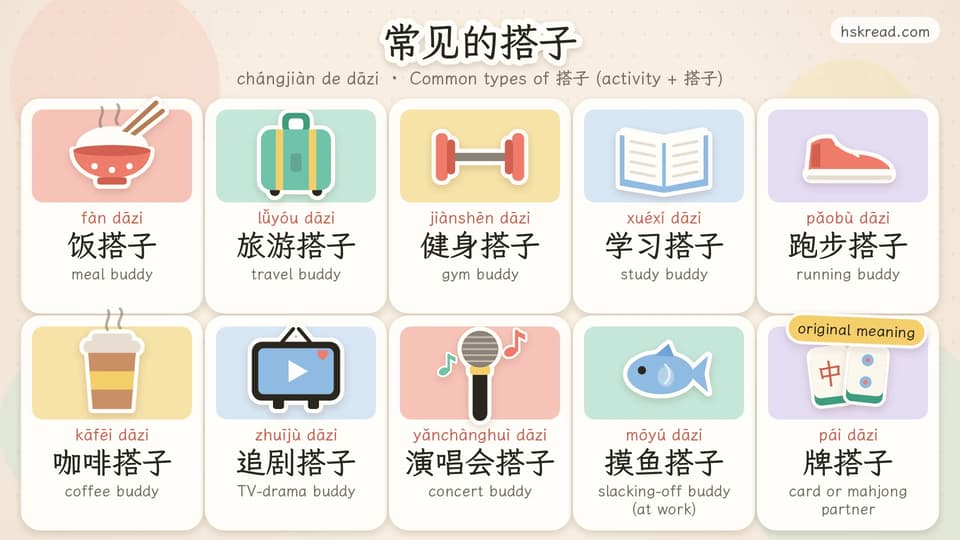
The 饭搭子 (meal buddy) is the classic example, and it makes a lot of sense. Many restaurant dishes in China are made for sharing, so eating alone means you can only order one or two dishes. With a 饭搭子, you can order more and try more. Splitting the bill also makes it cheaper.
Where does 搭子 come from?
From a mahjong table in old Shanghai to one of 2023's top buzzwords: here is the short life story of the word.
At the mahjong table
Picture a smoky room in old Shanghai, four people around a table, tiles clicking. 搭子 (dāzi, “activity buddy”) is not a new word.
It comes from Wu Chinese (吴语, Wúyǔ), the dialects spoken around Shanghai, Suzhou and Hangzhou. In 上海话 (Shànghǎihuà, Shanghainese), a 牌搭子 (pái dāzi) was one of the people you sat down with to play cards (打牌, dǎpái) or mahjong (麻将, májiàng).
Mahjong needs exactly four players, so if one person was missing, nobody could play until someone found another 搭子. Your 牌搭子 did not have to be your best friend—they just had to show up and play. That is still the heart of the word today.
Standard Mandarin has close relatives of the word, such as 搭档 (dādàng, “partner; teammate”) and 搭伙 (dāhuǒ, “to team up”). They share the same 搭.
2023: the year of 搭子
In 2023, the word suddenly took off on 社交媒体 (shèjiāo méitǐ, social media). On the lifestyle app 小红书 (Xiǎohóngshū, RedNote), young people began posting requests like “looking for a weekend hiking 搭子” or “need a 饭搭子 near my office.” By the middle of that year, posts about 搭子 had been viewed tens of millions of times, and Chinese media were writing about the new 搭子社交 (dāzi shèjiāo, “buddy-style socializing”).
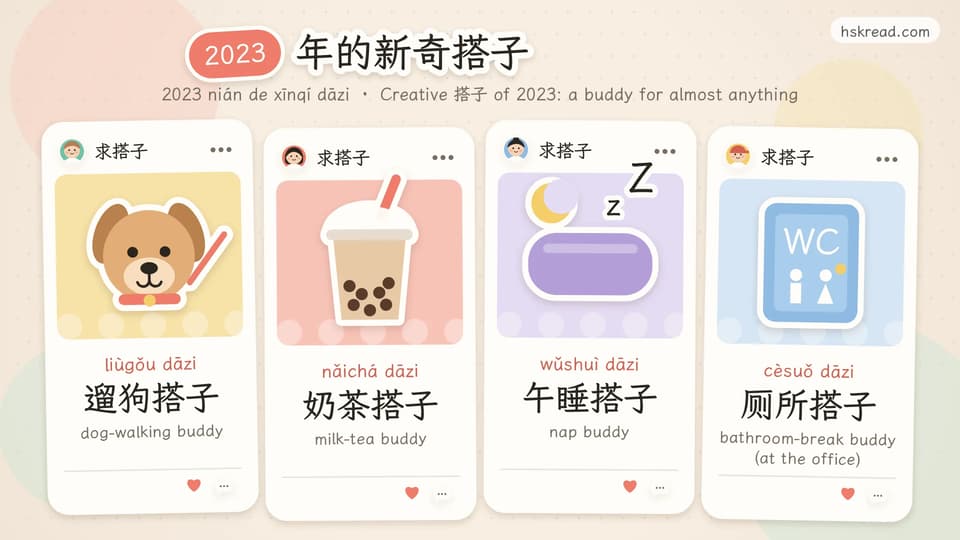
People got creative: there were dog-walking buddies (遛狗搭子, liùgǒu dāzi), milk-tea buddies (奶茶搭子, nǎichá dāzi), nap buddies (午睡搭子, wǔshuì dāzi), and even the office 厕所搭子 (cèsuǒ dāzi), a coworker who takes bathroom breaks with you, so you can escape your desk together for five minutes.
At the end of 2023, a well-known Chinese language magazine picked 搭子 as one of the year's top ten buzzwords (流行语, liúxíngyǔ). Not bad for a word that started at the mahjong table!
How to use 搭子
Ready to find your own 搭子 (activity buddy)? These are the patterns people actually use in chats and posts.
Useful patterns
| Pattern | Pinyin | Meaning |
|---|---|---|
| 找搭子 | zhǎo dāzi | to look for a buddy |
| 求一个……搭子 | qiú yí ge … dāzi | looking for a … buddy (common in posts) |
| 有没有……搭子? | yǒu méiyǒu … dāzi? | Anyone want to be my … buddy? |
| 我们是……搭子 | wǒmen shì … dāzi | We're … buddies. |
| 当……搭子 | dāng … dāzi | to be someone's … buddy |
| 搭子社交 | dāzi shèjiāo | buddy-style socializing |
On social media, you will often see posts that start with 求搭子 (“looking for a buddy”) followed by the city, the activity and a few details about the person.
搭子, 搭档 and 伙伴
| Word | Pinyin | Meaning | Feel |
|---|---|---|---|
| 搭子 | dāzi | activity buddy | casual, trendy |
| 搭档 | dādàng | partner; teammate; co-worker | neutral; work, sports, stage duos |
| 伙伴 | huǒbàn | partner; companion | neutral to formal |
| 同伴 | tóngbàn | companion; someone you go with | neutral |
Two TV hosts who always work together are 搭档. Two strangers who meet every Saturday to play badminton (羽毛球, yǔmáoqiú) are 搭子.
搭子 vs. 朋友: what's the difference?
Is your 搭子 your friend? This is the question everyone asks. A 搭子 (activity buddy) is not the same as a 朋友 (péngyou, friend), and it is definitely not a 闺蜜 (guīmì, best girlfriend) or a 死党 (sǐdǎng, ride-or-die best friend).
| 搭子 | 朋友 | |
|---|---|---|
| Why you meet | for one activity | because you like each other |
| What you share | that activity | many parts of your life |
| How you talk | mostly about the activity | about everything |
| If one of you moves away | you find a new 搭子 | you stay in touch |
| Pressure | very low | higher—you need to keep in touch |
You could say a 搭子 sits somewhere between a 陌生人 (mòshēngrén, stranger) and a friend—closer to a 熟人 (shúrén, acquaintance) who shares your hobby.
That said, the line is not fixed. Many people say their 饭搭子 slowly turned into a real friend. That is part of the charm: a 搭子 is an easy first step if you want to 交朋友 (jiāo péngyou, make friends) in a new place.
Why do young people love 搭子?
How did an old mahjong word become the way a generation makes friends? Chinese media and researchers have offered several reasons why young people love the 搭子 (activity buddy):
- Big cities, busy lives. Many young people move to a new city for study or work. Their old friends are far away, and they have little time to build deep friendships from scratch.
- Low pressure. There is very little 压力 (yālì, pressure). A 搭子 does not expect long chats, birthday gifts or help moving house. You meet, do the activity and go home. People often call it “no-pressure socializing.”
- Clear boundaries. You and your 搭子 agree on what you share. Your private life stays private, and you never have to share your 秘密 (mìmì, secrets).
- Practical benefits. A 健身搭子 keeps you going to the gym. A 旅游搭子 helps split hotel costs. A 学习搭子 makes it harder to give up.
In one 2023 survey, about seven in ten young people said they had at least one 搭子. Another found that the 饭搭子 was by far the most popular kind. Not everyone is a fan, though. Some critics say 搭子 friendships are too shallow, and that people simply forget one 搭子 and find another.
Related slang
Are you an i人 or an e人? Here are the social-life words that often show up next to 搭子 (activity buddy):
| Word | Pinyin | Meaning |
|---|---|---|
| i人 | i rén | an introvert, a 内向 person (from the “I” in MBTI) |
| e人 | e rén | an extrovert, an 外向 person (from the “E” in MBTI) |
| 社恐 | shèkǒng | socially anxious; short for 社交恐惧 |
| 社牛 | shèniú | socially fearless; someone who can talk to anyone |
| 搭子社交 | dāzi shèjiāo | buddy-style socializing |
| 驴友 | lǘyǒu | a backpacking buddy (驴 “donkey” is often said to stand for 旅 “travel”) |
For an i人 (an introvert), a 搭子 can be the perfect solution: you get company for the things you want to do, without the pressure of a big social circle.
Useful vocabulary
| Chinese | Pinyin | English |
|---|---|---|
| 搭子 | dāzi | activity buddy; partner for one activity |
| 饭搭子 | fàn dāzi | meal buddy |
| 旅游搭子 | lǚyóu dāzi | travel buddy |
| 健身搭子 | jiànshēn dāzi | gym buddy |
| 学习搭子 | xuéxí dāzi | study buddy |
| 牌搭子 | pái dāzi | card or mahjong partner |
| 找搭子 | zhǎo dāzi | to look for a buddy |
| 搭子社交 | dāzi shèjiāo | buddy-style socializing |
| 搭 | dā | to put up; to team up; to match |
| 搭档 | dādàng | partner; teammate |
| 伙伴 | huǒbàn | partner; companion |
| 朋友 | péngyou | friend |
| 社交 | shèjiāo | social life; socializing |
Keep learning
Want more modern Chinese? Read our guides to 夯 and 夯爆了 and 彩虹屁, the “rainbow fart”—perfect words to use with your new 搭子.
So next time you want company for lunch, a trip or a workout, you know what to say: 有没有搭子?
Check your understanding
01What does 搭子 mean in Chinese?
搭子 (dāzi) means a partner you team up with for one specific activity, such as eating, traveling, working out or studying. A 饭搭子 is a meal buddy and a 旅游搭子 is a travel buddy. You may not be close friends outside that activity.
02How do you pronounce 搭子?
It is pronounced dāzi. 搭 has the first tone, and 子 is said lightly in the neutral tone, as in 桌子 (zhuōzi) and 孩子 (háizi).
03Where does the word 搭子 come from?
It comes from Wu Chinese, especially Shanghainese, where 搭子 or 牌搭子 meant the people you play cards or mahjong with. In 2023 the word spread across Chinese social media with the wider meaning of “activity partner,” and it was named one of the top ten buzzwords of the year.
04What is the difference between 搭子 and 朋友?
A 朋友 (friend) shares many parts of your life. A 搭子 shares one part. You meet your 饭搭子 for lunch, but you may not tell them your secrets or see them on weekends. Of course, some 搭子 later become real friends.
05What is 搭子社交?
搭子社交 (dāzi shèjiāo) means “buddy-style socializing,” a light, low-pressure kind of friendship built around shared activities. It became a popular topic in China in 2023, especially among young people in big cities.
06Is 搭子 a formal word?
No. 搭子 is casual and fine in conversation, chat messages and social media posts. In formal writing, use 伙伴 (huǒbàn, partner) or 同伴 (tóngbàn, companion) instead.