What Does 彩虹屁 Mean? The Chinese Slang for Over-the-Top Praise
Learn what 彩虹屁 (“rainbow fart”) means, how it grew out of Chinese fan culture, how to use 吹彩虹屁 naturally, and how it differs from 拍马屁 and other praise words.
If a Chinese friend reads your post and comments 别吹彩虹屁了, they are not talking about the weather—or about your stomach. 彩虹屁 (cǎihóngpì) literally means “rainbow fart,” and it is one of the most colorful words in modern Chinese slang. It describes praise so lavish, creative and over-the-top that it sounds almost magical.
The picture behind it is simple: you admire someone so much that even their farts come out as rainbows. In this guide, you will learn what 彩虹屁 means, where it came from, how to use it in real sentences, and how it compares with other Chinese words for praise and flattery.
Key takeaways
- 彩虹屁 means extravagant, imaginative praise—usually playful, not insulting.
- It began in Chinese fan culture (饭圈, fànquān) around 2017.
- The usual verb is 吹: 吹彩虹屁 means “to shower someone with praise.”
- It is different from 拍马屁 (pāi mǎpì), which means flattering someone to get something.
- It is casual. Use it with friends and online, not in formal writing.
What does 彩虹屁 mean?
The word has two parts:
| Part | Pinyin | Meaning |
|---|---|---|
| 彩虹 | cǎihóng | rainbow |
| 屁 | pì | fart; in slang, “nonsense” or “empty talk” |
| 彩虹屁 | cǎihóngpì | over-the-top, beautiful praise |
The joke works on two levels. First, it imagines someone so perfect that even their farts are beautiful. Second, 屁 is already part of older words for flattery, such as 拍马屁, so “a rainbow-colored fart” sounds like a prettier, more artistic kind of flattery.
In English, you might call it gushing, glowing praise or laying it on thick. The difference is that 彩虹屁 is usually lighthearted. When people say it, they are often smiling.
Where did 彩虹屁 come from?
Fan culture (2017)
The word was born in Chinese 饭圈 (fànquān, “fan circles”), the online communities of fans who follow pop idols and actors. Around 2017, fans began competing to write the most beautiful compliments about their idols on social media. A simple photo of an idol drinking water could receive hundreds of comments like “连喝水都这么好看!”—“Even drinking water looks this good!” Many people believe this style of fan writing was inspired by Korean fan culture.
Fans needed a name for this kind of praise. Because it was so flowery that even something as unattractive as a fart would be described as a rainbow, they called it 彩虹屁.
From fans to everyone (2018–2019)
In 2018, the word spread far beyond fan groups when fans of the popular web drama Guardian (《镇魂》) filled the internet with creative compliments and memes about its stars. In 2019, China Daily chose 彩虹屁 as one of its “words of the day,” translating it literally as “rainbow fart.”
That same year, 夸夸群 (kuākuā qún, “praise groups”) went viral on Chinese university campuses. In these group chats, anyone could post a problem—“I failed my exam”—and the other members would shower them with praise: “Failing shows you have room to grow!” Praise groups made the idea of 彩虹屁 part of everyday humor.
彩虹屁 today
Today, almost anyone can be the target of a 彩虹屁: friends, coworkers, pets, a delicious bowl of noodles, a city, even a brand. People still use it for idols, but it is now a normal part of casual Chinese.
How to use 彩虹屁
Common phrases
| Phrase | Pinyin | Meaning |
|---|---|---|
| 吹彩虹屁 | chuī cǎihóngpì | to shower someone with praise |
| 给某人吹彩虹屁 | gěi mǒu rén chuī cǎihóngpì | to gush about someone |
| 一波彩虹屁 | yì bō cǎihóngpì | a wave of glowing praise |
| 彩虹屁大师 | cǎihóngpì dàshī | a “rainbow fart master”; a great praiser |
| 别吹彩虹屁了 | bié chuī cǎihóngpì le | stop flattering me |
| 这波彩虹屁我收下了 | zhè bō cǎihóngpì wǒ shōuxià le | I'll gladly accept that praise |
The verb 吹 (chuī) means “to blow.” It also appears in 吹牛 (chuīniú, “to brag”), so in Chinese, both bragging and praising involve a lot of blowing air.
What does a 彩虹屁 sound like?
A good 彩虹屁 is creative and exaggerated. These phrases often appear in fan comments and friendly praise:
| Expression | Pinyin | Literal meaning | Used to say… |
|---|---|---|---|
| 盛世美颜 | shèngshì měiyán | a beautiful face for a golden age | You are stunning. |
| 神仙颜值 | shénxiān yánzhí | the looks of an immortal | You look out of this world. |
| 颜值天花板 | yánzhí tiānhuābǎn | the ceiling of good looks | No one looks better than you. |
| 宝藏男孩 | bǎozàng nánhái | a treasure boy | He has endless hidden talents. (女孩 for a girl) |
| 永远的神 | yǒngyuǎn de shén | a god forever | The greatest of all time (often typed yyds). |
| 人间理想 | rénjiān lǐxiǎng | the ideal of the human world | You are everything anyone could want. |
The pattern 连……都…… (“even … ”) is the secret ingredient of many 彩虹屁. It takes something ordinary—drinking water, getting angry, yawning—and turns it into proof of perfection.
彩虹屁 vs. 拍马屁 and other praise words
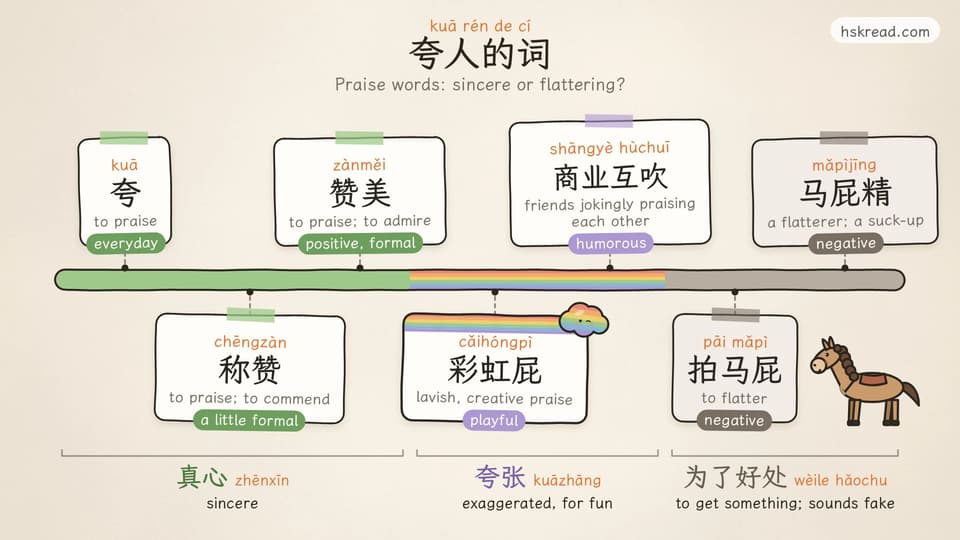
Chinese has many words for praise, and they are not all equally positive.
| Word | Pinyin | Meaning | Tone |
|---|---|---|---|
| 夸 | kuā | to praise | neutral, everyday |
| 称赞 | chēngzàn | to praise; to commend | neutral, a little formal |
| 赞美 | zànměi | to praise; to admire | positive, formal |
| 彩虹屁 | cǎihóngpì | lavish, creative praise | playful, casual |
| 拍马屁 | pāi mǎpì | to flatter (literally “pat the horse's bottom”) | negative |
| 马屁精 | mǎpìjīng | a flatterer; a suck-up | negative |
| 商业互吹 | shāngyè hùchuī | “business mutual praise”; friends jokingly praising each other | humorous |
The key difference is motive. 拍马屁 means flattering someone with power—a boss, a teacher, a rich client—because you want something. It sounds fake. 彩虹屁 is usually open and enthusiastic. Everyone knows it is exaggerated, and that is part of the fun.
Why “patting a horse”? A popular explanation goes back to the horse-riding peoples of northern China. When two riders met, one might pat the other's horse on the rump and praise it—“What a fine horse!”—even if the horse was quite ordinary. Over time, “patting the horse's bottom” came to mean flattering someone to please them.
Why is 彩虹屁 so popular?
Traditional Chinese manners value 谦虚 (qiānxū, “modesty”). When someone praises you, the classic polite reply is not “thank you” but 哪里哪里 (nǎlǐ nǎlǐ)—literally “where? where?”—meaning “Oh, not at all.”
彩虹屁 gives people a fun way around this. Because the praise is so exaggerated that it is half a joke, the person receiving it does not need to feel embarrassed, and the person giving it does not sound like a flatterer. It lets friends say “you're amazing” in a way that feels light and natural.
How to reply to 彩虹屁
| Reply | Pinyin | Meaning | Style |
|---|---|---|---|
| 哪里哪里 | nǎlǐ nǎlǐ | Oh, not at all. | traditional, modest |
| 过奖了 | guòjiǎng le | You flatter me. | polite |
| 你太会夸人了 | nǐ tài huì kuā rén le | You're so good at compliments. | warm |
| 彩虹屁我收下了 | cǎihóngpì wǒ shōuxià le | I'll accept that rainbow fart. | playful |
| 别吹了,我会骄傲的 | bié chuī le, wǒ huì jiāo'ào de | Stop it, I'll get a big head. | playful |
When should you use 彩虹屁?
Use 彩虹屁 in relaxed situations: group chats, social media comments, conversations with friends and classmates, or when talking about fans and idols. It sounds young, funny and friendly.
Avoid it in formal writing, business emails and conversations with people you have just met. The word contains 屁, which is a bit crude. In formal situations, use 称赞, 赞美 or 高度评价 (gāodù píngjià, “to speak highly of”).
Useful vocabulary
| Chinese | Pinyin | English |
|---|---|---|
| 彩虹屁 | cǎihóngpì | over-the-top praise; “rainbow fart” |
| 吹 | chuī | to blow; to brag or praise excessively |
| 饭圈 | fànquān | fan circles; fandom |
| 偶像 | ǒuxiàng | idol |
| 粉丝 | fěnsī | fan; fans |
| 夸 | kuā | to praise |
| 夸夸群 | kuākuā qún | a “praise group” chat |
| 拍马屁 | pāi mǎpì | to flatter; to suck up |
| 马屁精 | mǎpìjīng | flatterer |
| 商业互吹 | shāngyè hùchuī | friends jokingly praising each other |
| 谦虚 | qiānxū | modest |
| 哪里哪里 | nǎlǐ nǎlǐ | Oh, not at all. (reply to praise) |
| 过奖了 | guòjiǎng le | You flatter me. |
Keep learning
Chinese internet slang changes quickly, but it often grows out of very old words. If you enjoyed 彩虹屁, read our guide to 夯 and 夯爆了, another modern word for “amazing” with a surprisingly long history.
So the next time a friend writes a long, poetic comment under your photo, you will know exactly what to say: 谢谢你的彩虹屁!
Check your understanding
01What does 彩虹屁 mean?
彩虹屁 (cǎihóngpì), literally “rainbow fart,” means lavish, creative, over-the-top praise. The joke is that you praise someone so much that even their farts sound like rainbows.
02How do you use 彩虹屁 in a sentence?
The most common verb is 吹, so you 吹彩虹屁 (“blow a rainbow fart”). For example, 他又在给偶像吹彩虹屁 means “He's gushing about his idol again.” You can also say 一波彩虹屁 for “a wave of praise.”
03Where does 彩虹屁 come from?
It started in Chinese fan circles (饭圈) around 2017, where fans wrote long, poetic compliments about their idols. In 2018 and 2019 it spread to everyday online language.
04Is 彩虹屁 rude?
Not usually. It is playful and informal, and the person receiving it often takes it as a compliment. But it contains 屁 (“fart”), so avoid it in formal writing.
05What is the difference between 彩虹屁 and 拍马屁?
拍马屁 means flattering someone to get something, such as a boss. It is negative. 彩虹屁 is usually open, playful and exaggerated praise, often given just for fun.
06How should I reply to 彩虹屁?
You can be modest with 哪里哪里 or 过奖了 (“you flatter me”), or play along with 彩虹屁我收下了 (“I'll accept that rainbow fart”).