Chinese Provinces (省份): What a 省 Is, Fun Names, Nicknames and Food
What is a Chinese province, and why is it called 省? Learn the surprising story of the word, how names like 河北, 湖南 and 山东 work, the one-character nicknames on license plates, fun facts about ten places you will hear about, and how to say where you are from in Chinese.
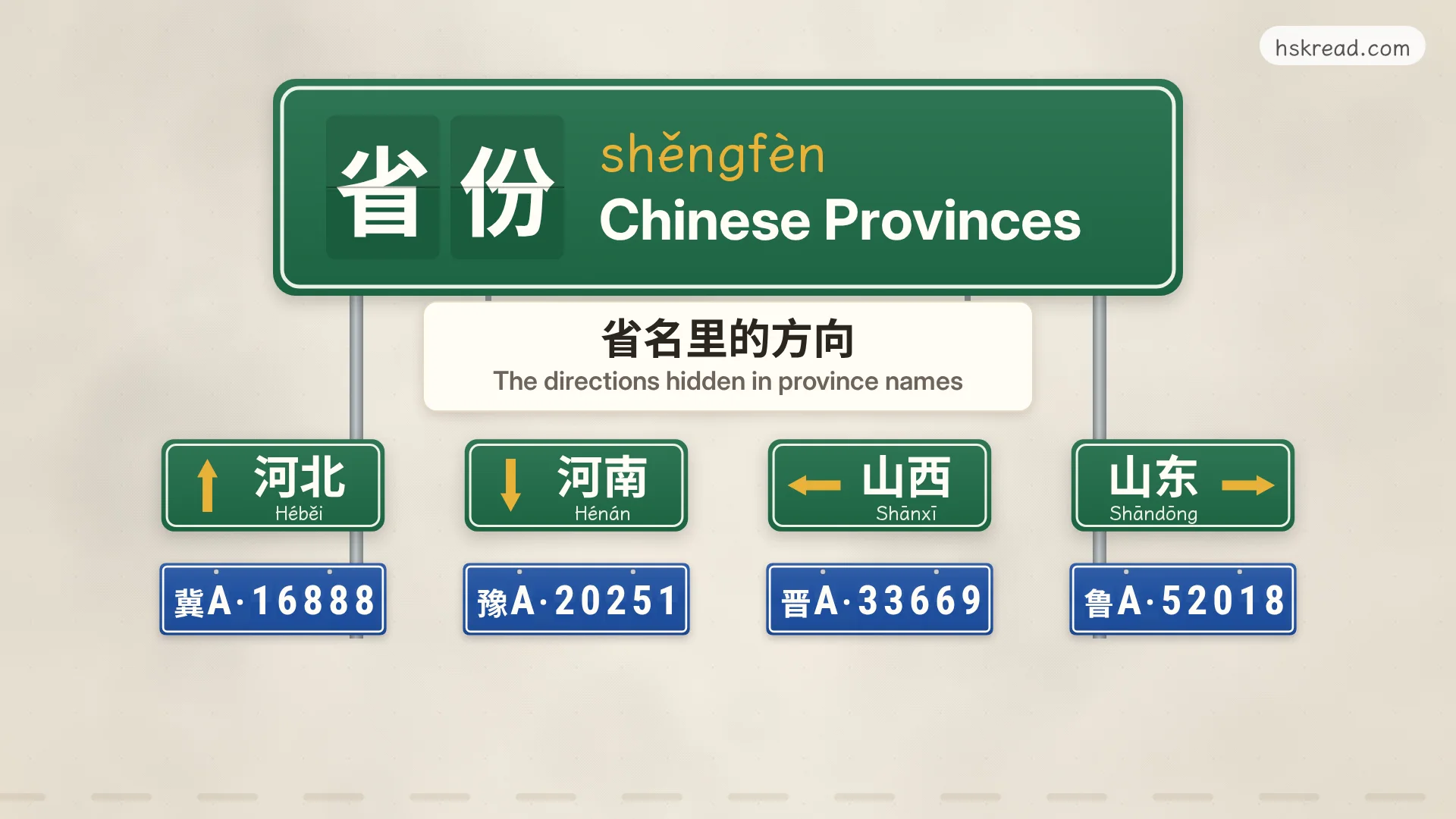
Get into a taxi in China, and the driver may ask you one question before you even put on your seatbelt: 你是哪里人? (Nǐ shì nǎlǐ rén?), "Where are you from?"
Ask a Chinese person the same thing, and the answer is almost always a province: "I'm from 四川," "I'm a 东北 person," "Wait—you're from 山东 too?" Then the conversation takes off: spicy food, accents, who makes the best dumplings, and whether tofu pudding should be sweet or salty.
Provinces are a big part of how people in China see themselves. They also show up everywhere in daily life—on license plates, train lines, menus and in a lot of friendly jokes. In this guide, you will learn what a Chinese province is, where the funny little word 省 comes from, how to "read" province names, and one fun thing about ten places you are sure to hear about. No need to memorize a map—this is the story version.
Key takeaways
- The Chinese word for province is 省 (shěng); "provinces" in general is 省份 (shěngfèn). A 省 is a bit like a US state or a French région—but much bigger, and without its own constitution.
- The word 省 started as the name of a government office. In the Yuan dynasty, "traveling" branch offices (行省) settled down and became provinces.
- Many names are directions: 河北 = north of the river, 湖南 = south of the lake, 山东 = east of the mountains.
- Every province has a one-character nickname (简称), like 京, 沪, 粤 and 川, and you see it on every license plate.
- Ten places you will hear about—from Sichuan's pandas to Xinjiang's 10 p.m. sunsets—each come with one fun fact.
- Spicy food and north-vs-south debates (sweet or salty tofu pudding?) are China's favorite friendly arguments.
- To ask where someone is from, say 你是哪里人?
What is a Chinese province (省)?
A 省 (shěng) is the biggest kind of region inside China. Each one has its own capital city, called the 省会 (shěnghuì)—成都 is the capital of 四川, and 广州 is the capital of 广东. Counting the big cities and special regions that have the same rank, China has 34 provincial-level regions.
If you come from the United States, you can think of a 省 as a bit like a state. If you are from France, think of a région; from Spain, a comunidad autónoma (Spanish readers, note that China's provincias are much bigger than Spain's).
The comparison is loose, though. US states have their own constitutions and many of their own laws. Chinese provinces do not—they are parts of one national system, a bit like very large branches of the same company.
What really surprises visitors is the size. Chinese provinces are the size of countries:
- 四川 (Sìchuān) is almost as big as Spain and has roughly as many people as Germany.
- 广东 (Guǎngdōng) has more people than Japan—about 128 million.
- 新疆 (Xīnjiāng), the largest, covers about one-sixth of China. It is bigger than France and Spain put together.
So when a Chinese friend says "I'm from 四川," it is a bit like a European saying "I'm from Spain." There is a lot of variety inside: big cities, small towns, mountains, farms, and very different accents. Each province is divided into cities, counties, towns and villages—we explain that ladder in our guide to China's administrative divisions.
Where the word 省 comes from: the office that never went home
The Chinese word for "province" began as the name of an office—one that was sent out on a trip and never came back. Long ago, 省 was the name of a government office in the emperor's capital. In the Yuan dynasty (1271–1368), the most important office was the 中书省 (Zhōngshū Shěng), the Central Secretariat—the place where the empire's top ministers worked.
The Yuan empire was enormous. To run faraway regions, the Secretariat sent out branch offices called 行中书省 (xíng Zhōngshū Shěng). The 行 (xíng) means "to go" or "to travel," so the name meant something like a "traveling Secretariat."
The historian Qian Mu (钱穆) called it "a mobile central government." People soon shortened the long name to 行省 (xíngshěng).
At first these offices were meant to be temporary: go to a region, solve the problem, come back. But they never came back. They stayed, settled down and became the permanent government of each region. Over time, people started using the office's name for the land it ran. "The 省" stopped meaning "the office" and started meaning "the province."
The name was so sticky that later rulers could not get rid of it. In 1376, the Ming dynasty gave the provinces a long official name, 承宣布政使司 (chéngxuān bùzhèngshǐ sī). Almost nobody used it in daily life—people kept saying 省. Today, more than 700 years later, the "traveling office" is still on every map of China.
A bonus for learners: the same character 省 also means "to save," as in 省钱 (shěng qián, to save money). Same character, two very different jobs: one saves money, the other runs a region the size of a country.
What do Chinese province names mean? Mini geography lessons
Learn eight simple characters, and a list of strange province names turns into a little geography lesson.
Eight characters that unlock the map
Most province names are made of characters you may already know:
| Character | Pinyin | Meaning |
|---|---|---|
| 东 | dōng | east |
| 南 | nán | south |
| 西 | xī | west |
| 北 | běi | north |
| 河 | hé | river; in old texts, the Yellow River |
| 湖 | hú | lake |
| 山 | shān | mountain |
| 海 | hǎi | sea |
The famous pairs: Hebei and Henan, Hubei and Hunan
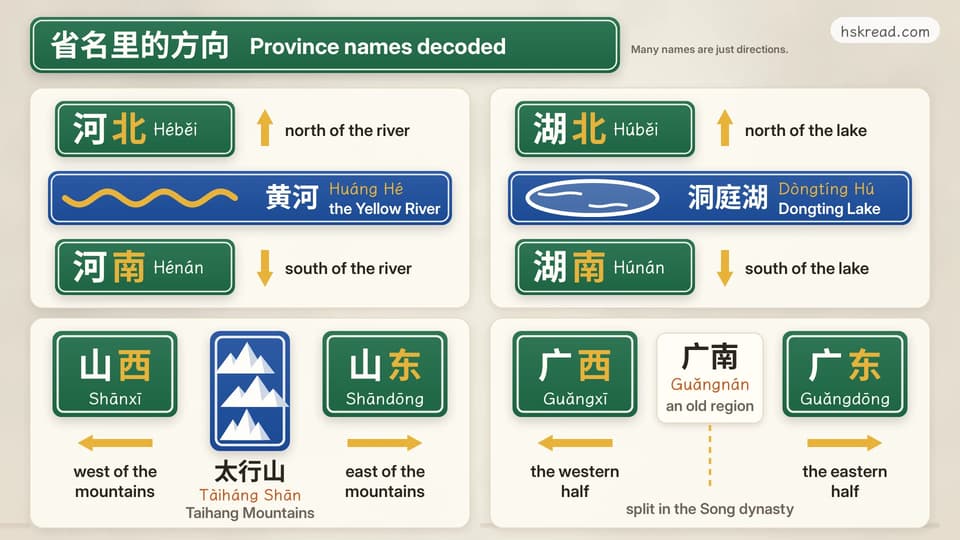
- 河北 (Héběi) and 河南 (Hénán): in ancient Chinese, 河 meant the river—the 黄河 (Huáng Hé), the Yellow River. Hebei is "north of the river," and Henan is "south of the river."
- 湖北 (Húběi) and 湖南 (Húnán): the lake is 洞庭湖 (Dòngtíng Hú), Dongting Lake. Hubei is "north of the lake," and Hunan is "south of the lake."
- 山东 (Shāndōng) and 山西 (Shānxī): "east of the mountains" and "west of the mountains." The mountains are usually said to be the Taihang Mountains.
- 广东 (Guǎngdōng) and 广西 (Guǎngxī): the eastern and western halves of an old region called 广南, split in the Song dynasty.
- 海南 (Hǎinán): "south of the sea"—China's tropical island province.
- 云南 (Yúnnán): often explained as "south of the clouds." Not a direction you can find with a compass, but a lovely name.
Two traps: Shanxi vs. Shaanxi, and Sichuan's "four rivers"
山西 (Shānxī) and 陕西 (Shǎnxī) are two different neighbors. Their pinyin differs only in tone, so the official English spelling for 陕西 adds an extra "a": Shaanxi. If you are going to see the Terracotta Army in Xi'an, you want Shaanxi with two a's!
And 四川? Many people will tell you it means "four rivers." That is the popular story, but most historians say the name comes from four administrative areas of the Song dynasty, later shortened to 四川. Both versions are fun to know—just don't bet money on the rivers.
License plates and the one-character nicknames (简称)
Every Chinese province has a one-character nickname—and you can spot it on every car. It is called a 简称 (jiǎnchēng, "abbreviation"). Some are just the first character of the name, but many are much older and tell a story:
| Place | 简称 | Pinyin | The story |
|---|---|---|---|
| 北京 | 京 | Jīng | 京 simply means "capital" |
| 上海 | 沪 | Hù | an old name for the river mouth near the city |
| 广东 | 粤 | Yuè | the ancient Yue peoples of the south |
| 四川 | 川 | Chuān | from the name 四川 |
| 山东 | 鲁 | Lǔ | the ancient state of Lu, home of Confucius |
| 河南 | 豫 | Yù | 豫州, one of the legendary Nine Provinces |
| 湖南 | 湘 | Xiāng | the Xiang River, which flows through the province |
| 重庆 | 渝 | Yú | an old name for a river that meets the Yangtze |
On every license plate
The first character on every Chinese 车牌 (chēpái, license plate) is the 简称, followed by a letter for the city:
- 京A — a car from Beijing
- 粤A — Guangzhou, the capital of Guangdong; 粤B — Shenzhen
- 川A — Chengdu, the capital of Sichuan
In most provinces, A is the capital city. That makes a fun game on long road trips: kids (and bored adults) shout out where each car comes from. A 京 car in Guangzhou? Someone drove a long way!
On trains and menus, too
The nicknames also hide in the names of train lines and highways. The famous 京沪高铁 (Jīng-Hù gāotiě) is the high-speed railway between Beijing (京) and Shanghai (沪).
And they are in the names of Chinese cuisines, too: 川菜 is Sichuan food, 粤菜 is Cantonese food, and 湘菜 is Hunan food. They are part of the famous 八大菜系 (bā dà càixì), the "Eight Great Cuisines" of China.
Five places for food lovers: Sichuan, Chongqing, Hunan, Guangdong and Hong Kong
Pandas, hot pot, chili and dim sum: these five places are the ones visitors and learners hear about again and again—usually at the dinner table.
Sichuan: pandas, hot pot and "bashi"
四川 is the home of giant pandas, and its capital, 成都 (Chéngdū), has a famous panda base where you can watch them eat bamboo all morning. Sichuan's poetic nickname is 天府之国 (tiānfǔ zhī guó), the "Land of Abundance," thanks to its rich farmland.
The food is the famous 麻辣 (málà) flavor—spicy and numbing at the same time, thanks to Sichuan pepper. If a local tastes something great, they might say 巴适 (bāshì), a Sichuan word for "great, comfortable, just right."
Chongqing: the "8D" mountain city
重庆 (Chóngqìng) is a city with the rank of a province, a 直辖市 (zhíxiáshì), since 1997. Its nickname is 山城 (Shānchéng), the "Mountain City," because it is built on steep hills over two rivers.
Roads cross over roads, you can walk into a building from one street, ride the elevator up and step out onto another street, and at Liziba station a metro train runs right through an apartment building. Chinese internet users call it an "8D city." Oh, and Chongqing hot pot is so spicy that locals have strong opinions about it.
Hunan: the land of fresh chili
湖南 (nickname 湘) is famous for 湘菜, Hunan food, which uses lots of fresh and pickled chili. Try 剁椒鱼头, a whole fish head covered in chopped red chili, or the stinky tofu of 长沙 (Chángshā), the capital. The smell is strong; the fans are loyal.
Guangdong: dim sum and Cantonese
广东 is the land of 粤菜 (Cantonese food) and 早茶 (zǎochá), "morning tea"—long, slow breakfasts of dim sum with family. Many people here speak 粤语 (Yuèyǔ), Cantonese, and its capital 广州 (Guǎngzhōu) has an old saying: 食在广州, "for eating, go to Guangzhou." It is also home to 深圳 (Shēnzhèn), which grew from a small town in 1980 into one of China's biggest tech cities.
Hong Kong: 港 and silk-stocking milk tea
香港 (Xiānggǎng), "fragrant harbor," is a special administrative region. Its one-character nickname is 港 (Gǎng). Hong Kong has its own currency, cars drive on the left, and everyday life happens in Cantonese. Try a cup of Hong Kong-style milk tea, nicknamed "silk-stocking milk tea" because the cloth filter used to make it looks like a stocking.
More places to know: Shandong, Henan, Yunnan, Xinjiang, Beijing and Shanghai
Confucius, kung fu, eternal spring and 10 p.m. sunsets: here are more places you are sure to hear about, with one fun thing to know about each.
Shandong: Confucius, Mount Tai and giant scallions
山东 (nickname 鲁) is the home province of Confucius, who was born near the city of Qufu. It also has 泰山 (Tài Shān), Mount Tai, one of China's most famous mountains.
The province's tourism slogan is 好客山东, "Friendly Shandong," and Shandong people are known for being tall, generous hosts who will refill your glass again and again. Try a 煎饼 (jiānbing) pancake rolled around a whole green scallion—a true local classic.
Henan: Shaolin kung fu and the word "中"
河南 (nickname 豫) is often called the cradle of Chinese civilization, and several ancient capitals are here. It is also home to the 少林寺 (Shàolín Sì), the Shaolin Temple, famous for kung fu. Learners love the local word 中 (zhōng): in Henan, it means "OK!" or "Good!" Ask a Henan friend "Shall we eat noodles?" and the happy answer is "中!"
Yunnan: south of the clouds
云南, "south of the clouds," has mild weather, snowy mountains, tea gardens and more ethnic groups than any other province (learn more in our guide to China's ethnic groups). Its capital, 昆明 (Kūnmíng), is called 春城 (Chūnchéng), the "City of Eternal Spring."
Legend says the local dish 过桥米线, "crossing-the-bridge noodles," was invented by a wife who carried hot soup across a bridge to her husband, who was studying on an island. In summer, Yunnan goes crazy for wild mushrooms—the rainy season is mushroom season.
Xinjiang: the "new frontier" with late sunsets
新疆 means "new frontier." It is China's largest region, with deserts, grasslands and snowy mountains. All of China uses Beijing time, and Xinjiang is far to the west—so in summer, the sun can set close to 10 p.m. People eat dinner when it is still light outside. Do not leave without trying 羊肉串 (yángròuchuàn), lamb skewers, and the sweet grapes of Turpan.
Beijing and Shanghai: the "imperial capital" and the "magic city"
北京 and 上海 are not inside any province—they are 直辖市, cities with the same rank as a province. Beijing's one-character nickname, 京, means "capital," and internet users sometimes call it 帝都 (Dìdū), the "imperial capital."
Shanghai's nickname online is 魔都 (Módū), the "magic city," for its mix of old lanes and glittering skyscrapers. (Read more in our guide to Beijing, the Chinese capital.)
A spicy map of China, in words
Ask "Which province eats the spiciest food?" and you will start a friendly fight. There is even a famous saying about it:
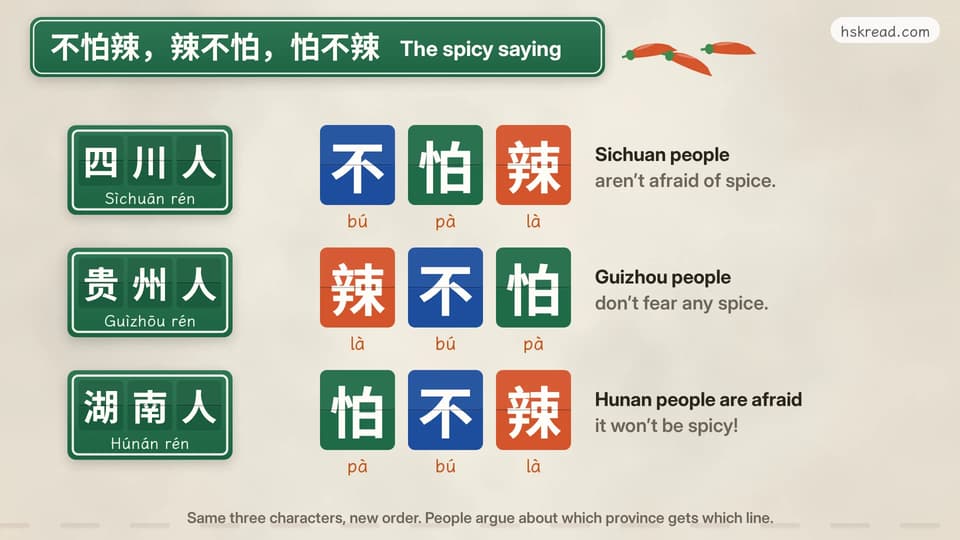
四川人不怕辣,贵州人辣不怕,湖南人怕不辣。 Sìchuān rén bú pà là, Guìzhōu rén là bú pà, Húnán rén pà bú là. "Sichuan people aren't afraid of spice, Guizhou people don't fear any spice, and Hunan people are afraid it won't be spicy."
The same three characters—不, 怕, 辣—just change places. (People argue about which province gets which line, which is half the fun.)
Roughly speaking, Sichuan and Chongqing love 麻辣, the spicy-and-numbing flavor; Hunan loves fresh, pure chili heat; and Guizhou loves hot-and-sour flavors. Head east to the coast—Shanghai, Jiangsu, Zhejiang—or south to Guangdong, and the food gets lighter and often a little sweeter.
North vs. south: the friendliest arguments in China
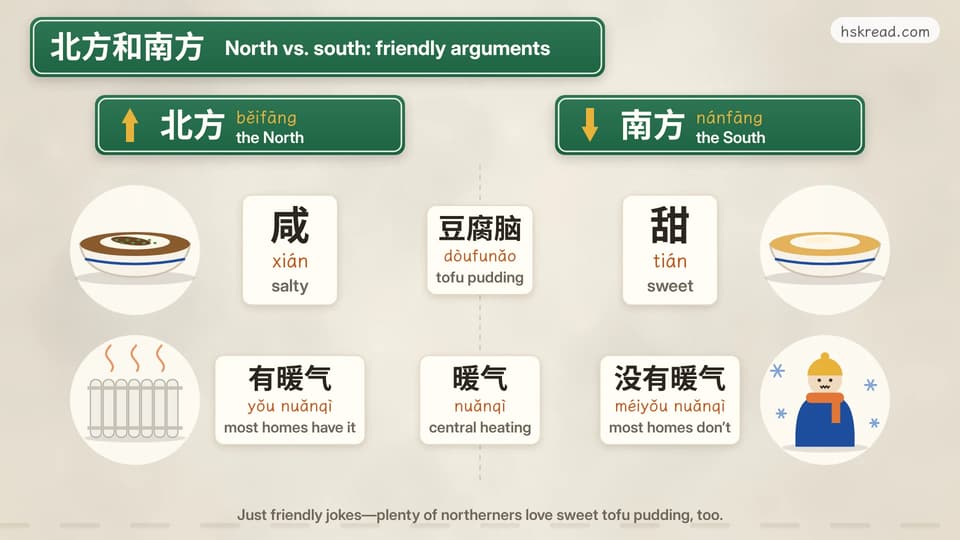
The biggest regional "rivalry" in China is not between two provinces. It is between 南方人 (nánfāng rén, southerners) and 北方人 (běifāng rén, northerners). It is almost always good-natured. Two classic examples:
- Tofu pudding (豆腐脑): northerners usually eat it salty, with a savory sauce; many southerners eat it sweet, with syrup. Online, the "sweet team" and the "salty team" have argued for years.
- Winter: most northern homes have central heating, called 暖气 (nuǎnqì). Most southern homes do not. So a southerner in winter may feel colder indoors in Shanghai than a northerner does in Beijing—and southerners get very excited when it snows.
Then there are the 东北人 (Dōngběi rén), people from the Northeast—辽宁, 吉林 and 黑龙江. They are known for their warm, funny way of talking, and the Northeastern accent is a favorite in TV comedy sketches. The capital of 黑龙江, 哈尔滨 (Hā'ěrbīn), is the "Ice City," with a giant winter ice festival.
Remember: these are jokes people tell about themselves, with a smile—and plenty of northerners love sweet tofu pudding, too.
How to say where you are from in Chinese
Here is how to answer the question every taxi driver in China seems to ask—and how to ask it back:
- 你是哪里人? (Nǐ shì nǎlǐ rén?) — Where are you from?
- 我是四川人。 (Wǒ shì Sìchuān rén.) — I'm from Sichuan. Just add 人 (rén, person) to any place name: 美国人, 法国人, 西班牙人.
- 你老家在哪儿? (Nǐ lǎojiā zài nǎr?) — Where is your hometown?
- 老乡 (lǎoxiāng) — someone from the same hometown or province. Meeting a 老乡 far from home is a happy moment, and it often comes with a free drink.
- 家乡 (jiāxiāng) — hometown. 我想家乡的菜 means "I miss the food from home."
On official forms, you may also see 籍贯 (jíguàn), your family's ancestral home, written as a province plus a city or county.
Useful vocabulary
| Chinese | Pinyin | Meaning |
|---|---|---|
| 省 | shěng | province |
| 省份 | shěngfèn | province (in general) |
| 省会 | shěnghuì | provincial capital |
| 行省 | xíngshěng | Yuan-dynasty "traveling" province office |
| 直辖市 | zhíxiáshì | city with the rank of a province |
| 简称 | jiǎnchēng | abbreviation; short name |
| 车牌 | chēpái | license plate |
| 东南西北 | dōng nán xī běi | east, south, west, north |
| 南方人 | nánfāng rén | southerner |
| 北方人 | běifāng rén | northerner |
| 东北人 | Dōngběi rén | person from Northeast China |
| 老乡 | lǎoxiāng | person from the same hometown |
| 家乡 | jiāxiāng | hometown |
| 麻辣 | málà | spicy and numbing |
Next time a taxi driver asks 你是哪里人, answer with a smile—and then ask them the same question. You may get a ten-minute story about the best food in their home province.
Check your understanding
01How many provinces are there in China?
China has 34 provincial-level regions. Most of them are ordinary provinces (省), and the rest are big cities like Beijing and Shanghai, autonomous regions like Xinjiang, and the special administrative regions of Hong Kong and Macao, which all have the same rank as a province.
02Is a Chinese province like a US state?
Only loosely. A 省 is a big region with its own capital and government, a bit like a US state, a French région or a Spanish comunidad autónoma. But Chinese provinces do not have their own constitutions or laws like US states; they are parts of one national system. Many are also huge—Sichuan is almost as big as Spain.
03Where does the Chinese word 省 (province) come from?
省 was first the name of a government office in the capital. In the Yuan dynasty, the central office sent out branch offices called 行中书省, or 行省—literally a "traveling" office. They stopped traveling and stayed in the regions, and over time the office name became the name of the region.
04What do Chinese province names mean?
Many names are simple directions. 河北 means "north of the (Yellow) River," 湖南 means "south of the lake" (Dongting Lake), 山东 means "east of the mountains," and 云南 is often explained as "south of the clouds." If you know 东, 南, 西, 北, 河, 湖 and 山, you can read a lot of the map.
05Why do Chinese license plates start with a Chinese character?
The first character is the province's one-character nickname, its 简称. 京 is Beijing, 沪 is Shanghai, 粤 is Guangdong and 川 is Sichuan. The letter after it stands for a city; in most provinces, A is the provincial capital.
06How do you ask "Where are you from?" in Chinese?
Say 你是哪里人? (Nǐ shì nǎlǐ rén?). The usual answer is a province or city plus 人, the word for person—for example, 我是四川人 (I'm from Sichuan). If you meet someone from your own hometown or province, you can happily call them your 老乡.