The Forbidden City (紫禁城): History, Facts, Layout and Visiting Tips
A learner-friendly guide to Beijing's Forbidden City—why it is called 紫禁城, how it became 故宫, who built it, the truth about its "9,999 rooms," what to see inside and how to visit.
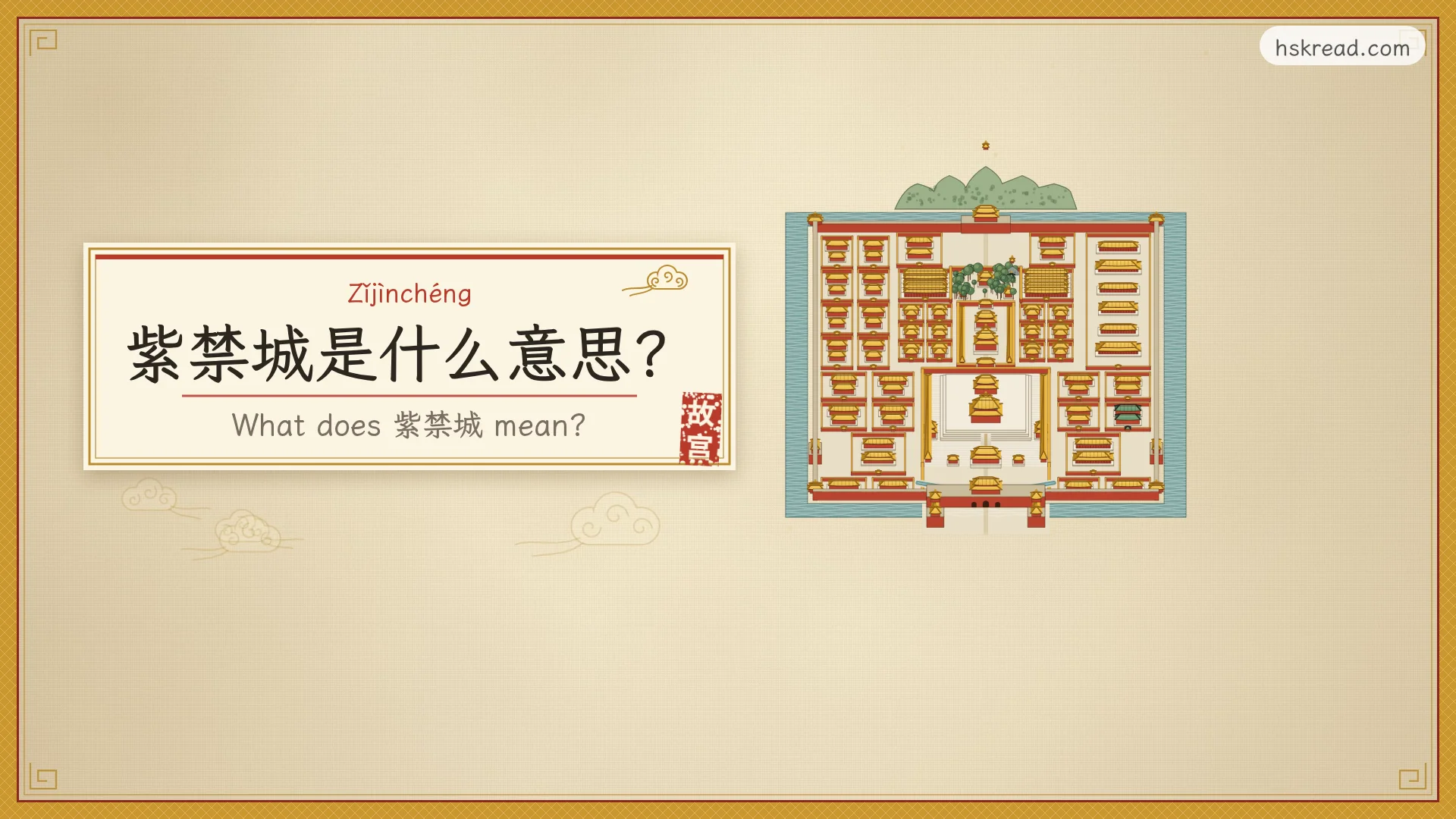
Right in the middle of Beijing, surrounded by a wide moat and tall red walls, stands the largest palace complex in China. For almost 500 years, this 皇宫 (huánggōng, imperial palace) was the home of China's emperors, and ordinary people were not allowed inside. In English, we call it the Forbidden City. In Chinese, its old name is 紫禁城 (Zǐjìnchéng), but today most people simply call it 故宫 (Gùgōng).
Millions of visitors walk through its gates every year. But what does the name really mean? Who built it, how many rooms does it have, and what should you look for when you visit? This guide answers those questions—and teaches you the Chinese words you will see on the signs.
Key takeaways
- 紫禁城 means "Purple Forbidden City." The purple comes from the stars, not the walls.
- Today it is called 故宫, "the former palace," and it is home to the Palace Museum (故宫博物院).
- It was built from 1406 to 1420 under the Ming dynasty's Yongle Emperor.
- 24 emperors (14 Ming and 10 Qing) lived here until the last emperor gave up the throne in 1912.
- The famous "9,999 and a half rooms" is a legend; real counts are lower.
- The palace has been a museum since 1925 and a UNESCO World Heritage Site since 1987.
Why is it called the Forbidden City?
The Chinese name has three characters:
| Character | Pinyin | Meaning |
|---|---|---|
| 紫 | zǐ | purple; here, the "purple" star enclosure in the sky |
| 禁 | jìn | forbidden; off-limits |
| 城 | chéng | city; city walls |
The walls of the palace are red, and the roofs are yellow, so where does the purple come from? It comes from the night sky. Ancient Chinese astronomers divided the stars around the North Star into an area called the 紫微垣 (Zǐwēi Yuán), the "Purple Forbidden Enclosure." Because these stars seem to stay in the center while the rest of the sky turns around them, people believed this was where the Lord of Heaven lived.
The emperor called himself the 天子 (tiānzǐ), the "Son of Heaven." So his home on earth was seen as a mirror of the heavenly palace: the center of the world. That is the 紫 in 紫禁城.
The 禁 part is easier to understand. The palace was a 禁地 (jìndì), a forbidden place. Officials, servants and guards could enter only with permission, and ordinary people could not go in at all. Put the two ideas together and you get the "Purple Forbidden City."
故宫: the "former palace"
After the last emperor left, the palace was no longer an imperial home. People began to call it 故宫. Here 故 (gù) means "former" or "old," and 宫 (gōng) means "palace." So 故宫 is literally "the former palace."
Today, 故宫 is by far the most common name in China. If you ask a taxi driver in Beijing to take you to "紫禁城," the driver will understand, but 故宫 sounds more natural. The museum inside is called 故宫博物院 (Gùgōng Bówùyuàn), the Palace Museum.
Forbidden City history: from Ming palace to Palace Museum
Built by the Yongle Emperor (1406–1420)
The story begins with 朱棣 (Zhū Dì), the third emperor of the Ming dynasty, better known by his reign name 永乐 (Yǒnglè), the Yongle Emperor. The Ming capital was in Nanjing at the time, but Zhu Di had spent years as a prince in the north, in the city then called Beiping. He decided to move the capital there and renamed it 北京, "the northern capital." (You can read more about the city in our guide to Beijing.)
In 1406, he ordered the building of a new palace. Workers brought precious wood from the forests of southwest China, stone from quarries near Beijing and special bricks from kilns far to the south. Historians estimate that hundreds of thousands of workers took part, and some sources say the total reached about a million. The palace was finished in 1420, and the next year Beijing officially became the capital.
Home of 24 emperors (1420–1912)
From 1420 to 1912, the Forbidden City was the home and office of 24 emperors from two 朝代 (cháodài, dynasties): 14 from the Ming dynasty and 10 from the Qing dynasty. Fires, wars and lightning damaged many halls over the centuries, so several of the buildings you see today were rebuilt during the Qing dynasty, while keeping the original plan.
Life inside followed strict rules. The emperor held court, signed orders and received officials in the front halls, while his family, concubines and servants lived in the back. Want to know more about how Chinese emperors lived and spoke? See our article on Chinese emperors.
The last emperor leaves
In 1912, after the 1911 Revolution, the last emperor, 溥仪 (Pǔyí), gave up the throne. He was only six years old. As part of the agreement, he was allowed to keep living in the back half of the palace for more than a decade. In 1924, he was forced to leave for good.
The Palace Museum (1925) and world heritage (1987)
On October 10, 1925, the palace opened to the public as the Palace Museum, a 博物馆 (bówùguǎn, museum) for everyone. For the first time, ordinary people could walk through the gates that had been closed to them for five centuries.
In 1987, UNESCO added the palace to its World Heritage List. In 2024, the palace also became part of a larger World Heritage Site, the Beijing Central Axis (北京中轴线), a 7.8-kilometer line of historic buildings running north to south through the city. Today the museum holds more than 1.8 million 文物 (wénwù, cultural relics), from paintings and 书法 (shūfǎ, calligraphy) to clocks, jade and 瓷器 (cíqì, porcelain).
Forbidden City facts and numbers
| Fact | Number |
|---|---|
| Built | 1406–1420 |
| Used as palace | 1420–1912 (about 500 years) |
| Emperors | 24 (14 Ming + 10 Qing) |
| Area | about 72 hectares (720,000 m²) |
| Size | about 961 m north to south, 753 m east to west |
| City wall (城墙) | about 10 m high, with a corner tower at each corner |
| Moat | about 52 m wide |
| Buildings | 980 historic buildings is the number most often quoted |
The "9,999 and a half rooms" legend
You may have heard that the Forbidden City has 9,999 and a half rooms. It is one of the most famous stories about the palace. According to legend, the Lord of Heaven's palace had 10,000 rooms, and an emperor on earth—only the "Son of Heaven"—could not have more than his heavenly father. So the builders stopped just short, at 9,999 and a half.
It is a lovely story, but it is a legend. Surveys tell a different story:
- A survey in the 1970s counted about 8,700 rooms inside the palace walls.
- In 2012, the director of the Palace Museum, 单霁翔 (Shàn Jìxiáng), spent about five months walking through every building with a colleague. They counted about 1,200 buildings and 9,371 rooms—but that number includes buildings outside the main walls that the museum manages. Inside the walls, the count was 8,728.
Why are the numbers different? Partly because of the Chinese word for "room." In traditional architecture, a room is counted as one 间 (jiān): the space between four pillars. One big hall can be many 间 wide. Different surveys also count different buildings. So the honest answer is "a little under 9,000 inside the walls"—and definitely no half room.
The layout: outer court and inner court
The Forbidden City is a perfect rectangle, and its most important buildings stand on a straight 中轴线 (zhōngzhóuxiàn), a central axis that runs from south to north. Everything is arranged in pairs on either side of this line. The plan is 对称 (duìchèn, symmetrical), so the palace feels balanced and calm.
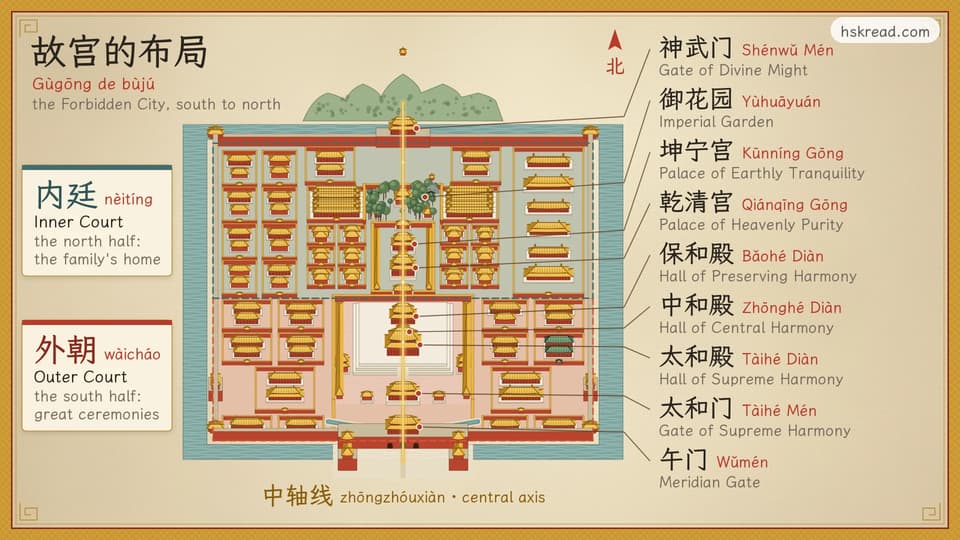
The palace has two main parts:
| Part | Chinese | Pinyin | What happened there |
|---|---|---|---|
| Outer Court | 外朝 | wàicháo | the southern half: great ceremonies and state affairs |
| Inner Court | 内廷 | nèitíng | the northern half: where the emperor's family lived |
Here are the main stops you pass as you walk from south to north:
| Building | Chinese | Pinyin | What to know |
|---|---|---|---|
| Meridian Gate | 午门 | Wǔmén | the main south gate and today's visitor entrance |
| Gate of Supreme Harmony | 太和门 | Tàihé Mén | guarded by a pair of bronze lions |
| Hall of Supreme Harmony | 太和殿 | Tàihé Diàn | the largest hall, used for coronations and New Year ceremonies |
| Hall of Central Harmony | 中和殿 | Zhōnghé Diàn | a small square hall where the emperor rested before ceremonies |
| Hall of Preserving Harmony | 保和殿 | Bǎohé Diàn | banquets, and later the final round of the imperial exams |
| Palace of Heavenly Purity | 乾清宫 | Qiánqīng Gōng | the emperor's main residence in the Ming and early Qing |
| Palace of Earthly Tranquility | 坤宁宫 | Kūnníng Gōng | the palace of the Ming 皇后 (huánghòu, empresses) |
| Imperial Garden | 御花园 | Yùhuāyuán | old trees, rockeries and pavilions |
| Gate of Divine Might | 神武门 | Shénwǔ Mén | the north gate and visitor exit |
太和殿: the Hall of Supreme Harmony
The star of the Outer Court is 太和殿 (Tàihé Diàn), the Hall of Supreme Harmony. It stands on a three-level white marble terrace and is the largest hall in the palace. Inside, the golden 龙椅 (lóngyǐ, "dragon throne") sits under a ceiling decorated with a coiled dragon. People often call this hall the 金銮殿 (Jīnluán Diàn), the "golden throne hall," a name you will also hear in TV dramas about emperors.
Behind the three great halls, the Inner Court feels smaller and more private. The Qing emperors after Yongzheng actually lived in the 养心殿 (Yǎngxīn Diàn), the Hall of Mental Cultivation, to the west of the main axis.
Colors and symbols: yellow roofs and roof beasts
Why are the roofs yellow?
Look down on the Forbidden City from above, and you will see a sea of golden-yellow tiles on every 屋顶 (wūdǐng, roof). In imperial China, 黄色 (huángsè, yellow) was the emperor's color. In the theory of the five elements, yellow belongs to earth and to the center—and the emperor saw himself as the center of the world. Ordinary people were not allowed to use yellow glazed tiles.
The walls are a deep 红色 (hóngsè, red), a color of happiness, good fortune and power. And everywhere you look—on roofs, steps, ceilings and the throne—you will find the 龙 (lóng, dragon), the symbol of the emperor. A few buildings break the pattern: the imperial library, 文渊阁 (Wényuān Gé), has a black roof. A popular explanation is that black stands for water in the five elements, so it was meant to "protect" the books from fire.
The little beasts on the roof
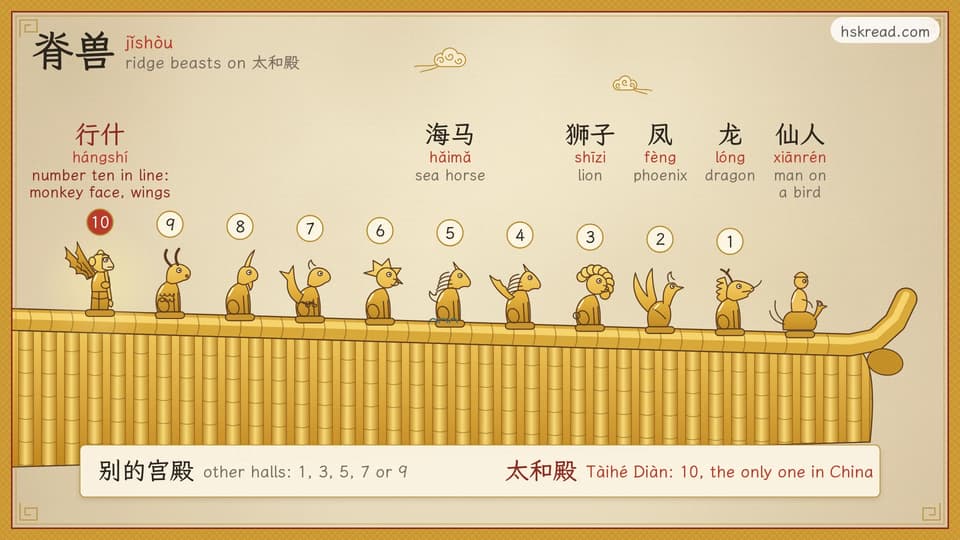
At the end of each sloping roof ridge, you will see a line of small statues called 脊兽 (jǐshòu, "ridge beasts"). They are led by a man riding a bird and followed by animals such as a dragon, a phoenix, a lion and a sea horse. They protected the building, at least in people's minds, and they also showed its rank: the more beasts, the more important the building.
Most palace buildings have an odd number of beasts—one, three, five, seven or nine. 太和殿 is the only building in China with ten. The tenth is a monkey-faced figure with wings called 行什 (hángshí, "number ten in line"), found only here. Many people see it as a guardian against 闪电 (shǎndiàn, lightning), which caused several 火灾 (huǒzāi, fires) in the hall's history.
You will also notice the number 9 everywhere. In Chinese tradition, nine is the largest single-digit odd number, a "yang" number linked to the emperor. Many palace gates have golden door nails arranged in nine rows of nine.
Feng shui: a mountain behind, water in front
The site of the Forbidden City also follows the classic rules of feng shui, the traditional Chinese art of placing buildings. The ideal site has a hill behind it and water in front: 背山面水 (bèi shān miàn shuǐ). The palace faces south, toward the sun. Behind it, to the north, stands 景山 (Jǐngshān), a hill made from the earth that workers dug out when they made the moat. In front, the curving 金水河 (Jīnshuǐ Hé), the Golden Water River, flows past the Gate of Supreme Harmony. The river also had a practical job: it gave the palace a water supply in case of fire.
Visiting the Forbidden City today
The Forbidden City is one of the most popular places to visit in China, and on busy days there are huge crowds of 游客 (yóukè, visitors). A little planning helps. Rules can change, so always check the official Palace Museum website or its official WeChat mini program before you go.
- Book online in advance. Tickets are sold online only, with real-name registration. Foreign visitors book with their passport and bring it on the day. Popular dates, like summer weekends and the National Day holiday, sell out fast.
- Don't go on a Monday. The museum is closed on Mondays, except on national public holidays.
- Know the prices. A standard ticket is about 60 yuan in the peak season (April to October) and about 40 yuan in the off-season. The Treasure Gallery and the Clock Gallery cost a little extra.
- Enter from the south. Visitors go in through the 午门 (Meridian Gate) and walk north. You cannot go back out the way you came, so plan to leave from the north or east gate.
- Give it time. Most people spend three to four hours, and you will still not see everything. Wear comfortable shoes.
- Climb 景山 afterward. Just across the road from the north gate, Jingshan Park gives you the classic view of the golden roofs of the whole palace.
Some useful words for your visit:
| Chinese | Pinyin | English |
|---|---|---|
| 门票 | ménpiào | admission ticket |
| 预约 | yùyuē | to book; to make a reservation |
| 护照 | hùzhào | passport |
| 入口 | rùkǒu | entrance |
| 出口 | chūkǒu | exit |
| 闭馆 | bìguǎn | (a museum) closed |
| 讲解器 | jiǎngjiěqì | audio guide |
| 导游 | dǎoyóu | tour guide |
| 排队 | páiduì | to wait in line |
Useful vocabulary
| Chinese | Pinyin | English |
|---|---|---|
| 紫禁城 | Zǐjìnchéng | the Forbidden City (historical name) |
| 故宫 | Gùgōng | the Forbidden City; "the former palace" |
| 故宫博物院 | Gùgōng Bówùyuàn | the Palace Museum |
| 皇帝 | huángdì | emperor |
| 宫殿 | gōngdiàn | palace; palace hall |
| 天子 | tiānzǐ | the Son of Heaven (the emperor) |
| 禁地 | jìndì | forbidden area |
| 中轴线 | zhōngzhóuxiàn | central axis |
| 外朝 | wàicháo | the Outer Court |
| 内廷 | nèitíng | the Inner Court |
| 太和殿 | Tàihé Diàn | the Hall of Supreme Harmony |
| 龙椅 | lóngyǐ | the dragon throne |
| 脊兽 | jǐshòu | roof ridge beasts |
| 间 | jiān | measure word for rooms |
| 参观 | cānguān | to visit (a place); to tour |
Now that you know what 紫禁城 means and what to look for, you are ready to walk the central axis like an emperor—just remember to book your ticket first.
Check your understanding
01Why is it called the Forbidden City?
Its Chinese name 紫禁城 (Zǐjìnchéng) means "Purple Forbidden City." 紫 refers to the Purple Forbidden Enclosure, the stars around the North Star where the Lord of Heaven was said to live, and 禁 means "forbidden," because ordinary people could not enter without permission.
02When was the Forbidden City built?
The Yongle Emperor (永乐) of the Ming dynasty ordered it in 1406, and it was completed in 1420. It was the imperial palace from 1420 until the last emperor gave up the throne in 1912.
03How many emperors lived in the Forbidden City?
Twenty-four emperors—14 of the Ming dynasty and 10 of the Qing dynasty—lived and ruled there over almost 500 years.
04Does the Forbidden City really have 9,999 rooms?
No. "9,999 and a half rooms" is a popular legend. Surveys counted roughly 8,700 rooms inside the palace walls, and a 2012 count by the Palace Museum found 9,371 rooms in all the old buildings it manages.
05What is the difference between 故宫 and 紫禁城?
They are the same place. 紫禁城 is the historical name of the palace. 故宫 (Gùgōng) means "the former palace" and is what people in China call it today; the museum inside is the 故宫博物院, the Palace Museum, founded in 1925.
06Is the Forbidden City open on Mondays?
Usually not. The Palace Museum is closed on Mondays except on national public holidays, and tickets must be booked online in advance with real-name registration. Check the official website before you go, because rules can change.