Journey to the West (西游记): Summary, Characters, Author and the Real Monk Behind the Story
A learner-friendly guide to 西游记, one of China's Four Great Classical Novels—the real monk Xuanzang who walked to India, the five pilgrims, the 81 hardships, the funniest and most famous episodes, and the TV shows, films and games it inspired.
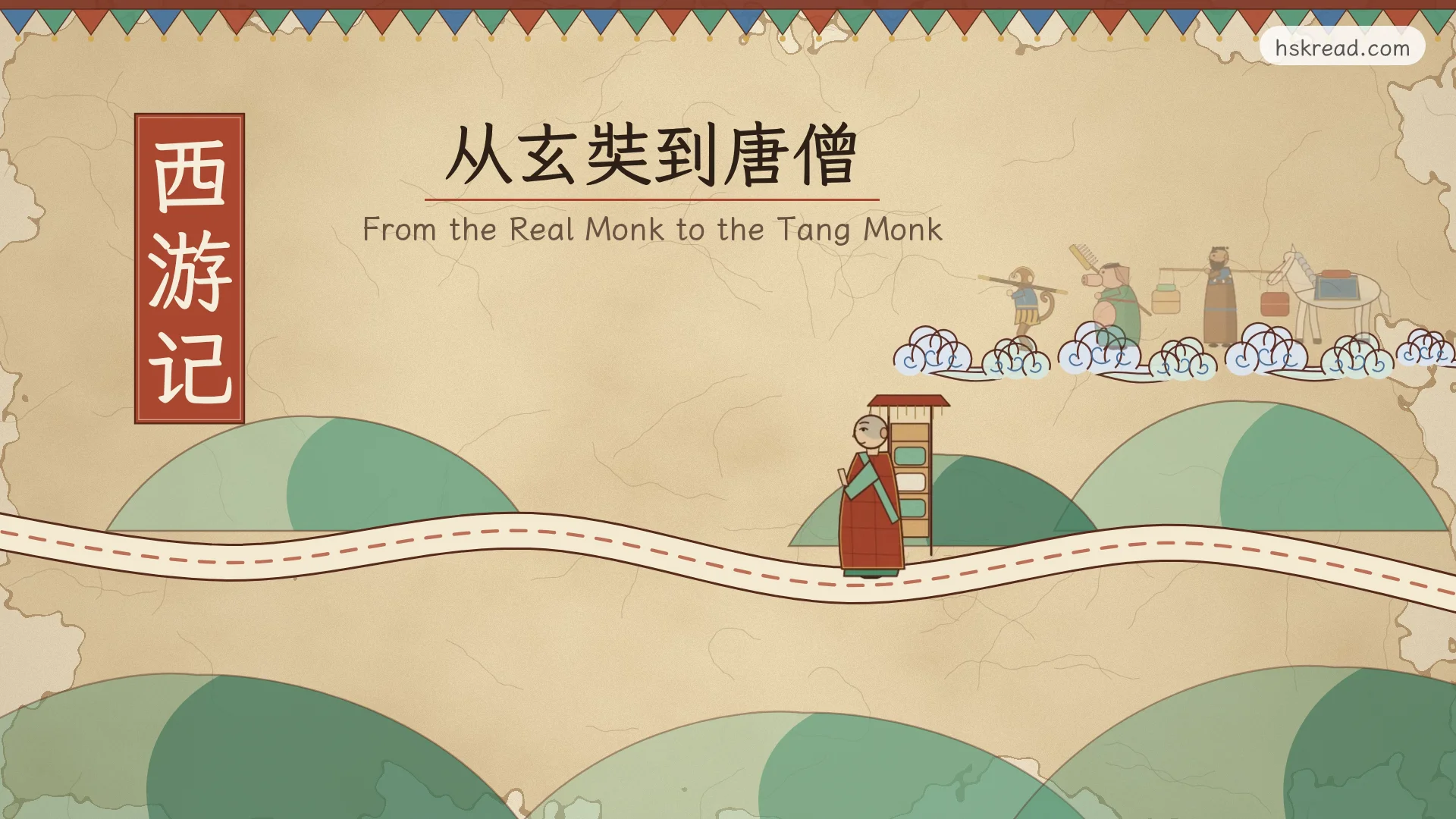
Imagine a road trip that lasts fourteen years. The group is a gentle monk, a monkey who can turn into 72 different things, a lazy pig who used to be a heavenly general, a quiet giant from a river of sand, and a dragon prince who has been turned into a white horse. Along the way, almost every mountain hides a demon who wants to eat the monk.
This is 西游记 (Xīyóujì), Journey to the West, one of the best-loved stories in China. It is a 16th-century 小说 (xiǎoshuō, novel), but you don't need to read it to know it: almost every Chinese child knows the story from picture books, cartoons and the TV series that has been shown again and again since the 1980s. If you have watched Dragon Ball or played Black Myth: Wukong, you already know a piece of it too.
This guide explains the story, the characters, the funniest episodes, the real monk behind it, the title and the Chinese words that come with them.
Key takeaways
- 西游记 is a Ming-dynasty novel of 100 chapters and one of China's Four Great Classical Novels (四大名著).
- Five pilgrims travel west: 唐僧, 孙悟空, 猪八戒, 沙僧 and the 白龙马.
- Famous episodes include the White Bone Demon, the Kingdom of Women and the Flaming Mountains.
- They must pass 九九八十一难, “nine times nine, 81 hardships”—and the road is 108,000 li long.
- The story is based on a real journey: the monk 玄奘 (Xuánzàng) sneaked out of China, walked to India and came back in 645 with hundreds of Buddhist texts.
- The “west” in the title means India and Central Asia, not Europe and America.
- The 1986 TV series has been rerun so many times that it is part of every Chinese summer vacation.
- In everyday Chinese, 取经 (“to fetch the scriptures”) also means “to learn from someone's experience.”
Journey to the West summary
Short on time? Here is the whole 100-chapter story in a few minutes.
The novel has 100 回 (huí, chapters). Old Chinese novels like this were written for readers who loved storytellers, so almost every chapter ends on a cliffhanger with a line like this: 欲知后事如何,且听下回分解—“If you want to know what happens next, listen to the next chapter.” It is the Ming-dynasty version of “to be continued.”
The story has three parts:
- Chapters 1–7: the Monkey King. A stone monkey is born on a mountain, learns magic, makes himself “Great Sage Equal to Heaven,” and turns the Heavenly Palace upside down. In the end, the Buddha traps him under a mountain for 500 years. (We tell his story in detail in our guide to Sun Wukong, the Monkey King.)
- Chapters 8–12: why the journey begins. The Buddha wants to send true scriptures to China. The 菩萨 (púsà, Bodhisattva) 观音 (Guānyīn) goes east to find a pilgrim, and the Tang emperor chooses the monk Tang Sanzang.
- Chapters 13–100: the journey. The monk sets off. One by one, he takes in his disciples, and together they walk west, fighting demons, crossing rivers and getting out of trouble—until they reach the Buddha, receive the scriptures and fly home.
In the novel, the road to the Western Heaven is 十万八千里 (shíwàn bāqiān lǐ), “108,000 li,” and the trip takes fourteen years. Today, 十万八千里 means “miles and miles away”—you can say your answer is 差了十万八千里, “way off.”
Journey to the West characters
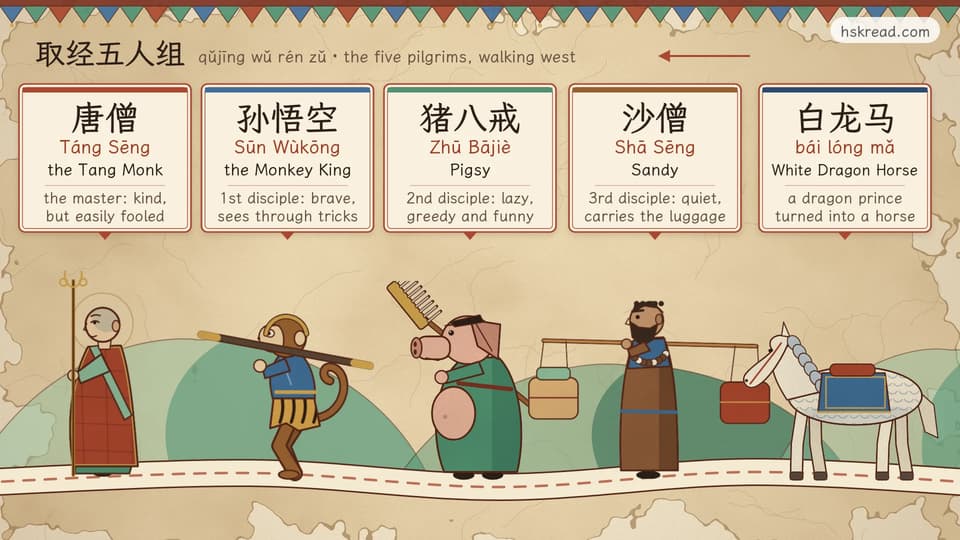
Meet the five pilgrims: a monk, a monkey, a pig, a quiet giant and a horse who is really a dragon.
The main 人物 (rénwù, characters) are often called 师徒四人 (shī tú sì rén), “the master and his three disciples”—plus the horse. A disciple is a 徒弟 (túdì), and the disciples call the monk 师父 (shīfu, master).
| Character | Pinyin | Also called | Who he is |
|---|---|---|---|
| 唐僧 / 唐三藏 | Táng Sēng | Tripitaka; the Tang Monk | the master: kind, stubborn and easily fooled; every demon wants to eat him |
| 孙悟空 | Sūn Wùkōng | 美猴王, the Monkey King | the first disciple: brave, clever, hot-tempered; sees through every disguise |
| 猪八戒 | Zhū Bājiè | 猪悟能, Pigsy | the second disciple: a heavenly marshal sent down as a pig for flirting; lazy, greedy, funny |
| 沙僧 | Shā Sēng | 沙悟净, Sandy | the third disciple: a former heavenly general from the River of Flowing Sand; quiet and loyal |
| 白龙马 | bái lóng mǎ | the White Dragon Horse | a dragon prince who ate the monk's horse and was turned into a horse to carry him |
All three disciples have Buddhist names with 悟 (wù, “to awaken”): 悟空 “awakened to emptiness,” 悟能 “awakened to ability,” 悟净 “awakened to purity.”
The team works a bit like a family. 唐僧 is the strict parent, 孙悟空 is the talented but rebellious older brother, 猪八戒 is the funny younger brother who always complains and tells on Monkey, and 沙僧 quietly carries the luggage. Ask Chinese friends which one they are most like—everyone has an answer, and almost nobody wants to be 唐僧.
Famous episodes from Journey to the West
Each adventure on the road is almost a complete story. Here are three that every Chinese kid knows.
三打白骨精: Monkey strikes the White Bone Demon three times
A 妖怪 (yāoguài, demon) called 白骨精 (Báigǔjīng, the White Bone Demon) wants to eat the monk. She turns into a pretty young woman, then an old woman, then an old man. Each time, Monkey sees through her disguise and strikes her.
But 唐僧, the gentle monk, only sees an innocent person being killed. Angry, he sends Monkey away. It is the classic “nobody believes the hero” story—and every Chinese kid shouts at the screen when 唐僧 gets it wrong.
女儿国: the Kingdom of Women
The team enters 女儿国 (Nǚ'ér Guó), a kingdom where only women live. Just before they arrive, there is a very silly moment: 唐僧 and 猪八戒 (Pigsy) drink from a river whose water makes anyone who drinks it pregnant—and both of them end up with big bellies until Monkey finds a cure.
Then the queen falls in love with 唐僧 and wants to marry him and give him her throne. He gently says no and continues west. In the 1986 TV series, the queen's sad goodbye became one of the most romantic and talked-about scenes.
火焰山: the Flaming Mountains
The road is blocked by 火焰山 (Huǒyàn Shān), the Flaming Mountains, which burn for 800 li. Only one thing can put out the fire: the 芭蕉扇 (bājiāo shàn, banana-leaf fan) of 铁扇公主 (Tiěshàn Gōngzhǔ), Princess Iron Fan. She is the wife of the 牛魔王 (Niúmówáng, Bull Demon King), and Monkey once helped capture their son, Red Boy—so she is not in a helping mood.
Her first wave of the fan blows Monkey thousands of miles away. Later he turns into a tiny bug, flies into her tea and makes her hand over the fan from the inside—only to find out it is a fake! (You can read more about Chinese fans in our guide to Chinese fans.)
The Flaming Mountains are a real place: red sandstone hills in the Turpan Basin of Xinjiang, one of the hottest places in China. In summer, people say the sand there gets hot enough to cook an egg.
九九八十一难: the 81 hardships
Why does the journey need exactly 81 disasters—and what happens when heaven counts only 80?
In Chinese culture, nine is the largest single-digit number, and nine times nine is a symbol of completeness. So the pilgrims must pass exactly 九九八十一难 (jiǔjiǔ bāshíyī nàn), 81 hardships, before their mission is complete.
Here is the funny part. Near the end of the book, after the pilgrims already have the scriptures, the Bodhisattva Guanyin checks the list and finds only 80. One more hardship is needed! So on the way home, the old turtle who once carried them across a river “accidentally” drops them into the water, and their scriptures get wet. Now the number is right.
Today, people use 九九八十一难 for any long series of problems, for example getting a visa or finishing a big project.
The real journey: Xuanzang goes to India
The monk in the novel was a real man—and his true trip was almost as wild as the fiction.
The hero of the novel, the monk 唐僧 (Táng Sēng, “the Tang monk”), is based on a real person: 玄奘 (Xuánzàng), a 佛教 (Fójiào, Buddhist) 和尚 (héshang, monk) of the 唐朝 (Tángcháo, Tang dynasty).
As a young monk, Xuanzang found that the Buddhist books in China were incomplete and often disagreed with each other. He wanted to go to India, the birthplace of Buddhism, to find the original texts. The 皇帝 (huángdì, emperor) did not give him permission to leave—so he sneaked out of the capital, Chang'an (today's Xi'an), and went anyway.
His real journey was as dramatic as any novel. In the desert (沙漠, shāmò), he dropped his water bag and spilled all his water. For days he walked with nothing to drink, until his horse found a spring. He crossed snowy mountains, met kings along the Silk Road, and finally reached India, where he studied for years at one of the greatest Buddhist universities of the time.
In 645, he came home with 657 Buddhist texts, and huge crowds came out to welcome him. He spent the rest of his life translating (翻译, fānyì) them into Chinese. If you visit Xi'an, you can climb the Giant Wild Goose Pagoda (大雁塔, Dàyàn Tǎ), which was built to keep the books he brought home.
The real Xuanzang traveled mostly alone. There was no monkey, no pig and no flying cloud—but his journey was so long and so brave that people kept telling it, and the story kept growing.
From history to legend
Over the next 900 years, 民间 (mínjiān, folk) storytellers turned the journey into a 传说 (chuánshuō, legend) and added more and more magic. First a 猴子 (hóuzi, monkey) joined the monk as his magical bodyguard—you can even see a monk with a monkey-faced helper on old cave paintings in Gansu. The pig came later. By the 明朝 (Míngcháo, Ming dynasty), all the stories were gathered into the 100-chapter novel we read today.
What does 西游记 mean?
Is the “west” in the title Europe? Not at all. The title has three characters:
| Character | Pinyin | Meaning |
|---|---|---|
| 西 | xī | west |
| 游 | yóu | to travel; a journey |
| 记 | jì | a record; an account (common in titles) |
So 西游记 is “A Record of the Journey to the West.” The “west” here is not 西方 (xīfāng), “the West” in the modern sense of Europe and America. It means the lands west of China—Central Asia and 印度 (Yìndù, India), where Buddhism came from. In the novel, the pilgrims' goal is 西天 (Xītiān, “the Western Heaven”), the home of the Buddha.
One of the Four Great Classical Novels
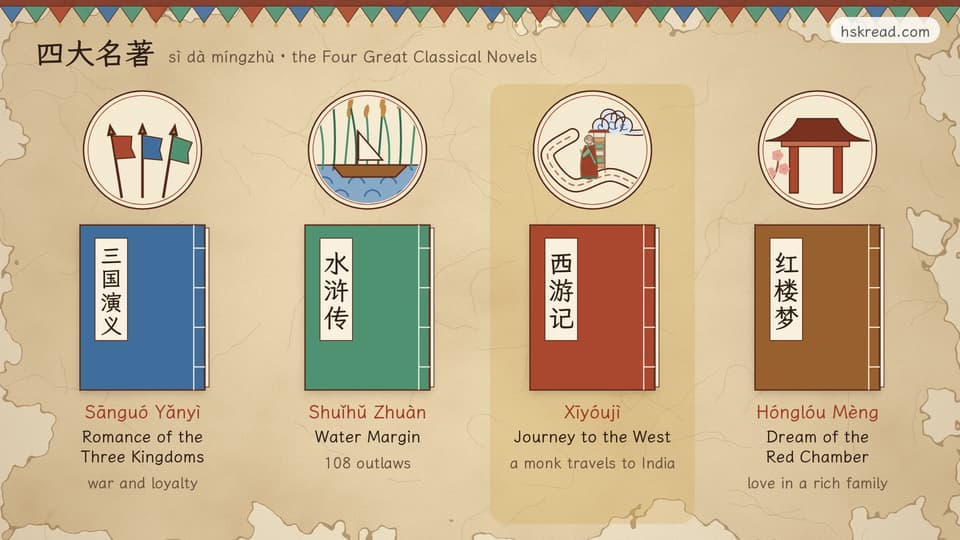
In China, 西游记 belongs to the 四大名著 (sì dà míngzhù), the Four Great Classical Novels. A 名著 (míngzhù) is a “famous book,” a masterpiece. Every Chinese student reads parts of these four at school:
| Novel | Pinyin | English title | What it is about |
|---|---|---|---|
| 三国演义 | Sānguó Yǎnyì | Romance of the Three Kingdoms | war, strategy and loyalty in the 3rd century |
| 水浒传 | Shuǐhǔ Zhuàn | Water Margin | 108 outlaws who fight corrupt officials |
| 西游记 | Xīyóujì | Journey to the West | a monk and his magical disciples travel to India |
| 红楼梦 | Hónglóu Mèng | Dream of the Red Chamber | love and decline in a rich family |
Of the four, 西游记 is the most fun for kids—and the one most often turned into cartoons, children's books and games.
Who wrote it? Almost every Chinese copy says 吴承恩 (Wú Chéng'ēn), a Ming-dynasty scholar, on the cover. The oldest surviving copy has no author's name, so historians aren't completely sure—but everyone agrees the writer built the novel from stories that people had been telling for centuries.
What is the story really about?
You can enjoy 西游记 simply as an adventure. But many Chinese readers see deeper meanings in it:
- A journey of the mind. The book often calls Monkey 心猿 (xīnyuán, “the monkey of the mind”) and the white dragon horse 意马 (yìmǎ, “the horse of the will”). Together they make the idiom 心猿意马, a restless mind that cannot settle—exactly how you feel when you are trying to study and your phone keeps buzzing. Many readers see the trip as a picture of a person learning to control their own thoughts.
- Humor and satire. The book is full of 幽默 (yōumò, humor) and 讽刺 (fěngcì, satire). Heaven in the novel works like a slow, proud government office. Gods give out titles, demons have powerful friends in heaven, and Monkey laughs at all of it.
Journey to the West adaptations
Few stories in the world have been retold as often. Here are some of the best-known 改编 (gǎibiān, adaptations):
| Year | Adaptation | Why it matters |
|---|---|---|
| 1958 | 《猪八戒吃西瓜》 Zhu Bajie Eats the Watermelon | China's first paper-cut 动画片 (animated film) (see Chinese paper cutting) |
| 1961–64 | 《大闹天宫》 Havoc in Heaven | a classic animated film from the Shanghai Animation Film Studio |
| 1984– | Dragon Ball (Japan) | Goku is loosely based on 孙悟空, whose name is read “Son Goku” in Japanese |
| 1986 | the CCTV TV series, often called 86版西游记 | the version almost every Chinese family grew up with |
| 1995 | 《大话西游》 A Chinese Odyssey (Stephen Chow) | a comic love story that became a cult classic |
| 2015 | 《西游记之大圣归来》 Monkey King: Hero Is Back | a hit 3D animated film |
| 2020– | LEGO Monkie Kid | a LEGO toy line and cartoon about a kid who inherits the Monkey King's staff |
| 2023 | The Monkey King (Netflix) | an animated comedy film produced by Stephen Chow |
| 2024 | 《黑神话:悟空》 Black Myth: Wukong | a best-selling action game (more in our Monkey King guide) |
You will also find the story in Chinese folk arts: in shadow puppet plays, in Peking opera, and in window paper cuts that show the Monkey King.
The 1986 TV series: Journey to the West every summer
For many Chinese people, 西游记 means one thing: the 1986 电视剧 (diànshìjù, TV series) made by China Central Television (CCTV) and directed by 杨洁 (Yáng Jié).
The crew spent about six years filming all over China with simple equipment and a tiny budget—many of the flying scenes were shot with actors hanging from wires. The 演员 (yǎnyuán, actor) 六小龄童 (Liù Xiǎo Líng Tóng) played the Monkey King so well that, for millions of viewers, his face simply is 孙悟空.
Chinese media report that the series has been 重播 (chóngbō, rerun) thousands of times, and it is still a summer-holiday favorite on Chinese TV. Its spacey electronic 主题曲 (zhǔtíqǔ, theme song) is instantly recognizable to almost anyone who grew up in China—play the first few notes, and watch your Chinese friends smile.
Words from Journey to the West in everyday Chinese
The story is so well known that its words have entered daily life:
- 取经 (qǔjīng), literally “to fetch the scriptures.” Today it also means to learn from someone else's success and 经验 (jīngyàn, experience). A company might send staff to another city to 取经.
- 唐僧肉 (Tángsēng ròu), “Tang Monk's meat.” In the novel, demons believe that eating the monk will make them live forever. Today it means something that everyone wants a piece of.
- 猪八戒照镜子——里外不是人 (Zhū Bājiè zhào jìngzi—lǐ wài bú shì rén), “Pigsy looks in the mirror: he's not human inside or out.” This is a 歇后语 (xiēhòuyǔ), a two-part saying, a bit like a riddle with a punchline. It means being blamed by both sides.
- 九九八十一难, the 81 hardships the pilgrims must pass; today, a long list of problems.
- Many famous sayings come from the Monkey King himself—like 火眼金睛 and 七十二变. You will find them in our Sun Wukong guide.
How to read Journey to the West as a learner
The original novel mixes classical and everyday Chinese of the Ming dynasty, and it is long. Start with a children's or graded version that retells the main episodes in modern Chinese, or try 连环画 (liánhuánhuà), small picture-story books with a drawing and a few lines of text on every page.
The 1986 TV series with Chinese subtitles is great listening practice, and because each adventure is almost a complete story, you can read one episode at a time.
Useful vocabulary
| Chinese | Pinyin | English |
|---|---|---|
| 西游记 | Xīyóujì | Journey to the West |
| 四大名著 | sì dà míngzhù | the Four Great Classical Novels |
| 小说 | xiǎoshuō | novel |
| 回 | huí | chapter (of a classic novel) |
| 唐僧 | Táng Sēng | the Tang Monk |
| 孙悟空 | Sūn Wùkōng | Sun Wukong, the Monkey King |
| 猪八戒 | Zhū Bājiè | Zhu Bajie, Pigsy |
| 沙僧 | Shā Sēng | Sha Wujing, Sandy |
| 师父 | shīfu | master; teacher |
| 徒弟 | túdì | disciple; apprentice |
| 妖怪 | yāoguài | demon; monster |
| 西天 | Xītiān | the Western Heaven |
| 取经 | qǔjīng | to fetch scriptures; to learn from others |
| 九九八十一难 | jiǔjiǔ bāshíyī nàn | the 81 hardships; a long series of troubles |
| 和尚 | héshang | Buddhist monk |
Pick up a picture-book version, put on the 1986 theme song, and start your own journey to the west—one chapter at a time.
Check your understanding
01What is Journey to the West about?
Journey to the West (西游记, Xīyóujì) is a Ming-dynasty novel about the monk Tang Sanzang, who travels from China to India to bring back Buddhist scriptures. He is protected by three magical disciples—the Monkey King Sun Wukong, the pig Zhu Bajie and the quiet Sha Wujing—and a dragon prince who serves as his white horse. On the way they face 81 hardships, most of them demons who want to eat the monk.
02Who wrote Journey to the West?
It is traditionally credited to Wu Cheng'en (吴承恩), a Ming-dynasty writer, and his name is on almost every Chinese edition. The earliest surviving copy, from the 1590s, has no author's name, so scholars still discuss it. Either way, the writer built the novel from stories that had been told for centuries.
03Is Journey to the West based on a true story?
Partly. The real monk Xuanzang (玄奘) secretly left China in the 7th century, walked across deserts and mountains to India, studied there for years and came home in 645 with 657 Buddhist texts. The monkey, the pig, the demons and the magic were added by storytellers over the next 900 years.
04What are the 81 hardships in Journey to the West?
九九八十一难 (jiǔjiǔ bāshíyī nàn) are the 81 trials the pilgrims must pass before they can finish their mission. Nine times nine is a perfect number in Chinese tradition. Near the end of the book, the Bodhisattva Guanyin counts only 80, so the team has to suffer one more before they get home.
05How many chapters does Journey to the West have?
The standard version has 100 chapters (回, huí). The first seven tell the Monkey King's early life, the next few explain why the monk sets out, and the rest follow the journey itself.
06Is Dragon Ball based on Journey to the West?
Loosely. Goku's name is the Japanese reading of 孙悟空 (Sun Wukong), and the early Dragon Ball story borrows a monkey-tailed boy, a magic staff, a flying cloud and a pig character from the novel. Akira Toriyama mixed these ideas with kung fu films and his own inventions.