Chinese Emperors (皇帝): The Title, the Names, the Symbols and the Words They Left Behind
What does 皇帝 mean, and why was the emperor called the Son of Heaven? Learn imperial words like 朕, 陛下 and 万岁, why emperors wore yellow dragons, how era names like 康熙 work, famous Chinese emperors, the last emperor Puyi, and emperor idioms still used today.
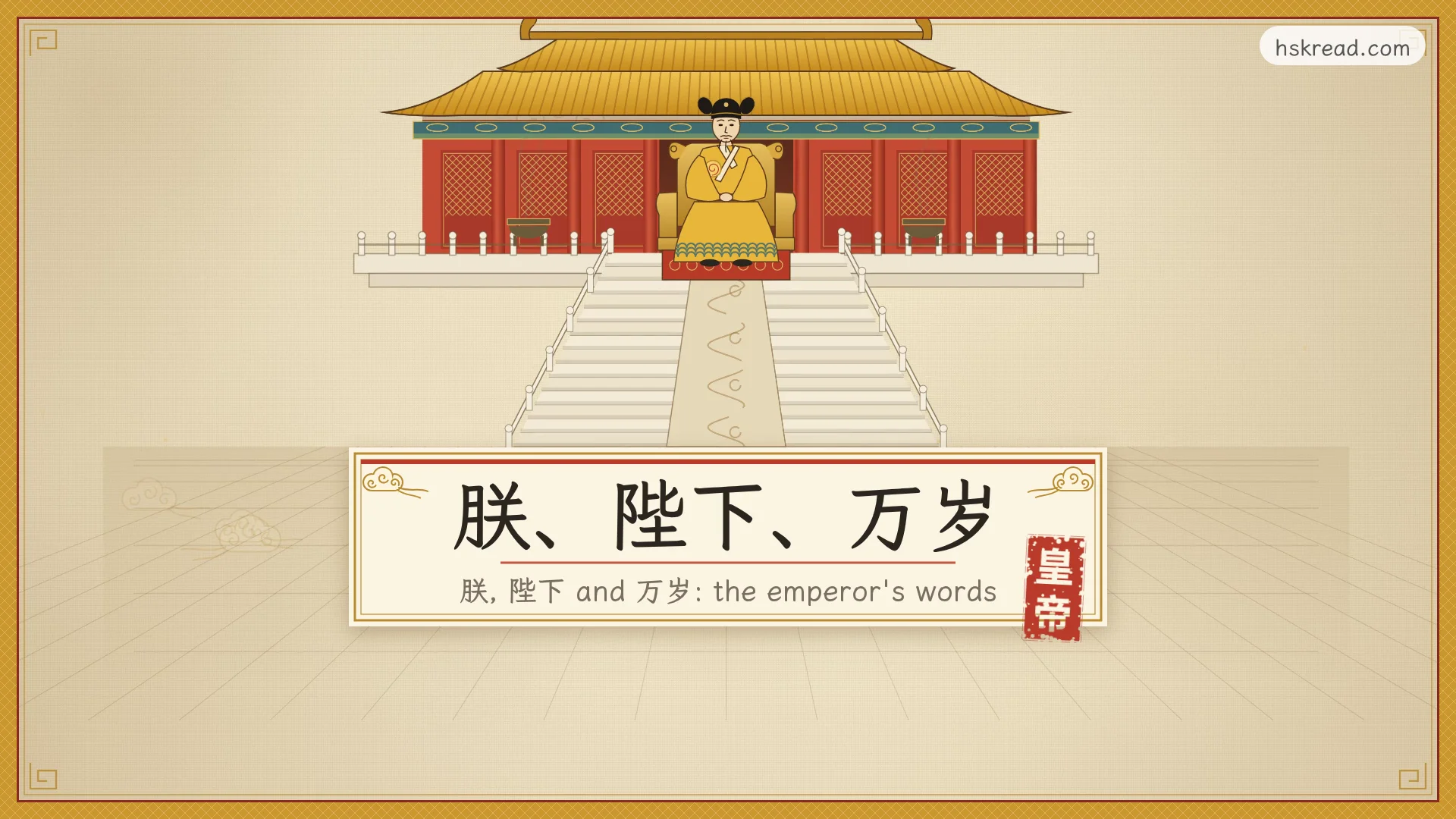
For more than two thousand years of Chinese 历史 (lìshǐ, history), from 221 BC to 1912, China was ruled by emperors. They lived in vast 宫殿 (gōngdiàn, palaces), wore yellow robes covered in dragons, and spoke a special language that nobody else was allowed to use. The emperors are gone, but their world is everywhere in Chinese today: in 电视剧 (diànshìjù, TV dramas), in idioms, and in jokes about 老板 (lǎobǎn, bosses) who act like kings.
In this guide, you will learn what the word 皇帝 (huángdì) means, why the emperor was the Son of Heaven, the words people used to speak to him, why yellow and dragons belonged to him, how to read names like 康熙 and 唐太宗, some of the most famous emperors, the story of the last emperor, and the emperor expressions people still use every day.
Key takeaways
- 皇帝 means “emperor.” The title was created by Qin Shi Huang in 221 BC.
- The emperor was the 天子 (tiānzǐ, “Son of Heaven”) and ruled with the Mandate of Heaven (天命).
- Only the emperor could call himself 朕 (zhèn); others called him 陛下 (bìxià) and wished him 万岁 (wànsuì).
- Yellow and the five-clawed dragon were symbols of the emperor.
- Emperors had several names: 年号 (era names), 庙号 (temple names) and 谥号 (posthumous names).
- The last emperor, 溥仪 (Pǔyí), gave up the throne on February 12, 1912.
How do you say “emperor” in Chinese?
The word is 皇帝 (huángdì):
| Character | Pinyin | Original meaning |
|---|---|---|
| 皇 | huáng | grand, august; linked to the legendary 三皇 |
| 帝 | dì | a supreme ruler or god; linked to the legendary 五帝 |
Ancient Chinese 传说 (chuánshuō, legends) tell of the 三皇五帝 (sān huáng wǔ dì), the “Three Sovereigns and Five Emperors,” wise rulers who taught people farming, medicine and writing in the distant past. Before 221 BC, real rulers called themselves 王 (wáng, “king”). When the king of Qin unified China, he decided that “king” was not grand enough. He combined 皇 and 帝 into a new title, 皇帝, and called himself the 始皇帝, the “First Emperor.” You can read his story in our guide to Qin Shi Huang.
A tip for learners: 皇帝 (huángdì, emperor) sounds exactly like 黄帝 (Huángdì), the Yellow Emperor, a legendary 祖先 (zǔxiān, ancestor) of the Chinese people and one of the 五帝. Same sound, different first character: 皇 “emperor” vs. 黄 “yellow.”
In everyday speech and TV dramas, you will also hear:
- 皇上 (huángshang): what officials and servants call the emperor, like “Your Majesty.”
- 君主 (jūnzhǔ): monarch, a more formal word.
- 帝王 (dìwáng): emperors and kings in general.
The Son of Heaven: 天子 and 天命
The emperor was not just a ruler. He was the 天子 (tiānzǐ), the “Son of Heaven,” the link between Heaven (天, tiān) and the people, and the ruler of 天下 (tiānxià), “all under heaven.”
This idea goes back to the Zhou dynasty (周朝), around 3,000 years ago. When the Zhou overthrew the Shang, they explained that the last Shang king had been cruel, so Heaven had taken away his right to rule and given it to them. This right is called 天命 (tiānmìng), the Mandate of Heaven.
The Mandate of Heaven had an important condition: it was not forever. A good ruler kept it. A cruel or careless ruler could lose it. Natural 灾难 (zāinàn, disasters) such as floods, famines and earthquakes were seen as signs that Heaven was unhappy. And if a rebellion succeeded, people took it as proof that the mandate had passed to a new family and a new 朝代 (cháodài, dynasty). That is how one dynasty after another could rise and fall while the idea of the emperor stayed the same.
Emperors liked to call themselves 真龙天子 (zhēnlóng tiānzǐ), “the true dragon, Son of Heaven,” to show that their rule was the real one.
How emperors talked—and how people talked to them
The emperor's world had its own vocabulary. If you watch Chinese historical dramas (古装剧, gǔzhuāng jù), you will hear these words in almost every episode.
| Chinese | Pinyin | Meaning |
|---|---|---|
| 朕 | zhèn | “I,” used only by the emperor |
| 陛下 | bìxià | Your Majesty (literally “below the steps”) |
| 万岁 | wànsuì | “ten thousand years,” long live the emperor |
| 圣旨 | shèngzhǐ | an imperial order |
| 龙袍 | lóngpáo | the emperor's dragon robe |
| 龙椅 | lóngyǐ | the dragon throne |
| 皇后 | huánghòu | the empress, the emperor's main wife |
| 太子 | tàizǐ | the crown prince |
| 后宫 | hòugōng | the inner palace where the empress and consorts lived; the harem |
| 太监 | tàijiàn | a eunuch serving in the palace |
| 平身 | píngshēn | “rise” (said by the emperor to people kneeling before him) |
A few of these have interesting stories:
- 朕 was once an ordinary word for “I.” Qin Shi Huang made it a word only the emperor could use. From then on, anyone who said 朕 was claiming to be the emperor.
- 陛下 literally means “below the steps.” The 陛 were the 台阶 (táijiē, steps) leading up to the throne. In theory, 官员 (guānyuán, officials) did not dare to speak to the emperor directly. They addressed the guards standing below the steps and asked them to pass the message on. Over time, 陛下 became the way to address the emperor himself.
- 万岁 means “ten thousand years.” When the 大臣 (dàchén, ministers) knelt (跪, guì) before the emperor, they shouted 万岁,万岁,万万岁! (“Long live the emperor, long live, long, long live!”).
- In dramas, the emperor's written 命令 (mìnglìng, orders) often begin with the famous line 奉天承运,皇帝诏曰 (fèng tiān chéng yùn, huángdì zhào yuē), “By the mandate of Heaven, the emperor decrees.”
The palace where the emperors of the Ming and Qing dynasties lived and worked was the Forbidden City in Beijing. This 皇宫 (huánggōng, imperial palace) is now a museum. Read more in our guide to the Forbidden City.
Yellow and dragons: the emperor's symbols
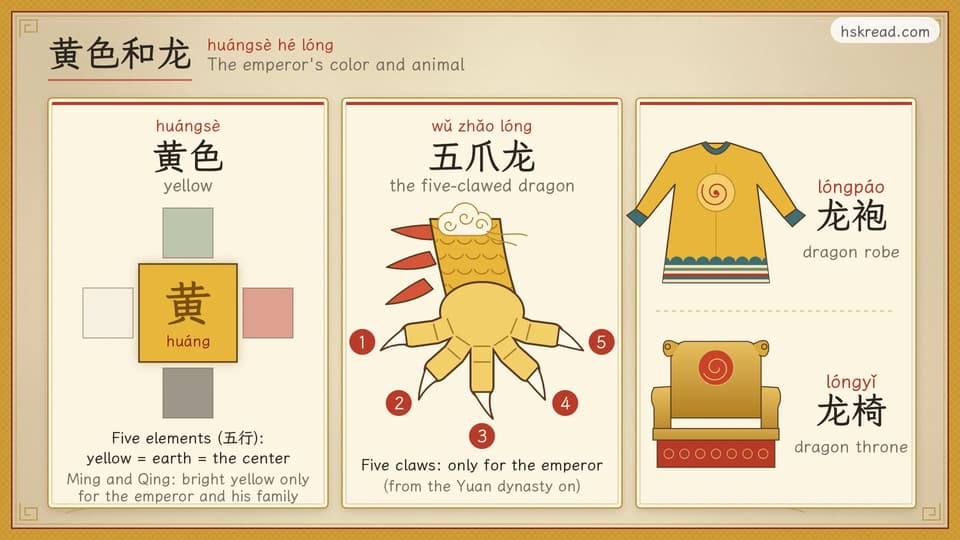
Why did Chinese emperors wear yellow?
In the old Chinese theory of the 五行 (wǔxíng, five elements), each element has a 颜色 (yánsè, color) and a direction. 黄色 (huángsè, yellow) belongs to earth and the 中心 (zhōngxīn, center), and the emperor was the center of the world. The legendary Yellow Emperor was also linked to this color.
From the Tang dynasty on, 老百姓 (lǎobǎixìng, ordinary people) were forbidden (禁止, jìnzhǐ) to wear the emperor's shade of yellow. In 960, a general named 赵匡胤 (Zhào Kuāngyìn) was dressed in a yellow robe by his soldiers and made emperor on the spot. He founded the Song dynasty, and the story gave Chinese the idiom 黄袍加身 (huángpáo jiā shēn), “to be draped in the yellow robe,” meaning to be suddenly put into a top position. By the Ming and Qing dynasties, bright yellow was strictly reserved for the emperor and his closest family. Even the roof tiles of imperial buildings were yellow.
The five-clawed dragon
The 龙 (lóng), the Chinese dragon, was the emperor's animal. His face was 龙颜 (lóngyán), his body was 龙体 (lóngtǐ), and he sat on a dragon throne. From the Yuan dynasty on, the dragon with five claws was reserved for the emperor; others could use dragons with fewer claws. In the Ming and Qing dynasties, putting a five-clawed dragon on your clothes without permission could get you severely punished.
Today, the dragon is no longer a royal symbol. It belongs to everyone, and Chinese people proudly call themselves 龙的传人 (lóng de chuánrén), “descendants of the dragon.”
康熙, 唐太宗, 汉武帝: how emperor names work
Why are some emperors called 康熙 (Kāngxī) or 乾隆 (Qiánlóng), while others are called 唐太宗 (Táng Tàizōng) or 汉武帝 (Hàn Wǔdì)? Because emperors had several names, and different periods use different ones:
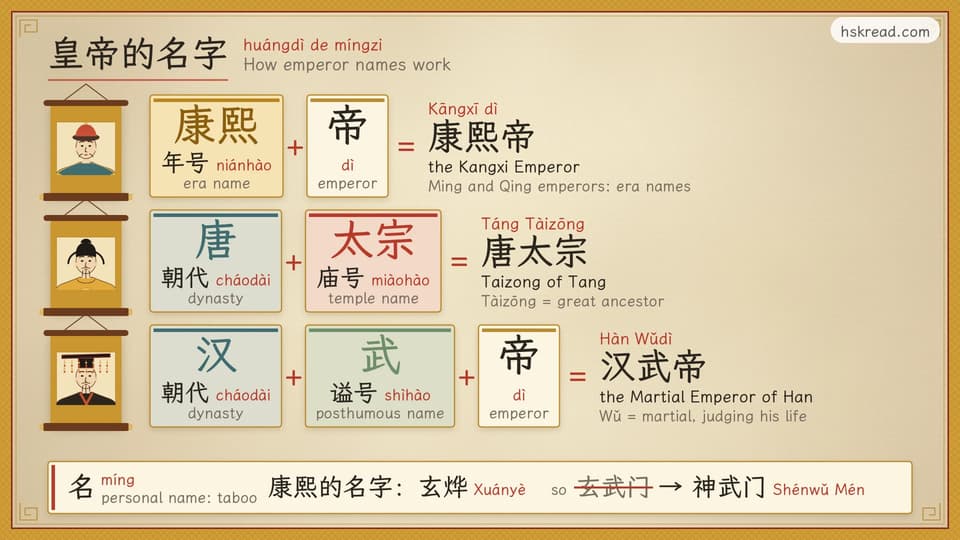
| Name type | Chinese | Pinyin | What it is | Example |
|---|---|---|---|---|
| Era name | 年号 | niánhào | the name of the years of a reign, used to count years | 康熙 (1662–1722), 乾隆 |
| Temple name | 庙号 | miàohào | the name used in the family temple after death | 太祖, 太宗: 唐太宗, 宋太祖 |
| Posthumous name | 谥号 | shìhào | a name after death that judges his life | 武 “martial”: 汉武帝 |
| Personal name | 名 | míng | the emperor's real name, which people were not allowed to say | 李世民, 玄烨 |
- 年号 (era names): Emperor Wu of Han is traditionally seen as the first emperor to use era names, starting with 建元 in 140 BC. Early emperors often changed era names many times. In the Ming and Qing dynasties, each emperor almost always used just one, so these emperors are usually called by their era names: the 康熙帝 (Kāngxī dì, the Kangxi Emperor) or 乾隆 (Qiánlóng). In Chinese, 康熙年间 means “during the Kangxi era.”
- 庙号 (temple names): These were given after death. 太祖 (“great founder”) usually went to the founder of a dynasty, and 太宗 (“great ancestor”) often to the second ruler. Tang and Song emperors are usually known this way: 唐太宗, 宋太祖.
- 谥号 (posthumous names): A one- or two-character judgment of the emperor's life. 武 means “martial,” so 汉武帝 is “the Martial Emperor of Han,” remembered for his military campaigns.
- Name taboo: It was forbidden to write or say the emperor's personal 名字 (míngzi, name). The Kangxi Emperor's name was 玄烨 (Xuányè), so the north gate of the Forbidden City, 玄武门, was renamed 神武门 (Shénwǔ Mén). It still has that name today.
Famous Chinese emperors
How many emperors did China have? There is no single answer. Depending on which rulers and regimes are counted, lists give more than 400, and some count over 500. Here are some of the best known:
| Emperor | Pinyin | Dynasty | Reign | Known for |
|---|---|---|---|---|
| 秦始皇 | Qín Shǐhuáng | Qin | 221–210 BC | first emperor; unified China |
| 汉武帝 | Hàn Wǔdì | Han | 141–87 BC | expanded the empire; made Confucianism the state teaching |
| 唐太宗 | Táng Tàizōng | Tang | 626–649 | a model wise ruler; the prosperous Tang |
| 武则天 | Wǔ Zétiān | Zhou (Tang) | 690–705 | the only woman to rule as emperor in her own name |
| 宋太祖 | Sòng Tàizǔ | Song | 960–976 | founded the Song after the “yellow robe” coup |
| 明太祖 | Míng Tàizǔ | Ming | 1368–1398 | Zhu Yuanzhang, rose from a poor farming family to the throne |
| 永乐 | Yǒnglè | Ming | 1402–1424 | moved the capital to Beijing; built the Forbidden City |
| 康熙 | Kāngxī | Qing | 1661–1722 | the longest reign in Chinese history: 61 years |
| 乾隆 | Qiánlóng | Qing | 1735–1796 | stepped down so as not to reign longer than his grandfather Kangxi |
Qianlong is a fun story. He ruled for 60 years, then gave the throne to his son in 1796 so that his reign would not be longer than his grandfather's. He still kept the real 权力 (quánlì, power) until he died in 1799, aged 87.
The last emperor: Puyi (溥仪)
The last emperor of China was 溥仪 (Pǔyí) of the Qing dynasty. In 1908, when he was only two years old, he was put on the throne. His era name was 宣统 (Xuāntǒng).
In 1911, the 辛亥革命 (Xīnhài Gémìng, the 1911 Revolution) broke out, and on February 12, 1912, the court announced his abdication. More than 2,000 years of imperial rule ended, and China became a 共和国 (gònghéguó, republic). Puyi was allowed to keep living in part of the Forbidden City until he was forced to leave in 1924.
His later life was dramatic. Japan made him the puppet ruler of 伪满洲国 (Wěi Mǎnzhōuguó, Manchukuo), a state it set up in Northeast China, and after World War II he spent years in 监狱 (jiānyù, prison). In the end, he became an ordinary 公民 (gōngmín, citizen) of Beijing, worked at the Beijing Botanical Garden for a time, wrote an autobiography called 《我的前半生》 (Wǒ de Qián Bànshēng, “The First Half of My Life”), and died in 1967. His story became the 1987 film The Last Emperor.
Emperor words in modern Chinese
The emperors are gone, but people still use their words, often to 开玩笑 (kāi wánxiào, make a joke):
| Expression | Pinyin | Literal meaning | Used to mean |
|---|---|---|---|
| 土皇帝 | tǔ huángdì | “local emperor” | a local boss who acts like he can do anything |
| 皇帝不急太监急 | huángdì bù jí tàijiàn jí | the emperor isn't worried, but the eunuch is | someone worries more about a problem than the person it belongs to |
| 山高皇帝远 | shān gāo huángdì yuǎn | the mountains are high and the emperor is far away | a place so remote that the rules are hard to enforce |
| 黄袍加身 | huángpáo jiā shēn | to be draped in the yellow robe | to be suddenly put into a top position |
| 皇帝的新装 | huángdì de xīn zhuāng | the emperor's new clothes | something everyone pretends to believe (from Andersen's 童话, fairy tale) |
There is also a famous internet meme from the hit palace drama 《甄嬛传》 (Zhēn Huán Zhuàn, Empresses in the Palace, 2011): 臣妾做不到啊! (Chénqiè zuò bú dào a!), “Your humble consort cannot do it!” People use it jokingly when someone asks them to do something impossible.
Useful vocabulary
| Chinese | Pinyin | English |
|---|---|---|
| 皇帝 | huángdì | emperor |
| 皇上 | huángshang | Your Majesty; the emperor |
| 皇后 | huánghòu | empress |
| 太子 | tàizǐ | crown prince |
| 天子 | tiānzǐ | Son of Heaven |
| 天命 | tiānmìng | the Mandate of Heaven |
| 朕 | zhèn | “I” (used only by the emperor) |
| 陛下 | bìxià | Your Majesty |
| 万岁 | wànsuì | long live; ten thousand years |
| 圣旨 | shèngzhǐ | imperial order |
| 龙袍 | lóngpáo | dragon robe |
| 朝代 | cháodài | dynasty |
| 年号 | niánhào | era name |
| 太监 | tàijiàn | eunuch |
| 土皇帝 | tǔ huángdì | local tyrant; a boss who acts like a king |
The age of emperors ended more than a century ago, but you will meet 皇帝, 陛下 and 万岁 in every Chinese costume drama. Now you will know exactly what they mean.
Check your understanding
01What is the Chinese word for emperor?
The word is 皇帝 (huángdì). It was created in 221 BC by Qin Shi Huang, who combined 皇 and 帝, two words linked to the legendary rulers of ancient China. In TV dramas, officials usually address the emperor as 皇上 (huángshang) or 陛下 (bìxià).
02Why was the Chinese emperor called the Son of Heaven?
The emperor was believed to rule with the Mandate of Heaven (天命, tiānmìng), the approval of Heaven. That is why he was called 天子 (tiānzǐ), “Son of Heaven.” If he ruled badly, people believed Heaven could take the mandate away and give it to a new dynasty.
03Why did Chinese emperors wear yellow?
In the theory of the five elements, yellow stands for earth and the center, so it became the color of the ruler. From the Tang dynasty on, ordinary people were forbidden to wear certain shades of yellow, and in the Ming and Qing dynasties bright yellow was reserved for the emperor and his closest family.
04What is the difference between 康熙 and 唐太宗?
康熙 (Kāngxī) is an era name (年号), the name of the years of an emperor's reign. 唐太宗 (Táng Tàizōng) is a temple name (庙号), given after death. Ming and Qing emperors are usually called by their era names, while Tang and Song emperors are usually called by their temple names.
05How many emperors did China have?
There is no single official number. From Qin Shi Huang in 221 BC to the last emperor in 1912, historians count more than 400 emperors, and some lists give over 500, depending on which rulers and regimes they include.
06Who was the last emperor of China?
The last emperor was Puyi (溥仪, Pǔyí) of the Qing dynasty, who became emperor in 1908 at the age of two. He gave up the throne on February 12, 1912, ending more than 2,000 years of imperial rule. He later lived as an ordinary citizen in Beijing and died in 1967.