Chinese Paper Cutting (剪纸): History, Techniques, Symbols and Regional Styles
A fun, learner-friendly guide to 剪纸, the Chinese art of paper cutting: what the word means, its 1,500-year story, scissors vs. knife, the lucky puns hidden in the patterns, the colorful regional styles and how it lives on today.
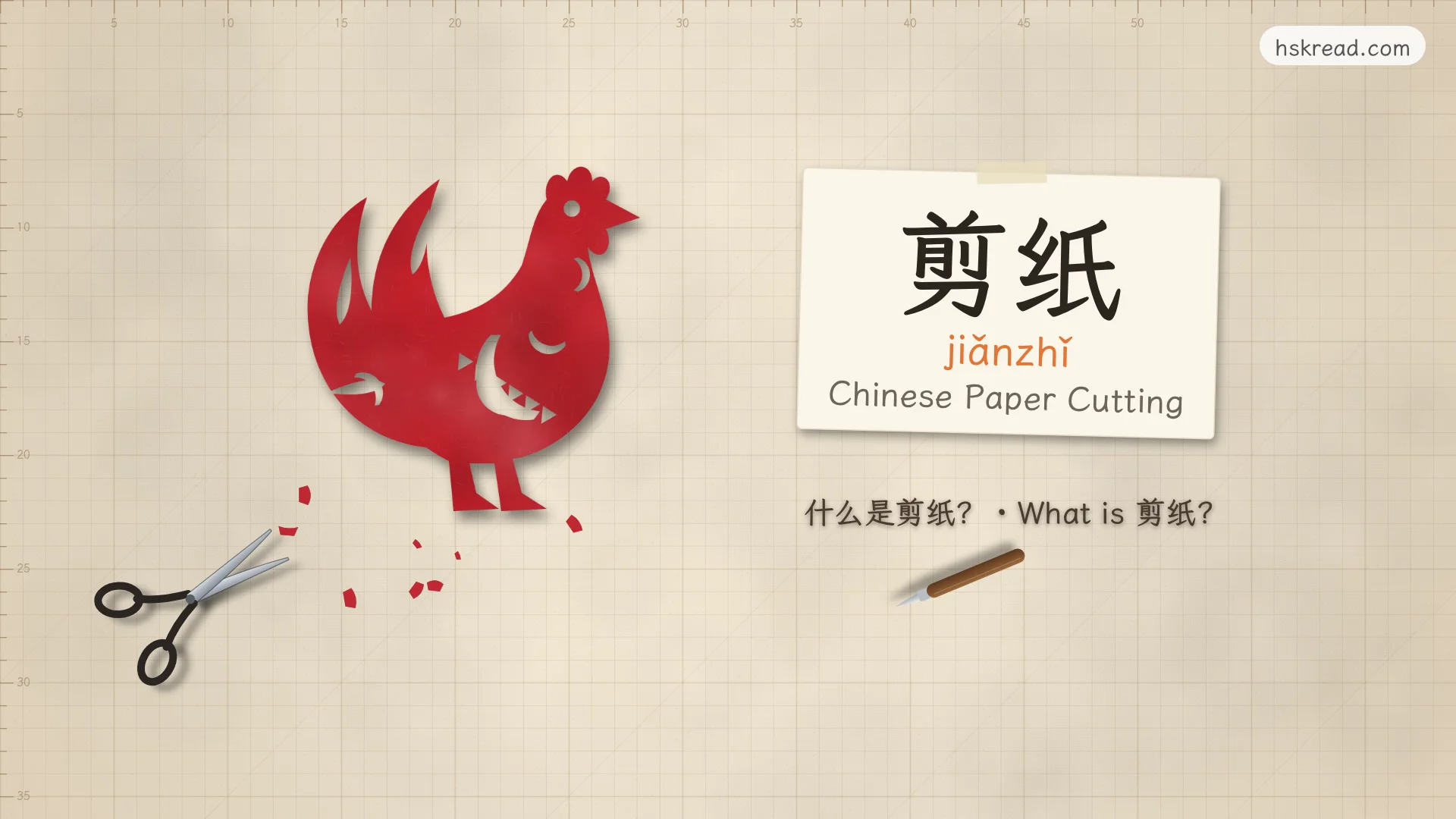
Give a Chinese folk artist a sheet of red paper and a pair of scissors, and in a few minutes she will hand you a rooster, a round flower or a whole village scene—all from one piece of paper, without a single drop of glue. This art is called 剪纸 (jiǎnzhǐ), Chinese paper cutting.
For centuries, Chinese families have used paper cuts to decorate windows and doors at New Year, to brighten weddings, and to wish each other luck. Today 剪纸 is on UNESCO's list of the world's intangible cultural heritage.
In this guide, you will learn what the word means, how artists cut with scissors and knives, what the patterns are trying to say, how styles change across China and where the art came from. Each section stands on its own, so skip to whatever catches your eye.
Key takeaways
- What it is: 剪纸 means "cut paper." It is one of China's best-known folk arts.
- How it's made: artists use either scissors (剪刀) or a carving knife (刻刀) on a wax board.
- Lucky puns: patterns are full of wishes: a bat (蝠 fú) means good fortune (福 fú).
- Regional styles: northern styles tend to be bold and simple; southern styles tend to be fine and delicate.
- History: the oldest surviving Chinese paper cuts are about 1,500 years old, found near Turpan in Xinjiang. "Chinese paper-cut" joined UNESCO's Representative List of the Intangible Cultural Heritage of Humanity in 2009.
- Today: you will see paper cuts on windows at New Year, at weddings, in animation and on your phone—and you can try it yourself.
What is 剪纸?
One sheet of paper, no glue, and every line connected: here is what makes a Chinese paper cut.
The word is easy to take apart:
| Character | Pinyin | Meaning |
|---|---|---|
| 剪 | jiǎn | to cut (with scissors) |
| 纸 | zhǐ | paper |
So 剪纸 is "cut paper." It can be a verb (to do paper cutting) or a noun (the art, or a single paper cut). The measure word is usually 张 (zhāng), the one for flat things like paper, or 幅 (fú), the one for pictures: 一幅剪纸, "a paper cut picture."
Because 剪 means cutting with scissors, artists who use a knife sometimes call their work 刻纸 (kèzhǐ), "carved paper." In everyday speech, though, 剪纸 covers both.
Most 剪纸 are red (红色, hóngsè), the color of joy and good luck.
They are usually made from a single sheet, and they are 镂空 (lòukōng, hollowed out): the empty spaces are as important as the paper. Every part of the design must stay connected, or the picture falls apart.
Many patterns are also 对称 (duìchèn, symmetrical), because the artist folds the paper before cutting.
In Chinese, it is called a 民间艺术 (mínjiān yìshù), a folk art: 民间 means "among the people," and 艺术 means "art."
Paper cutting is found in many cultures—think of Mexican papel picado banners or Swiss and German silhouette cutting. What makes Chinese 剪纸 special is its long, unbroken history as a home art: for centuries, most of its artists were not professionals but ordinary village women, who learned from their mothers and grandmothers.
Scissors or knife? How paper cuts are made
Some artists cut from imagination with scissors; others carve dozens of copies at once with a knife. There are two main ways to make a paper cut:
| Method | Tool | Pinyin | How it works |
|---|---|---|---|
| cutting | 剪刀 | jiǎndāo | small, sharp scissors; you fold one to a few sheets and cut by hand, often without a drawing |
| carving | 刻刀 | kèdāo | a small, very sharp knife; the paper lies on a soft wax board and you carve along a pattern |
Scissors are the tool of folk artists, especially in the north. A skilled grandmother can cut straight from her imagination, turning the paper in her left hand while the scissors move in her right. Folding the paper before cutting gives perfect symmetry: fold once for a left-right pair, fold several times for a round 团花 (tuánhuā, round flower).
Knives let artists make very fine lines and cut many sheets at the same time. The artist pins a stack of thin paper on a board made of wax mixed with ash, and carves the design with the knife held upright. One carving can produce dozens of copies, which is why knife-cutting was popular in workshops that sold their paper cuts.
阳刻 and 阴刻: keeping lines or cutting them away
Two more words are worth knowing:
| Term | Pinyin | Meaning |
|---|---|---|
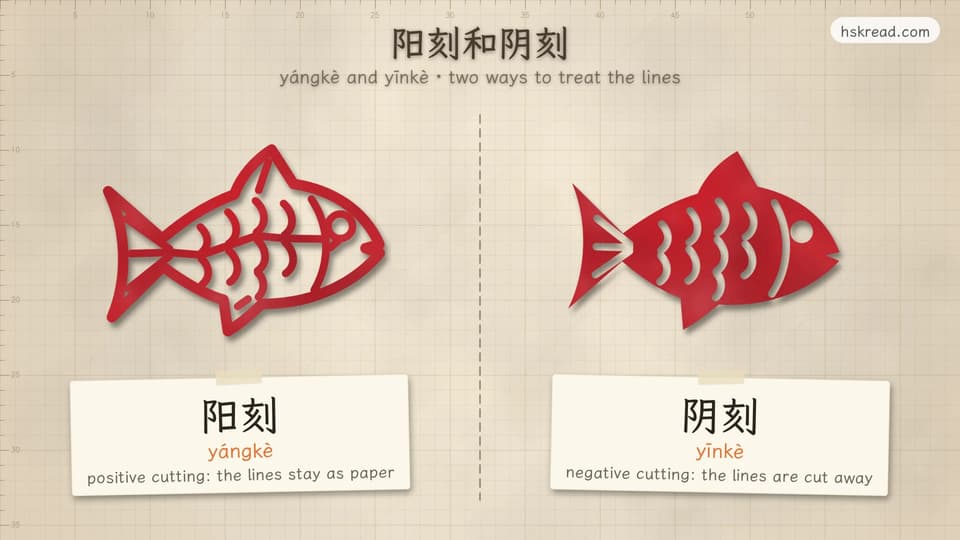
| 阳刻 | yángkè | "positive" cutting: the lines of the picture are kept as paper |
| 阴刻 | yīnkè | "negative" cutting: the lines are cut away, leaving holes |
The names come from 阳 and 阴, yang and yin—bright and dark. Many paper cuts mix both: outlines in 阳刻, with 阴刻 details inside, such as the eyes of a fish or the feathers of a bird.
One color or many?
Most paper cuts are a single color, usually red. Some regions dye the white paper by hand after cutting, so one 彩色 (cǎisè, colorful) piece glows in pink, yellow, green and blue. Others layer colored paper behind a cut-out outline.
Symbols and lucky puns in paper cutting
Why would anyone put a bat on a wedding gift? Chinese paper cuts are not just pretty pictures; most of them carry a wish.
Lucky puns: things that sound like wishes
The main trick is the pun, 谐音 (xiéyīn): you show an object whose name sounds like a lucky word. Here are some favorites:
| Pattern | Chinese | The pun | The wish |
|---|---|---|---|
| bat | 蝙蝠 biānfú | 蝠 fú sounds like 福 fú, fortune | good fortune |
| bat and coin | 蝙蝠 + 铜钱 | 蝠 = 福; 钱 qián sounds like 前 qián, "before"; the coin's hole is an "eye" (眼) | 福在眼前, "good fortune right before your eyes" |
| deer | 鹿 lù | sounds like 禄 lù, an official's salary | a good career and income |
| rooster | 鸡 jī | close to 吉 jí, lucky | good luck |
| vase | 瓶 píng | sounds like 平 píng, peace | 平安, safety and peace |
| fish | 鱼 yú | sounds like 余 yú, surplus | 年年有余, plenty every year |
| monkey on a horse | 马 + 猴 | 马上 "on a horse" also means "right away"; 猴 hóu sounds like 侯 hóu, a noble title | 马上封侯, "be promoted right away" |
Symbols that work by meaning
Other symbols work by meaning instead of sound:
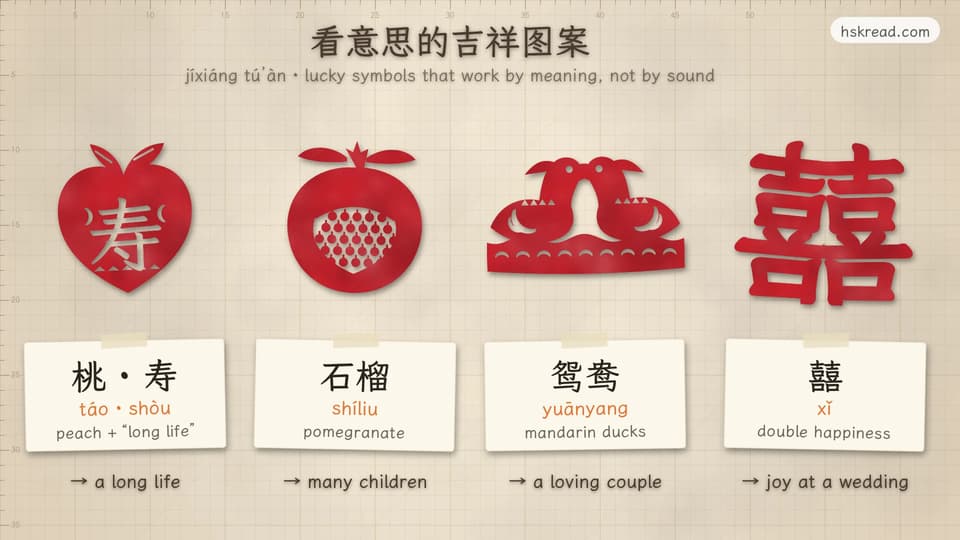
- Peach (桃, táo) and the character 寿 (shòu): a long life. Popular for birthdays.
- Pomegranate (石榴, shíliu): its many seeds stand for many children.
- Mandarin ducks (鸳鸯, yuānyang): they swim in pairs, so they stand for a loving couple.
- Double happiness (囍, xǐ): two 喜 "joy" characters joined together, the must-have paper cut at a Chinese wedding.
- The zodiac animal (生肖, shēngxiào): each New Year, artists cut the animal of the coming year.
Many New Year patterns—the fish, the magpie on a plum branch, the upside-down 福—are explained in our guide to Chinese window paper cuts.
Regional styles of Chinese paper cutting
Rainbow-dyed paper, a grandmother who woke up as the "Paper-Cut Lady," a hundred chrysanthemums: China is big, and the style (风格, fēnggé) of paper cuts changes from place to place.
A simple rule of thumb: northern (北方) paper cuts are bold, simple and strong; southern (南方) paper cuts are fine, detailed and elegant. Here are a few places—and people—worth knowing:
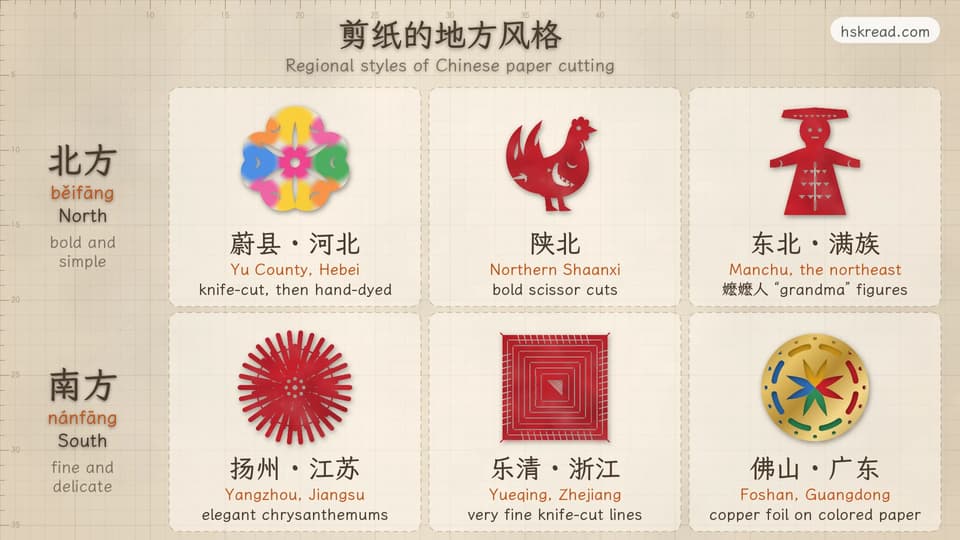
Yu County (蔚县, Yùxiàn), Hebei: the rainbow paper cuts
Here artists carve thin paper with a knife and then dye it by hand in hot pinks, greens and yellows. Locals simply call all their paper cuts 窗花, "window flowers." They say the work is 三分工,七分染: "30% cutting, 70% dyeing" (染, rǎn, means "to dye").
Northern Shaanxi (陕北, Shǎnběi): the scissor grandmothers
In the villages of the Loess Plateau, almost every woman used to cut paper, and their work is bold and full of life. The most famous of them, 库淑兰 (Kù Shūlán), has an amazing story.
In 1985, as the story goes, she fell off a cliff near her home and lay unconscious for days. When she woke up, she reached for her scissors and announced that she was now the 剪花娘子 (jiǎnhuā niángzǐ), the "Paper-Cut Lady" from heaven. From then on, she made huge, rainbow-colored collages, often with the Paper-Cut Lady herself in the middle.
Yangzhou (扬州, Yángzhōu), Jiangsu: elegant flowers
The master 张永寿 (Zhāng Yǒngshòu) cut a hundred different chrysanthemums (菊花, júhuā). He described good scissor lines like this: "round like the autumn moon, sharp like a wheat awn, square like a brick, jagged like a saw, and fine like a beard."
More places worth knowing
- Yueqing (乐清, Yuèqīng), Zhejiang: impossibly fine lines. Artists here are said to fit dozens of knife-cut lines into a single square inch. The art grew out of decorations for dragon-boat lanterns.
- Foshan (佛山, Fóshān), Guangdong: shiny metal. Instead of only paper, artists here cut thin copper foil and back it with colored paper, so the pictures shine like gold.
- The northeast: Manchu paper cuts. The 满族 (Mǎnzú, Manchu people) are known for 嬷嬷人 (mómo rén), simple "grandma" figures cut for good luck and protection.
A short history of Chinese paper cutting
A king's joke, 1,500-year-old horses in the desert and paper people in your hair: the early story of paper cutting is full of surprises.
Before paper: a king's joke
People were cutting patterns long before they had paper. Chinese archaeology (考古, kǎogǔ) has found cut-out designs in thin leather and metal foil that are more than 2,000 years old.
There is also a famous old story about a young king who cut a tree leaf into the shape of a jade tablet and handed it to his little brother as a joke: "I make you a lord!" His advisers were not amused. "A king's word is never a joke," they said—so the little boy really did get his land.
It is a legend about a leaf, not paper, but it shows how old the idea of "cutting shapes that mean something" is.
Horses and monkeys in the desert
Paper was invented in China during the Han dynasty (206 BC–AD 220) and slowly became cheap enough for everyday use. (Read more in our guide to ancient Chinese inventions.) Once people had paper, the old skill of cutting patterns found its perfect material.
The oldest paper cuts that survive today were found in ancient tombs near 吐鲁番 (Tǔlǔfān, Turpan), in the desert of Xinjiang. They are about 1,500 years old, and the hot, dry desert air kept them safe all that time.
They are all 团花 (tuánhuā), round flowers cut from folded paper. Around the edge of one, pairs of horses stand back to back; another has pairs of monkeys. They look surprisingly modern—and they were made with the same fold-and-cut method that children still use today.
Paper people in your hair
About 1,500 years ago, on 人日 (Rénrì, "Humankind Day," the 7th day of the New Year), people in central China cut colored silk or gold foil into little human figures. They stuck them on screens or wore them in their hair—a bit like a festival hair clip.
Paper cuts also played a part in folk beliefs. The great Tang poet 杜甫 (Dù Fǔ) once escaped a war and arrived, exhausted, at a friend's home. His friend's family, he wrote, "cut paper to call back my soul."
How paper cutting became a folk art (and world heritage)
How did a city craft turn into something every village grandmother could do—and end up on UNESCO's list?
Shops, stencils and fancy tea bowls
By the Song dynasty, about a thousand years ago, paper cutting had become a real job. In the busy city of Hangzhou, some people made a living cutting flower patterns, and one man was famous for cutting Chinese characters in the style of any great calligrapher you asked for.
Paper cuts were also used as patterns for embroidery (刺绣, cìxiù), and potters in Jiangxi even used them as stencils to put flowers and birds on their black tea bowls.
A folk art in every home
Over the centuries after the Song dynasty, 剪纸 (paper cutting) became part of everyday life across China, especially in the countryside. Women cut patterns for windows at New Year, for weddings, for birthdays, and for shoes and clothes to be embroidered.
In many villages, a girl's 手艺 (shǒuyì, craft skill) with scissors was seen as a sign of how clever and capable she was—something people noticed when choosing a bride. This is the folk tradition (传统, chuántǒng) that most of today's styles grew from.
World heritage
Today, Chinese paper cutting is on China's national list of 非物质文化遗产 (fēiwùzhì wénhuà yíchǎn, intangible cultural heritage), usually shortened to 非遗 (fēiyí). In 2009, "Chinese paper-cut" was also added to UNESCO's list of the world's intangible cultural heritage. Not bad for an art that needs only paper and scissors.
窗花: paper cuts for the windows
Why do red paper cuts glow on Chinese windows every New Year? The most common paper cuts of all are 窗花 (chuānghuā, "window flowers"), pasted on windows for the Spring Festival. In the past, Chinese windows were covered with thin white paper, and a red paper cut on it would glow when the lamp was lit inside.
Families still put them up a few days before Chinese New Year, along with spring couplets and the character 福. To learn when and how people put them up, what the New Year patterns mean and how to cut a simple one yourself, read our guide to Chinese window paper cuts.
Paper cutting in modern China
From a 1958 cartoon about a greedy pig to relaxing videos on your phone, 剪纸 (paper cutting) is still very much alive:
- Festivals and weddings. Red paper cuts appear every Spring Festival (see our overview of Chinese traditional festivals), and no wedding is complete without a 囍 on the door.
- Animation. In 1958, the Shanghai Animation Film Studio made China's first paper-cut animated film (动画片, dònghuàpiàn), Zhu Bajie Eats the Watermelon (《猪八戒吃西瓜》). Its greedy hero is 猪八戒 (Zhū Bājiè), Pigsy from Journey to the West, who finds a watermelon he is supposed to share—and, of course, eats it all himself.
- Design. Paper-cut patterns show up on stamps, posters, packaging, fashion and shop windows, especially around New Year.
- Schools and museums. Many Chinese children learn simple paper cutting in art class, and museums and cultural centers hold workshops, especially before the Spring Festival.
- Artists. Some artists now make huge paper cuts the size of a wall, or combine paper cutting with light, as in lamps and window installations.
- Online. On Chinese video apps, you can watch folk artists cut a whole dragon in one go, without drawing first—it is oddly relaxing.
Try it yourself: tips for beginners
Want to try 剪纸 (paper cutting) at home? You do not need special tools to start:
- Choose thin paper. Thin red paper is easier to fold and cut than thick craft paper.
- Use small, sharp scissors. Small tips make it easier to cut tight curves.
- Start with a 团花 (round flower). Fold a square several times, cut a few shapes along the folds, and open it. It is the easiest way to get a beautiful result.
- Cut the inside first. Artists usually cut the small holes inside the pattern first and the outline last, so the paper stays strong while you work.
- Keep everything connected. Before you cut, check that every part of the picture touches another part.
For a step-by-step 团花 and a "double happiness" 囍, see our window paper cut guide.
Useful vocabulary
| Chinese | Pinyin | English |
|---|---|---|
| 剪纸 | jiǎnzhǐ | paper cutting; a paper cut |
| 剪 | jiǎn | to cut (with scissors) |
| 剪刀 | jiǎndāo | scissors |
| 刻纸 | kèzhǐ | knife-carved paper cut |
| 刻刀 | kèdāo | carving knife |
| 民间艺术 | mínjiān yìshù | folk art |
| 对称 | duìchèn | symmetrical |
| 镂空 | lòukōng | hollowed out; openwork |
| 团花 | tuánhuā | round flower pattern |
| 窗花 | chuānghuā | window paper cut |
| 图案 | tú'àn | pattern; design |
| 谐音 | xiéyīn | homophone; pun |
| 吉祥 | jíxiáng | lucky; auspicious |
| 蝙蝠 | biānfú | bat |
| 非物质文化遗产 | fēiwùzhì wénhuà yíchǎn | intangible cultural heritage |
One sheet of paper, one pair of scissors and a little patience—that is all 剪纸 needs. Pick up some red paper and give it a try. 祝你剪得开心!
Check your understanding
01What is Chinese paper cutting called in Chinese?
It is called 剪纸 (jiǎnzhǐ), from 剪 "to cut with scissors" and 纸 "paper." Paper cuts made with a small knife are also called 刻纸 (kèzhǐ), "carved paper," but 剪纸 is the general name for the whole art.
02How old is Chinese paper cutting?
The oldest surviving Chinese paper cuts are round flower patterns found in ancient tombs near Turpan in Xinjiang. They are around 1,500 years old, and one of them shows pairs of horses. People cut thin leather, metal foil and silk into patterns even earlier.
03Is Chinese paper cutting a UNESCO heritage?
Yes. "Chinese paper-cut" was added to UNESCO's Representative List of the Intangible Cultural Heritage of Humanity in 2009. It is also on China's own national heritage list.
04What does red paper cutting mean?
Red is the color of joy and good luck in Chinese culture, so most paper cuts for festivals and weddings are red. The patterns themselves usually carry wishes, often through puns—a bat (蝠) for good fortune (福), a fish (鱼) for plenty (余).
05What is the difference between 剪纸 and 窗花?
剪纸 is the whole art of Chinese paper cutting. 窗花 (chuānghuā) are one kind of 剪纸—the paper cuts pasted on windows for the Spring Festival.
06What tools do you need for Chinese paper cutting?
For beginners, just thin paper and a pair of small, sharp scissors. Many professional artists also use a small carving knife on a soft wax board, which lets them cut many sheets at once. A pencil helps you draw the design first.