Chinese Fans (扇子): Types, History, Meaning and the Words Behind Them
A friendly guide to Chinese hand fans—round silk fans, folding fans, palm-leaf fans and feather fans—the stories behind them, fans in crosstalk, opera and park kung fu, what a fan symbolizes, where to buy a good one, and the tricky character 扇.
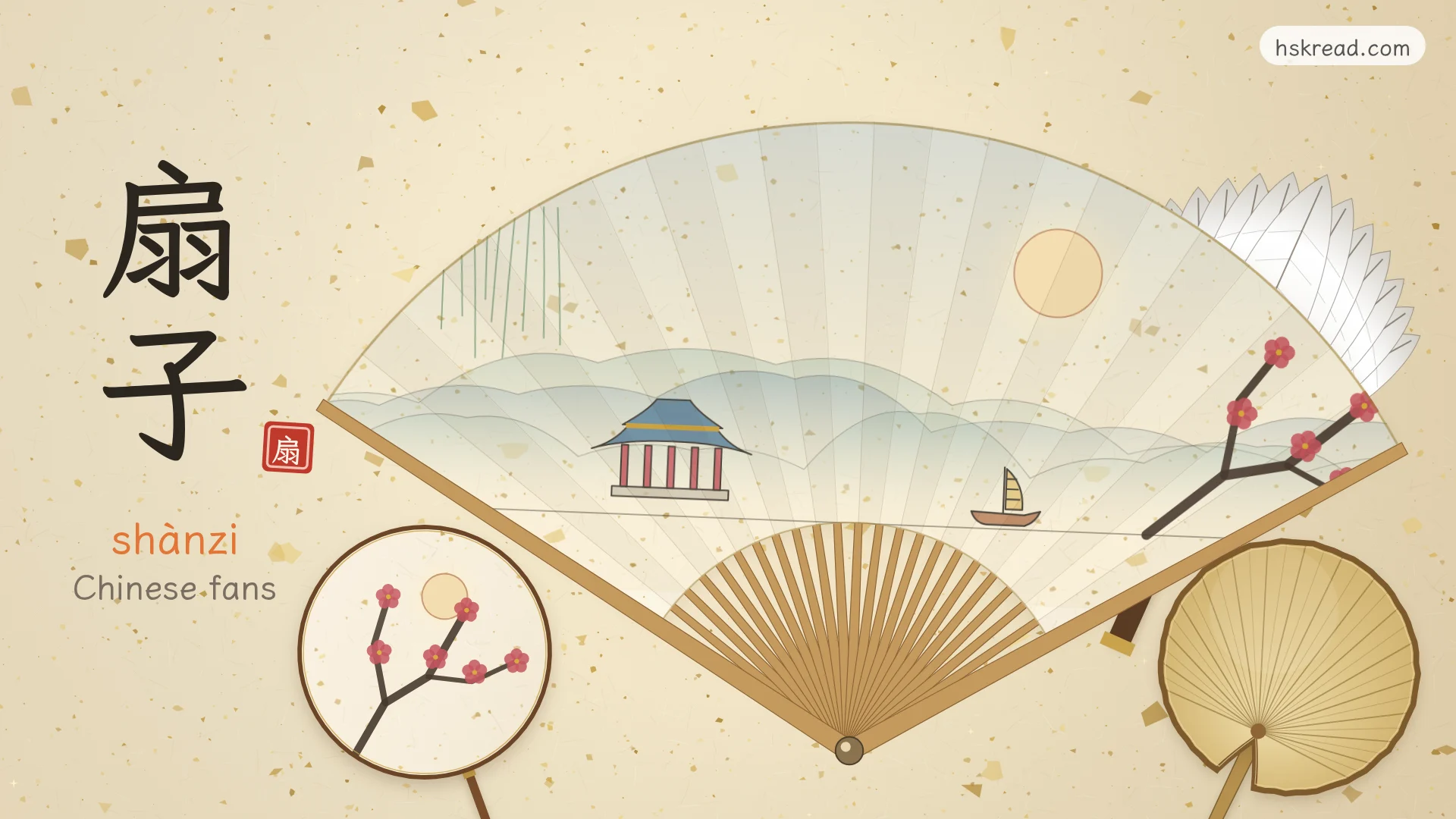
On a hot summer (夏天, xiàtiān) evening in a Chinese neighborhood, grandparents sit outside their buildings, chatting and slowly waving round palm-leaf fans. In a crosstalk theater, a comedian snaps open a folding fan and suddenly it becomes a sword, a pen or a letter. In the park the next morning, a group of retirees flick open bright red fans with a loud pa! and move together to a kung fu pop song.
The Chinese hand fan, the 扇子 (shànzi), is much more than a way to stay cool. For over 2,000 years it has been a tool, a work of art, a fashion item and a stage prop.
In this guide, you will meet the main types of Chinese fans, the fun stories behind them, what they mean, and the useful words that go with them—including one character with a surprising double life. Each section stands on its own, so jump to the fan that interests you.
Key takeaways
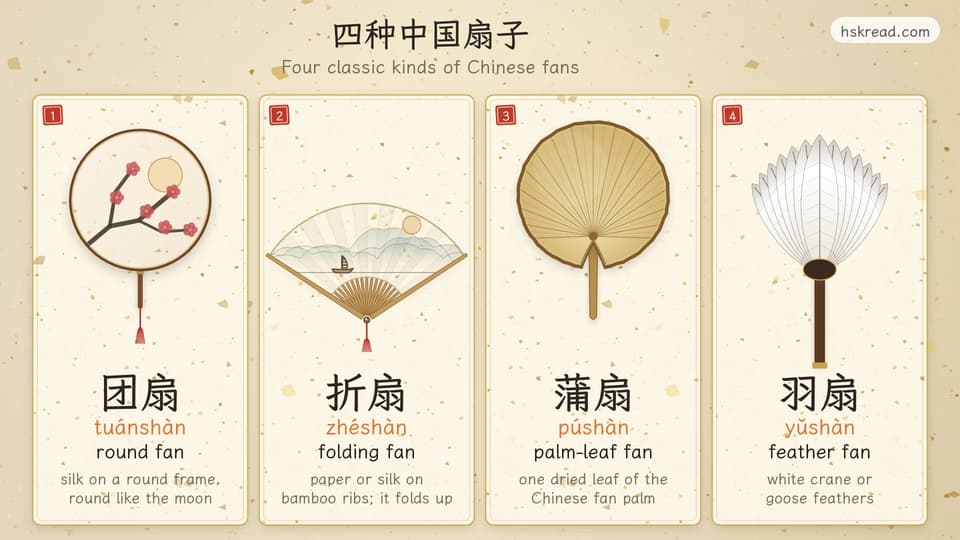
- Types: a fan is 扇子. The four classic types are 团扇 (round fan), 折扇 (folding fan), 蒲扇 (palm-leaf fan) and 羽扇 (feather fan).
- A surprise: the folding fan most likely came from Japan, but China fell in love with it in the Ming dynasty.
- Fans in action: crosstalk comedians, opera actors, dancers and kung fu retirees in the park all use fans.
- The character: 扇 is shàn as a noun but shān as a verb: 扇扇子 means “to fan yourself.”
- Meaning: 扇 sounds like 善 (good, kind), but some people avoid giving fans to couples because it also sounds a bit like 散 (to break up).
- Art and history: scholars painted and wrote poems on fans (the fan surface is called 扇面); the oldest fans found in China are woven bamboo fans from over 2,000 years ago.
Types of Chinese fans
Round silk, folding paper, a single palm leaf or a handful of feathers: here are the main types of 扇子 (shànzi, fan) you will see in China.
| Fan | Pinyin | English | What it is made of |
|---|---|---|---|
| 团扇 | tuánshàn | round fan | silk stretched on a round or oval frame |
| 折扇 | zhéshàn | folding fan | paper or silk on bamboo ribs that fold up |
| 蒲扇 | púshàn | palm-leaf fan | one dried leaf of the Chinese fan palm |
| 羽扇 | yǔshàn | feather fan | bird feathers, often white crane or goose feathers |
| 檀香扇 | tánxiāngshàn | sandalwood fan | thin, carved slices of sweet-smelling sandalwood |
团扇: the round silk fan
Brides hide behind it, poets pitied it, and today it is the must-have photo prop at China's old towns.
The 团扇 (tuánshàn) is a round or oval fan made of silk (丝绸, sīchóu) on a frame, with a straight handle. 团 means “round” or “group,” the same 团 as in 团圆 (tuányuán), family reunion. That is why round fans often stand for togetherness and the full moon (月亮, yuèliang).
Round silk fans were in fashion for more than a thousand years, from the Han dynasty to the Song dynasty.
Old poets loved them—and also felt a little sorry for them. One famous poem compares a silk fan to the bright moon, then sighs that it gets tossed into a box as soon as autumn arrives. That sad picture lives on in the idiom 秋扇见捐 (qiū shàn jiàn juān, “the fan is put away in autumn”), which means being cast aside once you are no longer needed.
Round fans also had a happier role. In Tang-dynasty weddings (婚礼, hūnlǐ), the bride (新娘, xīnniáng) hid her face behind a fan, and the groom had to recite a poem before she would lower it.
Imagine having to write a poem on the spot just to see your wife's face! Today, many brides at Chinese-style weddings bring the custom back and hold a round fan embroidered with flowers or the double-happiness character 囍.
You will see round fans all over China's tourist spots too. Young people who rent or buy 汉服 (Hànfú, traditional-style Han clothing) for photos almost always pose with one: half the face hidden behind the silk, eyes looking over the top. It is one of the most popular photo poses at old towns and palaces.
折扇: the folding fan
The fan everyone calls "Chinese" has a surprising origin story.
The 折扇 (zhéshàn) folds up into a neat stick. 折 (zhé) means “to fold.” It is the fan most people outside China picture when they hear “Chinese fan”—but here is a surprise: it probably was not invented in China.
Most historians believe the folding fan was first made in Japan and arrived in China about a thousand years ago, partly as gifts to the Song court.
At first, nobody important wanted one. Then, in the Ming dynasty, folding fans suddenly became the hottest fashion item for scholars. Chinese craftsmen made them their own, with dozens of thin ribs, paintings on both sides and carved handles. Later, through trade, Chinese and Japanese folding fans also became fashionable in Europe.
A folding fan is still the classic accessory of the scholar in TV dramas: a long robe, a folding fan in one hand, and a poem written on the fan. Snapping it shut is the perfect way to end an argument.
蒲扇: the palm-leaf fan
Cheap, light and smelling of summer at grandma's house—the palm-leaf fan also has a 1,600-year-old influencer story.
The 蒲扇 (púshàn), also called 葵扇 (kuíshàn), is the cheap, light, everyday fan of Chinese summers. Each one is a single dried leaf of the 蒲葵 (púkuí) tree, known in English as the Chinese fan palm, pressed flat, trimmed round and edged with bamboo or thread. The leaf stem becomes the handle.
For many Chinese people, a 蒲扇 is the smell and sound of childhood summers at grandma's house.
Palm-leaf fans have a fun celebrity story. An old history book says that when a man arrived in the capital with 50,000 palm-leaf fans that nobody would buy, the famous statesman Xie An (谢安) simply started carrying one. Everyone copied him, and the price of the fans went up several times—an early case of influencer marketing!
In Chinese stories, the scruffy, wine-loving monk 济公 (Jìgōng) always waves a torn palm-leaf fan. And in 西游记 (Journey to the West), Princess Iron Fan's magic 芭蕉扇 (bājiāo shàn, “banana-leaf fan”) can blow the Monkey King thousands of miles away—or put out the fires of the Flaming Mountains. Read more in our guide to Journey to the West.
羽扇: the feather fan
Waving a white feather fan while you outsmart a whole army: meet the most famous fan owner in Chinese history.
The 羽扇 (yǔshàn) is made of feathers. In Chinese minds, it belongs to one man: 诸葛亮 (Zhūgě Liàng), the brilliant strategist of the Three Kingdoms period. In the novel 三国演义 (Romance of the Three Kingdoms) and in countless TV shows and video games, he calmly waves a white feather fan while he defeats huge armies with clever plans.
His name even became a joke: someone who only has brilliant advice after things go wrong is called a 事后诸葛亮 (shìhòu Zhūgě Liàng), “a Zhuge Liang after the fact.”
There is a fun twist. The famous phrase 羽扇纶巾 (yǔshàn guānjīn, “feather fan and silk scarf”) comes from a poem by Su Shi, and in that poem the cool guy with the feather fan is actually Zhou Yu, Zhuge Liang's ally and rival. The novel later made the image Zhuge Liang's own—and it stuck.
Fans on stage, in the park and in kung fu
A sword, a pen, a letter—on a Chinese stage, a fan can be anything. Fans are one of the most important props (道具, dàojù) in Chinese performing arts—and in everyday exercise.
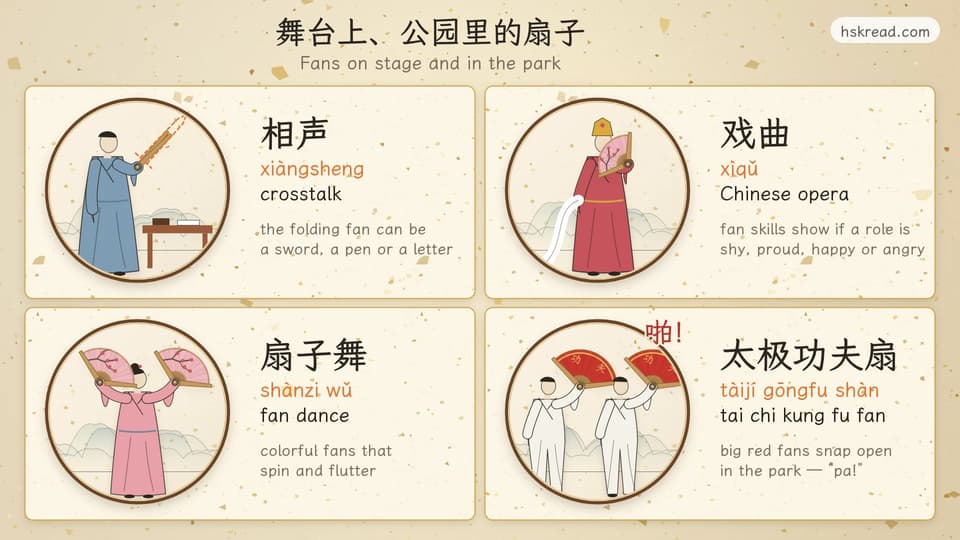
- Crosstalk: A 相声 (xiàngsheng, crosstalk) performer traditionally has three props: a folding fan, a handkerchief (手帕, shǒupà) and a small wooden block called a 醒木 (xǐngmù). On stage, the fan can become a sword, a spear, a pen or a letter. Performers like to say the fan can be anything—except a fan. A good comedian never uses it just to cool off.
- Opera: In Chinese opera (戏曲, xìqǔ), including 京剧 (jīngjù, Peking opera), actors learn a whole set of fan skills called 扇子功 (shànzi gōng). How a character opens, spins or hides behind a fan shows whether they are shy, proud, happy or angry.
- Dance: In the Chinese fan dance (扇子舞), dancers spin and flutter colorful fans, often with long silk edges. In northern folk dances like 秧歌 (yāngge), dancers wave fans and handkerchiefs to the beat of drums.
- Kung fu in the park: Visit a Chinese park in the morning and you may hear a row of fans snap open at the same moment. Many retirees practice 太极功夫扇 (tàijí gōngfu shàn, tai chi kung fu fan), a routine with big red fans set to the pop song 《中国功夫》 (“Chinese Kung Fu”). It is part martial art, part dance and a lot of fun to watch. Read more in our guide to tai chi.
扇: the character behind the fan
Why is a fan written with "door" on top of "wings"? This character has a surprising double life—and two pronunciations.
The character 扇 is made of two parts:
| Part | Pinyin | Meaning |
|---|---|---|
| 户 | hù | door; household |
| 羽 | yǔ | feather; wings |
A door on top of wings? It sounds strange, but it makes sense. China's oldest dictionary explains that 扇 first meant a door panel—a door that swings open and shut like a bird's wings. Later the meaning moved to the tool you wave to make a breeze.
The old meaning is still alive in a very common word: 扇 is the measure word for doors and windows. You say 一扇门 (yí shàn mén, a door) and 一扇窗 (yí shàn chuāng, a window). So every time you open a window in China, you are, in a way, opening a fan.
shàn or shān?
扇 has two pronunciations, and you need both:
| Word | Pinyin | Meaning |
|---|---|---|
| 扇子 | shànzi | a fan (noun, fourth tone) |
| 扇 | shān | to fan; to slap (verb, first tone) |
| 扇扇子 | shān shànzi | to fan yourself with a fan |
| 扇风 | shān fēng | to fan; to make a breeze |
| 扇耳光 | shān ěrguāng | to slap someone in the face |
The measure word for a fan is 把 (bǎ), the one for things with a handle: 一把扇子, “a fan.”
What does a fan symbolize? 善, 散 and good wishes
Thinking of giving a fan as a gift? Read this first. Chinese loves wordplay with sounds (homophones, 谐音 xiéyīn), and the fan is part of the game.
- 扇 = 善: 扇 (shàn) sounds exactly like 善 (shàn), “good; kind,” as in 善良 (shànliáng, kind-hearted). So a fan can carry a wish to be kind and do good.
- 扇 ≈ 散: In some places, people avoid giving a fan to a couple or at a wedding, because 扇 (shàn) sounds a bit like 散 (sàn), “to break up; to scatter.” This is a popular belief, not a strict rule: many people happily give fans as gifts, especially to friends.
- Out of season: A fan is useless once summer ends, so a fan can also stand for something—or someone—forgotten, as in the idiom 秋扇见捐, “the fan is put away in autumn.”
- The scholar's fan: A folding fan with painting and calligraphy stands for learning, good taste and a calm mind.
Gift-giving (送礼, sònglǐ) in China comes with many little rules like this. If you want to give a fan as a present (礼物, lǐwù), choose one with a kind message or a beautiful painting, and maybe skip it for a wedding.
扇面: painting and calligraphy on fans
How did a few brushstrokes make a cheap bamboo fan worth a fortune? It starts with the fan's surface.
The surface of a fan is the 扇面 (shànmiàn), the “fan face.” For Chinese scholars, a blank fan was like a small canvas you could carry. They painted landscapes, flowers and birds on it, or wrote a poem in beautiful 书法 (shūfǎ, calligraphy), and gave it to a friend.
Because a fan went everywhere with its owner, it was a way to show off your taste—a bit like a designer phone case today.
A famous story says the great calligrapher Wang Xizhi once saw an old woman selling bamboo fans that nobody wanted. He wrote a few characters on each one. The woman was upset—he had “ruined” her fans! But he told her to say they were written by Wang Xizhi, and people rushed to buy them at a much higher price.
Painting on fans is still a popular form of Chinese 国画 (guóhuà, traditional Chinese painting), and museums keep many old fan paintings flat in albums so they last longer.
A short history of Chinese fans
From royal status symbols to electric fans: you don't need to remember dynasties to enjoy fans, but a few snapshots help.
| When | What fans looked like |
|---|---|
| Legend | Old stories say a wise early king made the first fans—as ceremonial objects, not for heat. |
| Over 2,000 years ago | Woven bamboo fans with short handles, some found in ancient tombs. |
| Han to Song dynasty | Round silk fans are the fashion. |
| Ming dynasty (1368–1644) | Folding fans become the scholar's favorite; painting and calligraphy on fans flourish. |
| Today | Fans for dance, kung fu, weddings, photos—and electric fans in every home. |
The earliest fans were not only for cooling down. Early bamboo (竹子, zhúzi) fans were also held up to cover the face, and giant fans on long poles were carried behind emperors as a sign of rank. Watch any Chinese palace drama and you will spot them standing behind the throne.
Where to buy a good Chinese fan
Want a fan worth bringing home? Here is where to look. You can buy a simple paper folding fan for a few yuan on any tourist street. But if you want something special, two cities near Shanghai are famous for fans:
- 苏州 (Suzhou): Home of elegant folding fans and the sandalwood fan (檀香, tánxiāng, sandalwood). Its thin wooden ribs are carved with tiny patterns, and the fan gives off a sweet smell every time you wave it—people say the scent lasts for years.
- 杭州 (Hangzhou): Home of 王星记 (Wáng Xīng Jì), a fan shop that has been open since 1875. It is famous for black paper folding fans that take dozens of steps to make, and a fan from Hangzhou is a classic souvenir from a trip to West Lake.
Fan making in both cities is protected as national 非物质文化遗产 (intangible cultural heritage). In the south, many families still use simple palm-leaf fans, and in summer you can find them at almost any street market.
Fans in modern Chinese
Electric fans, ceiling fans, handheld mini fans: 扇 is still all over everyday Chinese.
Air conditioning has replaced most hand fans, but fans have not disappeared. On a hot summer day in a Chinese city, look around the subway: lots of people are holding a small, battery-powered 手持小风扇 (shǒuchí xiǎo fēngshàn, handheld mini fan) right in front of their faces.
And the word 扇 is everywhere in modern life:
| Chinese | Pinyin | English |
|---|---|---|
| 电风扇 | diànfēngshàn | electric fan |
| 风扇 | fēngshàn | fan (any electric fan) |
| 吊扇 | diàoshàn | ceiling fan |
| 排风扇 | páifēngshàn | exhaust fan |
| 空调 | kōngtiáo | air conditioner |
| 扇耳光 | shān ěrguāng | to slap someone in the face |
Be careful with one look-alike: 煽动 (shāndòng, to stir up; to incite) uses 煽, with the fire radical 火—like fanning a fire.
Useful vocabulary
| Chinese | Pinyin | English |
|---|---|---|
| 扇子 | shànzi | fan |
| 扇 | shàn / shān | fan; measure word for doors / to fan |
| 扇扇子 | shān shànzi | to fan yourself |
| 团扇 | tuánshàn | round fan |
| 折扇 | zhéshàn | folding fan |
| 蒲扇 | púshàn | palm-leaf fan |
| 羽扇 | yǔshàn | feather fan |
| 扇面 | shànmiàn | fan surface; fan painting |
| 书法 | shūfǎ | calligraphy |
| 相声 | xiàngsheng | crosstalk |
| 道具 | dàojù | prop |
| 善 | shàn | good; kind |
| 电风扇 | diànfēngshàn | electric fan |
Next summer, when the air conditioner breaks, pick up a fan and remember: you are holding a piece of history. 扇一扇,凉快一下吧!
Check your understanding
01What is a Chinese fan called?
A fan is 扇子 (shànzi) in Chinese. A round silk fan is a 团扇 (tuánshàn), a folding fan is a 折扇 (zhéshàn), a palm-leaf fan is a 蒲扇 (púshàn) and a feather fan is a 羽扇 (yǔshàn). The measure word is 把, as in 一把扇子.
02What does a fan symbolize in Chinese culture?
Fans stand for good taste and learning, especially folding fans with painting and calligraphy. Because 扇 (shàn) sounds the same as 善 (shàn, “kind; good”), a fan can also carry the wish to be kind. Round fans suggest the full moon and family reunion.
03Did the Chinese invent the folding fan?
Probably not. China has used fans for well over 2,000 years, but most historians believe the folding fan was first made in Japan. It reached China about a thousand years ago and became hugely popular in the Ming dynasty, when Chinese artists made it their own.
04Is it bad luck to give a fan as a gift in China?
It depends on who you ask. Some people avoid giving fans to couples or at weddings, because 扇 (shàn) sounds a bit like 散 (sàn, “to break up”). Many others see a fan as an elegant gift, especially one with a painting or a kind message.
05Why does Zhuge Liang hold a feather fan?
In the novel Romance of the Three Kingdoms and the many TV shows based on it, the strategist Zhuge Liang is almost always shown calmly waving a white feather fan. It became a symbol of cool, confident wisdom, and today almost every Chinese viewer connects the feather fan with him.
06How do you pronounce 扇?
As a noun, 扇 is shàn (fourth tone), as in 扇子 and 电风扇. As a verb meaning “to fan” or “to slap,” it is shān (first tone). So “to fan yourself with a fan” is 扇扇子, shān shànzi.