Sun Wukong (孙悟空): The Monkey King's Name, Story, Powers and Famous Sayings
Who is Sun Wukong, the Monkey King? Learn what 孙悟空 means, his many titles, how he was born from a stone and trapped under a mountain, his 72 transformations, cloud somersault and golden staff, Black Myth Wukong, and the everyday Chinese sayings he gave us.
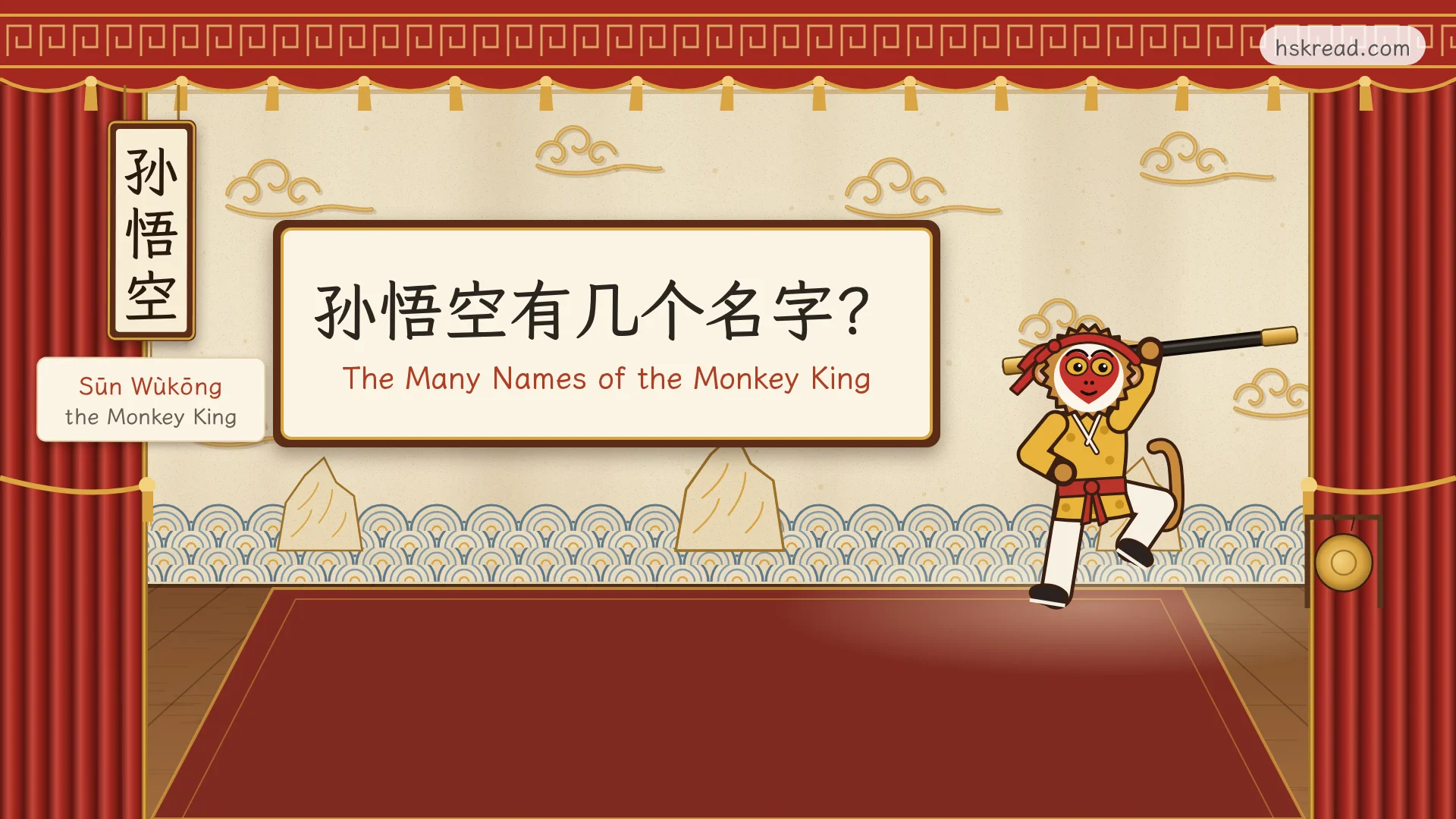
He was born from a stone. He made himself king of the monkeys, learned magic from a Taoist master, stole a weapon from a dragon, crossed his own name out of the Book of Death, and turned heaven upside down. Then he spent 500 years trapped under a mountain—and came out to protect a monk on the longest walk in Chinese literature.
He is 孙悟空 (Sūn Wùkōng), the Monkey King, the hero of the novel Journey to the West and probably the most famous character in Chinese culture. Children dress up as him, opera actors leap across the stage as him, and in 2024 millions of gamers around the world met him in Black Myth: Wukong.
In this guide, you will learn what his name means, his many titles, his wild story, his powers and the Chinese sayings that come from him.
Key takeaways
- 孙悟空 means roughly “the monkey who has awakened to emptiness.” 孙 comes from an old word for monkey.
- He has many titles: 美猴王 (Handsome Monkey King), 齐天大圣 (Great Sage Equal to Heaven), 弼马温 (heavenly stable keeper) and finally 斗战胜佛 (Victorious Fighting Buddha).
- He was born from a stone on 花果山, the Mountain of Flowers and Fruit.
- After 大闹天宫, “havoc in heaven,” the Buddha trapped him under 五行山 for 500 years.
- His four famous powers: 七十二变, 筋斗云, 金箍棒 and 火眼金睛—and his one weakness is the 紧箍咒, the tight-headband spell.
- Many everyday Chinese sayings come from him, like 火眼金睛 and 猴子请来的救兵.
- He lives on in opera “monkey plays,” the 1986 TV series, Dragon Ball's Goku and the 2024 hit game Black Myth: Wukong.
- People love him because he is brave, clever, a little naughty—and far from perfect.
What does Sun Wukong mean?
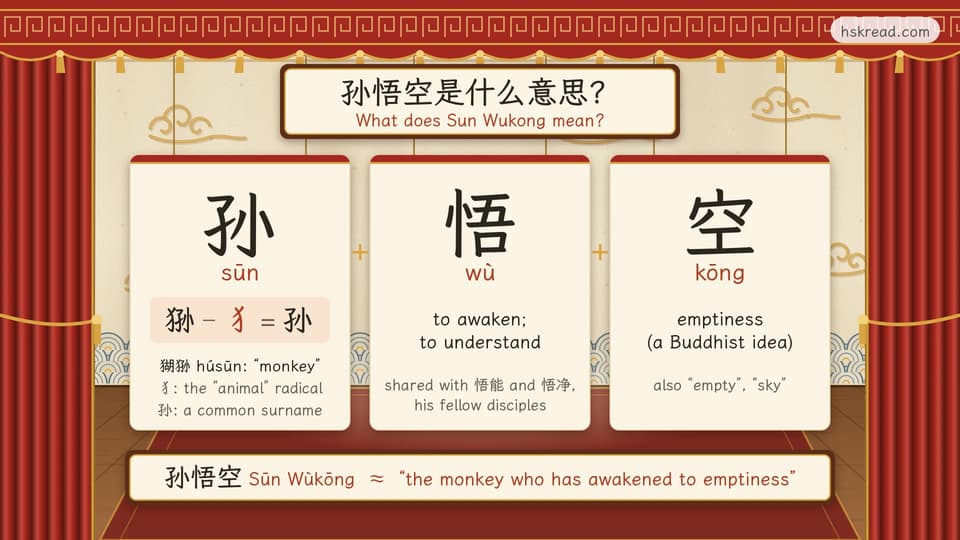
His name was given to him by his first teacher, a Taoist master called 菩提祖师 (Pútí Zǔshī, Patriarch Subodhi).
| Character | Pinyin | Meaning |
|---|---|---|
| 孙 | sūn | a surname; here, from 猢狲 húsūn, “monkey” |
| 悟 | wù | to awaken; to understand |
| 空 | kōng | emptiness (a Buddhist idea); also “empty” or “sky” |
The surname 孙
The master looks at the little stone monkey and says he looks like a 猢狲 (húsūn), an old word for a monkey. So he builds a surname from that word: he takes 狲 and removes the “animal” radical 犭. What is left is 孙 (sūn), which is also a very common Chinese 姓 (xìng, surname). In other words, the Monkey King's family name is basically “Monkey, minus the animal part”—a little joke hidden in a character.
The given name 悟空
For his given name, the master picks 悟空, “awakened to emptiness.” Later, his fellow disciples Zhu Bajie and Sha Seng receive the names 悟能 and 悟净 in the same pattern—so the three of them are like brothers who share a middle name.
The Monkey King's names and titles
Few characters collect as many names as Sun Wukong. Each 称号 (chēnghào, title) marks a stage in his life:
| Name / title | Pinyin | Meaning | When he gets it |
|---|---|---|---|
| 石猴 | shí hóu | the Stone Monkey | at birth |
| 美猴王 | Měi Hóuwáng | the Handsome Monkey King | after he jumps through the waterfall and becomes king of the monkeys |
| 孙悟空 | Sūn Wùkōng | “awakened to emptiness” | from his Taoist teacher |
| 弼马温 | bìmǎwēn | Keeper of the Heavenly Horses | his first job in heaven |
| 齐天大圣 | Qítiān Dàshèng | Great Sage Equal to Heaven | the title he gives himself |
| 孙行者 | Sūn Xíngzhě | Pilgrim Sun | from the Tang Monk, when the journey begins |
| 斗战胜佛 | Dòu Zhàn Shèng Fó | Victorious Fighting Buddha | at the very end of the journey |
Two of these titles have fun stories:
- 弼马温 sounds like an important title, but it is the lowest job in heaven—taking care of the horses. When Monkey finds out, he is furious, kicks over his desk and goes home. For the rest of the novel, his enemies love to tease him by calling him 弼马温—and it makes him angry every single time. A popular explanation of the name is that it sounds like 避马瘟 (bì mǎ wēn, “to keep away horse disease”): people used to believe that keeping a monkey in a stable kept the horses healthy.
- 齐天大圣 means “Great Sage Equal to Heaven.” 齐 means “equal,” 天 is heaven and 大圣 is “great sage.” Monkey simply gives himself this title and puts it on a big flag. In the end, heaven agrees to use it, just to keep him quiet.
People also have friendly 外号 (wàihào, nicknames) for him: 孙猴子 (Sūn hóuzi, “Sun the monkey”), 猴哥 (hóu gē, “Brother Monkey”) and simply 大圣 (Dàshèng, “the Great Sage”).
Where did the Monkey King come from? Born from a stone
The novel Journey to the West tells Monkey's early life in its first seven chapters, and it reads like a superhero origin story. (For the whole journey, see our guide to Journey to the West.)
A stone egg on the Mountain of Flowers and Fruit
On top of 花果山 (Huāguǒ Shān, the Mountain of Flowers and Fruit), a magic 石头 (shítou, stone) takes in the energy of heaven and earth for a very long time. One day, it cracks open and a stone egg comes out. In the wind, the egg 变成 (biànchéng, turns into) a monkey. When he opens his eyes, two beams of golden light shoot up to heaven and surprise the Jade Emperor.
The young monkey is brave enough to jump through a waterfall. Behind it, he finds a cave called 水帘洞 (Shuǐlián Dòng, the Water Curtain Cave). The other monkeys make him their king: the Handsome Monkey King.
You can actually visit a Huaguo Mountain today. Several places in China claim to be the “real” one; the best known is in Lianyungang, Jiangsu, complete with its own Water Curtain Cave—and plenty of real monkeys.
Learning magic
Afraid of growing old and dying, the Monkey King sails across the sea to find a teacher. He studies with the Taoist master Patriarch Subodhi for years and learns the 72 transformations and the cloud somersault. But he can't resist showing off his tricks to the other students, and the master sends him away, telling him never to say who taught him.
Where did the idea of a monkey hero come from?
Where did such a wild character come from? Nobody knows for sure. Some people see a cousin of Hanuman, the monkey god of India; others point to monkey-like creatures in old Chinese legends. Most likely, he grew over centuries from many stories, with every storyteller adding a little more mischief.
Havoc in Heaven (大闹天宫): Monkey's war with the gods
How do you make all of heaven angry? Steal a dragon's weapon, cross out your own death, and wreck heaven's party.
Making trouble everywhere
After learning magic from a Taoist master, Monkey goes home to the Mountain of Flowers and Fruit and wants a good weapon. He visits the 龙王 (Lóngwáng, Dragon King) of the Eastern Sea and walks off with a huge iron pillar from the dragon's palace—the staff that becomes his famous weapon.
When he dies in his sleep and is taken to the underworld, he simply crosses out his own name, and the names of all monkeys, from the Book of Life and Death. Problem solved!
The gods complain, and heaven decides it is easier to give Monkey a job. That job is 弼马温, keeper of the heavenly horses. When he learns how low it is, he goes home and calls himself 齐天大圣, the Great Sage Equal to Heaven.
Stealing the peaches of immortality
Heaven tries again and makes him guardian of the garden of the 蟠桃 (pántáo), the peaches of immortality. Bad idea. Monkey eats the best peaches (桃, táo), ruins the Queen Mother's peach banquet, and steals (偷, tōu) and eats the magic pills of the Taoist sage 太上老君 (Tàishàng Lǎojūn, Laozi). This is the famous 大闹天宫 (dà nào tiāngōng), “havoc in heaven.”
The heavenly armies cannot beat him. Finally, he is caught and thrown into Laozi's furnace to be burned for 49 days. The fire does not kill him. Instead, the smoke turns his eyes red, and he jumps out with 火眼金睛—fiery golden eyes. The punishment gave him a superpower.
The Buddha's palm: how Monkey ended up under a mountain for 500 years
Monkey can fly 108,000 li in one somersault—so how did he lose a bet to a single hand?
After Monkey's havoc in heaven, the Jade Emperor asks the Buddha (如来佛, Rúlái Fó) for help. The Buddha makes a bet: “If you can jump out of my right hand, you can have heaven.” Monkey laughs—he can go 108,000 li in one somersault!
He jumps, flies to the end of the world and sees five tall pink pillars. To prove he was there, he writes 齐天大圣到此一游, “The Great Sage Equal to Heaven was here,” on one pillar—and pees on another.
When he comes back, the Buddha shows him his hand. The words are written on the Buddha's middle finger. Monkey never left the palm. The Buddha turns his hand into 五行山 (Wǔxíng Shān, Five Elements Mountain) and traps Monkey underneath. He stays there for 500 years, until the Tang Monk, a pilgrim on his way to India, frees him and he becomes the monk's first disciple.
Sun Wukong's powers: 72 transformations and the cloud somersault
Can a monkey turn into a temple or fly 108,000 li in one jump? Here are the Monkey King's four most famous 本领 (běnlǐng, skills):
| Power | Pinyin | English | What it does |
|---|---|---|---|
| 七十二变 | qīshí'èr biàn | the 72 transformations | he can turn into animals, people, objects—even a temple |
| 筋斗云 | jīndǒu yún | the cloud somersault | one somersault carries him 108,000 li |
| 金箍棒 | jīngū bàng | the gold-banded staff | a 13,500-jin iron staff that grows or shrinks as he wishes |
| 火眼金睛 | huǒyǎn jīnjīng | fiery eyes and golden pupils | he can see through any demon's disguise |
七十二变: the 72 transformations
His Taoist master offers two kinds of magic: 36 transformations or 72. Monkey, of course, picks the bigger number. With 七十二变 (qīshí'èr biàn), he can become a bird, a fish, a tree, an old man or a little bug that flies into a demon's stomach. In the novel, 72 really means “countless.” Zhu Bajie (Pigsy), his fellow disciple, knows only 36.
There is one funny weak spot. Once, he turns into a temple to trick an enemy—but he can't hide his tail, so he makes it into a flagpole standing behind the temple. Who ever saw a temple with a flagpole at the back? The enemy isn't fooled for a second.
Monkey has one more trick: he can pull out some of his hairs, blow on them and turn them into dozens of little monkeys who fight for him.
筋斗云: the cloud somersault
筋斗云 (jīndǒu yún) lets him do one somersault and land 十万八千里 (shíwàn bāqiān lǐ), 108,000 li, away. Funny detail: that is exactly the distance from China to the Western Heaven in the novel.
So why doesn't Monkey just carry the monk he protects to India in one jump? Readers have asked this for centuries—and so does Zhu Bajie. Monkey explains: the monk is an ordinary human, “as heavy as a mountain,” and the scriptures can only be earned by walking every step of the hard road. No shortcuts, even for a superhero.
The golden staff, the fiery eyes and Monkey's one weakness
Monkey keeps a nearly seven-tonne staff inside his ear, got his fiery golden eyes from a furnace, and has exactly one weakness—on his own head.
金箍棒: the golden-banded staff
Its full name is 如意金箍棒 (rúyì jīngū bàng). 如意 means “as you wish,” 金箍 means “golden bands,” and 棒 means “staff” or “stick.” Legend says it was once used to measure the depth of the seas, and it lay in the Dragon King's palace until Monkey found it.
It is an iron pillar with a golden band at each end, and it weighs 13,500 斤 (jīn, about half a kilogram each)—almost seven tonnes. It can grow as tall as the sky or shrink to the size of an embroidery needle (针, zhēn), which Monkey keeps inside his 耳朵 (ěrduo, ear).
In modern Chinese, people call something or someone that keeps everything stable a 定海神针 (dìng hǎi shén zhēn), “the magic needle that calms the sea”—the popular name for this staff. Sports fans love to call their star defender the team's 定海神针.
火眼金睛: fiery golden eyes
After 49 days in the furnace of Laozi—the Taoist sage whose magic pills he stole— Monkey's eyes are red and golden. With these 火眼金睛 (huǒyǎn jīnjīng), he can recognize a demon no matter how it is disguised. This is why the gentle Tang Monk is so often fooled, and Monkey never is.
紧箍咒: the tight-headband spell
Monkey has one big weakness, and it is on his head. When the journey begins, the Bodhisattva Guanyin gives the monk a hat with a golden band inside. Monkey puts it on, and the band grows into his head. Whenever the monk recites the 紧箍咒 (jǐngū zhòu, “tight-headband spell”), the band squeezes and Monkey rolls on the ground in pain. It is the only thing that can 控制 (kòngzhì, control) him.
In everyday Chinese, 紧箍咒 now means any rule or pressure that keeps someone under control.
Everyday Chinese sayings from the Monkey King
Sun Wukong is so famous that his story has become part of everyday language:
| Saying | Pinyin | Literal meaning | How people use it |
|---|---|---|---|
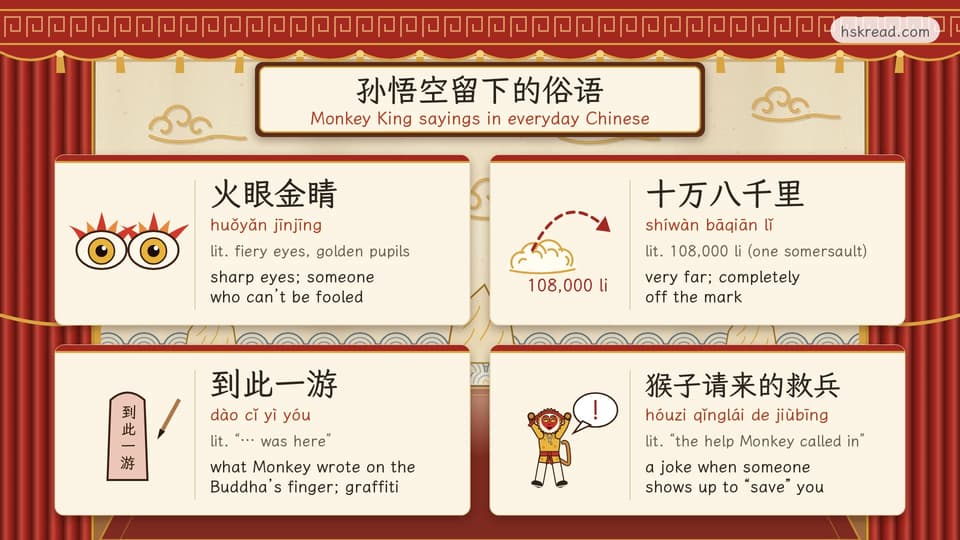
| 火眼金睛 | huǒyǎn jīnjīng | fiery eyes, golden pupils | sharp eyes; someone who can't be fooled |
| 七十二变 | qīshí'èr biàn | 72 transformations | endless changes; someone very versatile |
| 十万八千里 | shíwàn bāqiān lǐ | 108,000 li | very far; completely off the mark |
| 大闹天宫 | dà nào tiāngōng | to make havoc in heaven | to make a huge scene; to cause chaos |
| 紧箍咒 | jǐngū zhòu | the tight-headband spell | a strict rule that controls someone |
| 跳不出如来佛的手掌心 | tiào bu chū Rúlái Fó de shǒuzhǎngxīn | can't jump out of the Buddha's palm | can't escape someone's control |
| 到此一游 | dào cǐ yì yóu | was here | “X was here” (also the graffiti people write) |
| 猴子请来的救兵 | hóuzi qǐnglái de jiùbīng | the help that Monkey called in | a joke about someone who shows up to “save” you |
A few notes:
- 十万八千里 is very common in everyday talk. If your answer is completely wrong, it is “差了十万八千里,” “off by 108,000 li.”
- 猴子请来的救兵 comes from the 1986 TV series. When Monkey cannot beat the demon Red Boy, he asks Guanyin for help. Red Boy sneers at her: “你是猴子请来的救兵吗?”—“Are you the help the monkey brought?” The line became an internet joke, used when someone suddenly shows up to help—or to be silly.
- 到此一游 comes from the scene in the Buddha's palm, where Monkey writes “The Great Sage Equal to Heaven was here” on the Buddha's finger. Writing “XXX到此一游” on walls at tourist sites is a habit that Chinese media often criticize—so if you want to say it, say it with a photo, not a pen!
The Monkey King on stage and screen
猴戏: monkey plays in Chinese opera
In traditional 戏曲 (xìqǔ, Chinese opera), plays about Sun Wukong are called 猴戏 (hóuxì, monkey plays). The actors must be both comedians and acrobats: they scratch, blink, jump and spin the staff like real monkeys. Watching a good 猴戏 actor is like watching a gymnast and a clown at the same time.
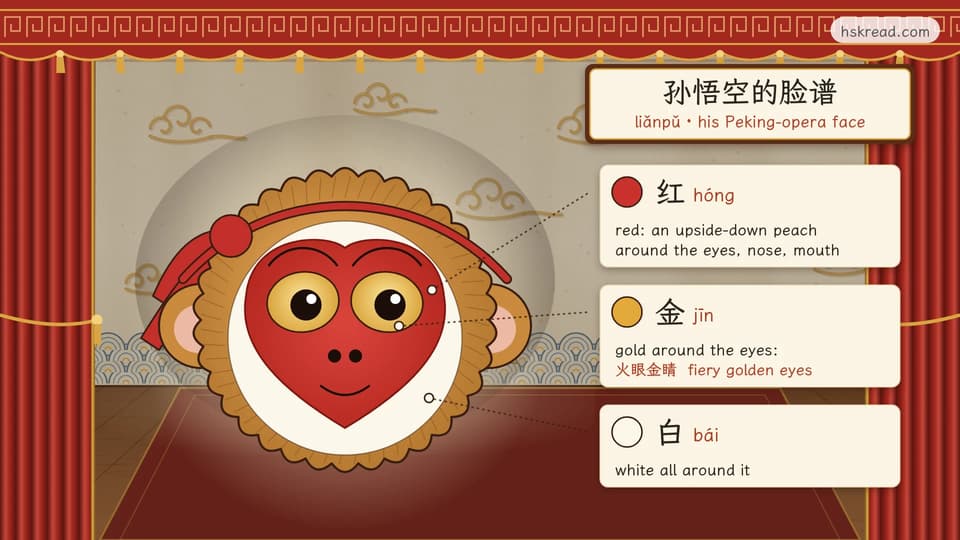
In 京剧 (jīngjù, Peking opera), the Monkey King wears a special painted face, or 脸谱 (liǎnpǔ, opera face paint). One classic pattern looks like an upside-down peach: red paint circles the eyes, nose and mouth, surrounded by white. Gold around the eyes stands for his 火眼金睛 and shows that he is no ordinary creature.
Film and TV
- The 1986 TV series. For many Chinese people, the Monkey King has the face of the actor 六小龄童 (Liù Xiǎo Líng Tóng), who played him in the CCTV series. (More about it in our Journey to the West guide.)
- Dragon Ball. Goku's name is the Japanese reading of 孙悟空, “Son Gokū,” and he is loosely based on the Monkey King—that is where the tail, the staff and the flying cloud come from.
- Cartoons and toys. From the classic Chinese animated film Havoc in Heaven (《大闹天宫》) to LEGO Monkie Kid, new generations keep meeting him on screen.
Black Myth: Wukong—the Monkey King video game
In 2024, the Monkey King became a gaming superstar. The action 游戏 (yóuxì, game) 黑神话:悟空 (Hēi Shénhuà: Wùkōng), made by the Chinese studio Game Science, came out on August 20, 2024. It sold about 10 million copies in its first three days and won Best Action Game at The Game Awards 2024. In the game, you play a monkey warrior called “the Destined One” on a journey inspired by the novel.
The game also sent players traveling in real life. Many of its beautiful temples, pagodas and statues were modeled on real ancient buildings—most of them in 山西 (Shānxī) Province, home to some of China's oldest wooden temples. After the game came out, young fans rushed to visit places like the Hanging Temple near Datong and the Yingxian Wooden Pagoda to see the “levels” for themselves.
Why do Chinese people love Sun Wukong?
Ask Chinese friends why they love the Monkey King, and here are some answers you will hear:
- He is 勇敢 (yǒnggǎn, brave). He fights anyone, from demons to the whole army of heaven.
- He is 聪明 (cōngming, clever). He uses tricks as often as his staff.
- He is a little 调皮 (tiáopí, naughty). He teases Pigsy, plays jokes and never stays still.
- He wants 自由 (zìyóu, freedom). He refuses to bow to anyone, and many readers see him as a 象征 (xiàngzhēng, symbol) of standing up to power.
- He is loyal (忠心, zhōngxīn). Even when the monk sends him away, he comes back to save him.
He is not perfect—he has a hot temper (脾气, píqi) and a big ego—and that is exactly why he feels so real. He starts as a wild 猴子 (hóuzi, monkey) who wants to live forever and ends as a Buddha who has learned to control himself. Many readers see his story as a story of growing up.
In the Chinese 生肖 (shēngxiào, zodiac), the Monkey (猴, hóu) stands for cleverness and energy, and in a Year of the Monkey, the Monkey King often shows up on posters and decorations. He is the 英雄 (yīngxióng, hero) every child wants to be.
Useful vocabulary
| Chinese | Pinyin | English |
|---|---|---|
| 孙悟空 | Sūn Wùkōng | Sun Wukong, the Monkey King |
| 美猴王 | Měi Hóuwáng | the Handsome Monkey King |
| 齐天大圣 | Qítiān Dàshèng | Great Sage Equal to Heaven |
| 猴子 | hóuzi | monkey |
| 花果山 | Huāguǒ Shān | the Mountain of Flowers and Fruit |
| 七十二变 | qīshí'èr biàn | the 72 transformations |
| 筋斗云 | jīndǒu yún | the cloud somersault |
| 金箍棒 | jīngū bàng | the gold-banded staff |
| 火眼金睛 | huǒyǎn jīnjīng | fiery golden eyes; sharp eyes |
| 紧箍咒 | jǐngū zhòu | the tight-headband spell; a strict control |
| 大闹天宫 | dà nào tiāngōng | havoc in heaven; to make a huge scene |
| 本领 | běnlǐng | skill; ability |
| 勇敢 | yǒnggǎn | brave |
| 调皮 | tiáopí | naughty; mischievous |
| 英雄 | yīngxióng | hero |
Next time someone sees through your excuse in a second, you will know what to call it: a pair of 火眼金睛.
Check your understanding
01What does Sun Wukong mean?
孙悟空 (Sūn Wùkōng) is the name his Taoist teacher gave him. 孙 comes from 猢狲 (húsūn), an old word for monkey, and is also a common surname. 悟空 means “awakened to emptiness,” a Buddhist idea. So the name is roughly “the monkey who understands emptiness.”
02What are Sun Wukong's powers?
In Journey to the West, he knows the 72 transformations (七十二变), can travel 108,000 li in one cloud somersault (筋斗云), fights with a magic staff that can grow or shrink (金箍棒), and has fiery golden eyes (火眼金睛) that see through any disguise. He can also turn his hairs into copies of himself.
03What is Sun Wukong's staff called?
Its full name is 如意金箍棒 (rúyì jīngū bàng), the “as-you-wish gold-banded staff.” He takes it from the Dragon King of the Eastern Sea. It weighs 13,500 jin (almost seven tonnes) and can shrink to the size of a needle, which he keeps inside his ear.
04Why was Sun Wukong trapped under a mountain?
After he made trouble in heaven—eating the peaches of immortality, stealing Laozi's magic pills and fighting the heavenly armies—the Buddha made a bet with him. Monkey could not even jump out of the Buddha's palm, so the Buddha turned his hand into Five Elements Mountain (五行山) and kept him under it for 500 years.
05Is Sun Wukong based on Hanuman?
Nobody knows for sure. Some people think the Indian monkey god Hanuman inspired him; others point to monkey-like creatures in old Chinese legends. Most people today think the Monkey King grew from many stories over centuries.
06Is Black Myth Wukong based on Sun Wukong?
Yes. 黑神话:悟空 (Black Myth Wukong), released in August 2024 by the Chinese studio Game Science, is an action game inspired by Journey to the West. The player is a monkey warrior called “the Destined One,” following in Sun Wukong's footsteps.