Chinese Shadow Puppetry (皮影戏): History, How It Works and How the Puppets Are Made
A beginner-friendly guide to Chinese shadow puppetry—what 皮影戏 means, the legend of Emperor Wu and Lady Li, how a show works behind the screen, how leather puppets are carved, regional styles, and how shadow play gave Chinese its word for “movie.”
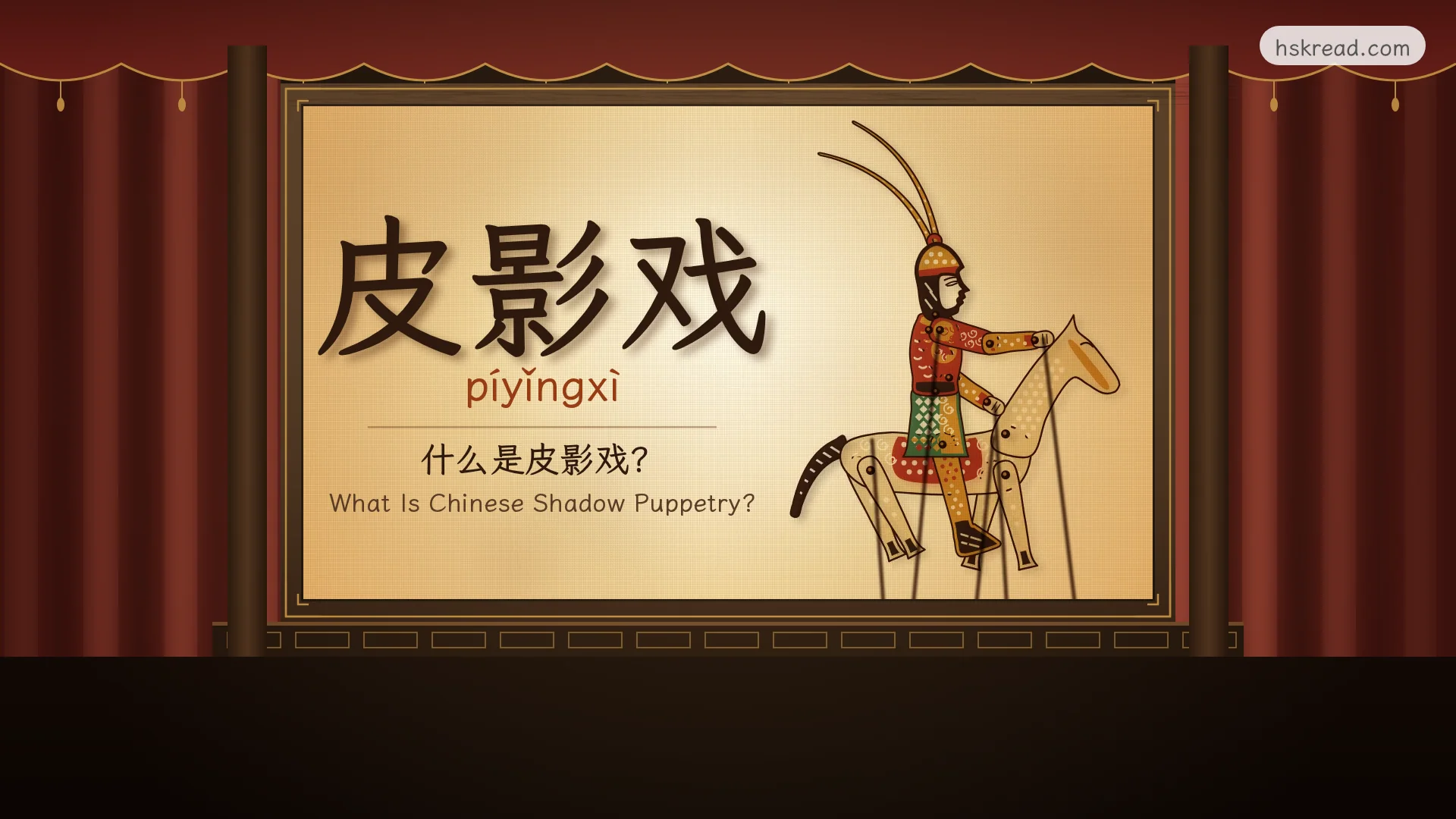
Picture a dark room in a Chinese village a hundred years ago. At the front is a small white screen, lit from behind by an oil lamp. Suddenly a general on horseback rides across the light, his armor glowing red and green. A drum crashes, a fiddle cries, and a singer's voice fills the room. Behind the screen, just a few people with bamboo sticks are bringing an entire army to life.
This is 皮影戏 (píyǐngxì), Chinese shadow puppetry. For centuries it was one of the most popular kinds of entertainment in China—a kind of movie long before movies. In fact, as you will see, it even gave Chinese its word for “movie.”
In this guide, you will learn what 皮影戏 means, how a show works, how the puppets are made, where it came from, and the useful Chinese words that go with it.
Key takeaways
- 皮影戏 means “leather shadow play”: colorful figures carved from leather are moved behind a lit screen.
- A puppet is usually controlled by three rods, and a whole troupe may be only seven to nine people.
- A detailed puppet can take thousands of cuts with tiny knives.
- A famous legend links it to a grieving emperor more than 2,000 years ago; real records start about a thousand years ago, in the Song dynasty.
- UNESCO added Chinese shadow puppetry to its intangible heritage list in 2011.
- The 影 in 电影 (movie) is the same 影 as in 皮影—Chinese movies are literally “electric shadows.”
- Today you can catch short shows in Xi'an, Chengdu and Tangshan—and even eat Sichuan's paper-thin “lamp-shadow beef.”
What does 皮影戏 mean?
The name has three characters:
| Character | Pinyin | Meaning |
|---|---|---|
| 皮 | pí | skin; leather |
| 影 | yǐng | shadow; image |
| 戏 | xì | play; show; opera |
So 皮影戏 is a “leather shadow play.” People also say 皮影 (píyǐng) for short, which can mean either the art or the puppets themselves. A single puppet is a 影人 (yǐngrén), a “shadow person”—a lovely name for a little leather actor.
Different regions have their own names:
| Name | Pinyin | Meaning | Where you hear it |
|---|---|---|---|
| 影戏 | yǐngxì | shadow play | the old general name |
| 灯影 | dēngyǐng | lamp shadows | Sichuan |
| 驴皮影 | lǘpíyǐng | donkey-skin shadows | Tangshan and eastern Hebei |
How a Chinese shadow play works
A shadow play needs only three things: a screen, a light and the puppets.
| Part | Chinese | Pinyin | What it is |
|---|---|---|---|
| screen | 亮子 | liàngzi | a frame covered with thin white paper or cloth |
| light | 灯 | dēng | an oil lamp in the past; electric lights today |
| puppet | 影人 | yǐngrén | a flat, jointed leather figure |
| rods | 签子 | qiānzi | thin sticks of bamboo (竹子) or wire that move the puppet |
The performers (演员, yǎnyuán) stand behind the screen, between the 灯光 (dēngguāng, light) and the cloth. They press each puppet flat against the screen, so the audience (观众, guānzhòng) on the other side sees a sharp, colorful 影子 (yǐngzi, shadow).
Because the leather is scraped so thin and almost 透明 (tòumíng, transparent), light shines through it like stained glass. This is what makes 皮影 different from 木偶 (mù'ǒu), the wooden puppets you see from the front.
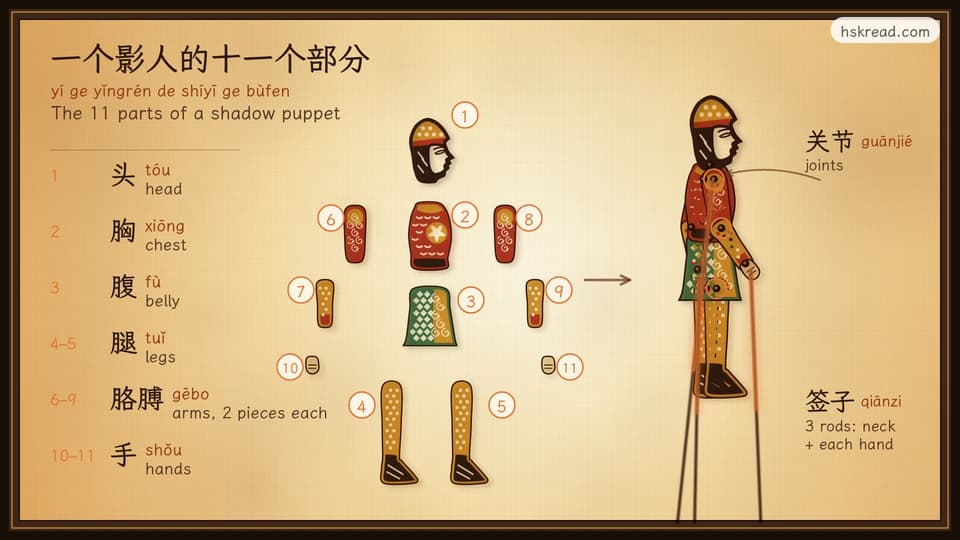
Most puppets are moved with three rods: one at the neck or chest that holds the body, and one at each hand. With five fingers, a skilled puppeteer works all three rods at once, making a figure walk, bow, wave a sword or ride a horse. Masters can even move two puppets at a time, one in each hand—a sword fight with no one else's help.
The troupe and the stories: seven people, an army of a million
How many people does it take to put a whole army on stage? In a shadow theater, fewer than ten.
A tiny troupe with a big sound
A traditional shadow troupe (剧团, jùtuán) is small. An old saying puts it like this:
七紧八慢九消停。
“Seven is tight, eight is easy, nine is relaxed.”
With seven people, a troupe can just manage a show; with nine, everyone can breathe. Together they handle the puppets, the singing and the musical instruments (乐器, yuèqì)—usually a Chinese fiddle, a lute, a loud 唢呐 (suǒnà, a Chinese horn) and plenty of 锣鼓 (luógǔ, gongs and drums).
One singer may voice many characters, young and old, male and female, switching voices in a second.
That is why people describe shadow puppeteers with a famous couplet:
一口叙说千古事,双手对舞百万兵。
“One mouth tells stories of a thousand years; two hands command an army of a million.”
What stories do they tell?
Shadow plays tell the same stories as Chinese opera (戏曲, xìqǔ): battles from the Three Kingdoms, the adventures of the Monkey King from 西游记 (Journey to the West), love stories like 白蛇传 (The Legend of the White Snake), and tales of loyal generals.
The Monkey King is a natural star of the shadow stage: he can somersault across the screen, change shape and fight a dozen demons at once. There are also short, funny plays for children.
How Chinese shadow puppets are made
A shadow puppet looks simple from the audience, but up close it is a work of 艺术 (yìshù, art)—and a 手艺 (shǒuyì, craft) that masters pass down to their students. Makers in Shaanxi usually use cowhide (牛皮, niúpí); in the Tangshan style, donkey hide (驴皮, lǘpí) is traditional.
Here is the journey from animal hide to hero:
- Prepare the hide. The skin is soaked in water and scraped again and again, until it is so thin that light shines through it.
- Draw the figure. The design is copied onto the leather with a steel needle. Many patterns have been handed down for generations.
- Carve. This is the hardest part. A master may use a dozen or more tiny knives (刀, dāo), and a detailed figure is often said to need thousands of cuts. Carving (雕刻, diāokè) a whole set of characters can take months.
- Color. Painters use a few pure colors (颜色, yánsè)—mainly red, yellow, green and black—because they glow beautifully when light passes through.
- Press and join. The pieces are heated and pressed flat, then joined together.
A puppet is usually made of about eleven parts: head, chest, belly, two legs, and two pieces for each arm plus two hands. The joints (关节, guānjié) are what make it move so smoothly. Fun detail: in many styles, the heads are separate and can be swapped onto different bodies, so one troupe can “cast” hundreds of characters from a few boxes of costumes and heads.
If you have seen Chinese paper cutting, you will notice the family resemblance: the same open, lacy patterns and the same love of symbols, just on leather instead of paper.
Regional styles of Chinese shadow puppetry
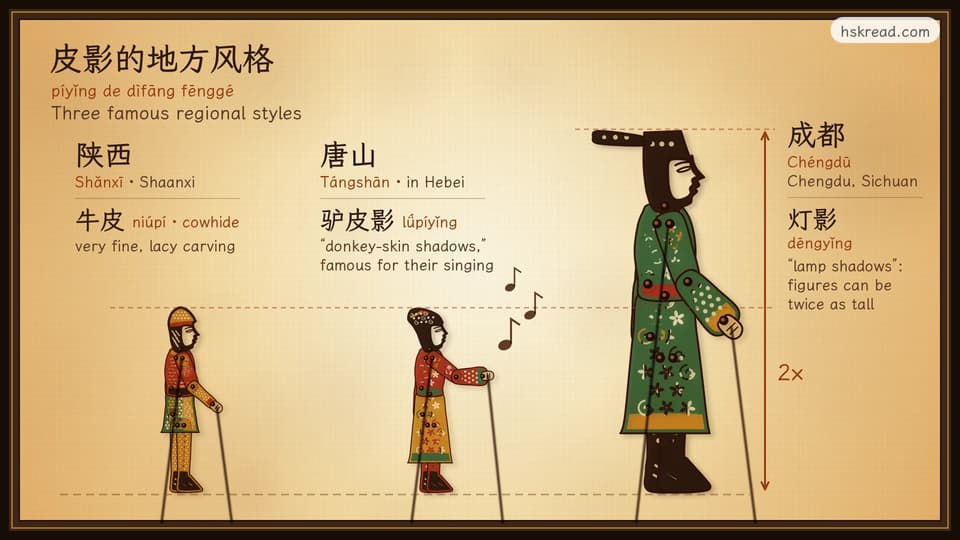
China has dozens of local shadow traditions, each with its own look and its own music. Three famous ones:
| Region | Style | What makes it special |
|---|---|---|
| 陕西 | Shaanxi shadows | cowhide figures with very fine, lacy carving; often called an old style |
| 河北 | Tangshan shadows | “donkey-skin shadows,” famous for their singing |
| 四川 | Sichuan 灯影 | “lamp shadows”; Chengdu figures can be twice as tall as northern ones |
The history of Chinese shadow puppetry: a legend and the Song dynasty
Did shadow puppetry begin with a heartbroken emperor? That is the legend—and the real story starts about a thousand years ago.
The legend: Emperor Wu and Lady Li
The most famous origin story is a 传说 (chuánshuō, legend) more than 2,000 years old. The 皇帝 (huángdì, emperor) 汉武帝 (Hàn Wǔdì, Emperor Wu of Han) loved a woman named 李夫人 (Lǐ Fūrén, Lady Li), who died young. The emperor could not stop missing her.
A magician promised he could bring her spirit back. One night he hung curtains and lit lamps, and the emperor, watching from a distance, saw the shape of a beautiful woman moving behind the cloth—just like Lady Li.
Later storytellers said the figure was really cut from cloth or leather and moved behind the curtain. Historians aren't sure there is any real link to shadow play, but it is a beautiful story, and many Chinese people still call it the beginning of 皮影戏.
The Song dynasty: the first blockbusters
The first reliable records come from the 宋朝 (Sòngcháo, Song dynasty), about a thousand years ago. Storytellers in the capital began making shadow figures to act out the wars of the 三国 (Sānguó, Three Kingdoms). Records say the first figures were cut from plain paper; later, craftsmen carved them from leather and painted them, so they would last longer.
Shadow plays became a hit in the busy entertainment districts of Song cities. The puppet makers even used faces to show character: loyal heroes (英雄, yīngxióng) were carved with handsome, upright faces, and villains with ugly ones—so even a child knew whom to cheer for.
One Song writer tells of a rich young man who loved shadow plays so much that he burst into tears every time the show reached the death of the hero 关羽 (Guān Yǔ). Some things never change: people still cry when their favorite character dies.
Village nights and Paris fashion: shadow play from the Ming dynasty to UNESCO
For centuries, the shadow troupe was the best night out in a Chinese village—and in the 1700s, “Chinese shadows” were the fashion in Paris.
Ming and Qing: the village night out
By the Ming and Qing dynasties, shadow troupes traveled from village to village all over northern China and beyond, carrying the whole theater in a few boxes. Every region developed its own puppet style, music and singing.
For many farmers, the visiting shadow troupe—at a festival, a temple fair (庙会, miàohuì) or a wedding—was the most exciting night of the year. Kids would crowd in front of the screen, and the bravest would sneak around the back to see how it worked.
Shadows go global
People often say that Chinese shadow play traveled west along the trade routes, though historians aren't sure of the exact path—and other countries in Asia have their own old shadow theaters. What is certain is that by the late 1700s, shadow shows called ombres chinoises, “Chinese shadows,” were the fashion in Paris. That is why “Chinese shadows” is still a name for shadow shows in French and Spanish today.
In 2011, UNESCO added Chinese shadow puppetry to its list of the Intangible Cultural Heritage of Humanity.
From shadow play to cinema: why a movie is an “electric shadow”
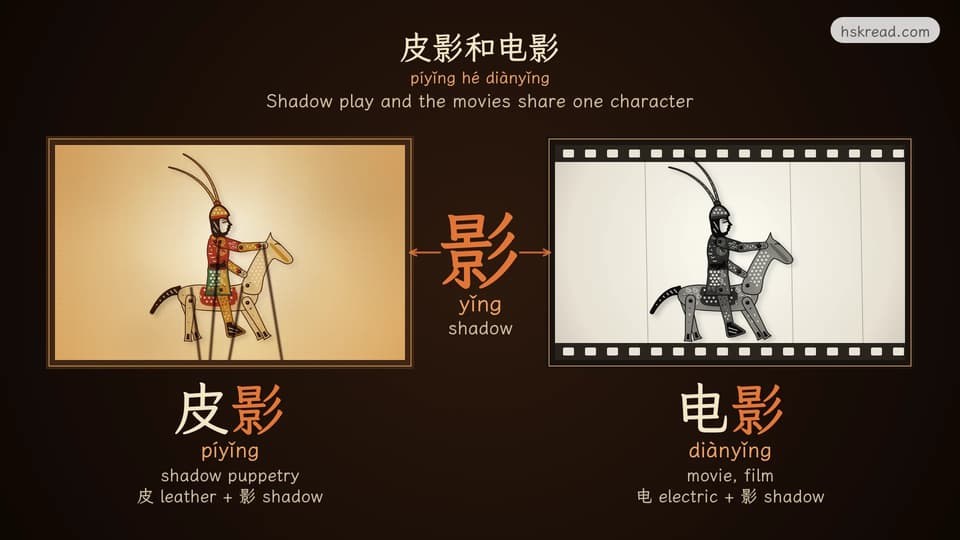
Here is a fun connection for Chinese learners. When foreign films were first shown in China at the end of the 1800s, people compared them to shadow plays and called them “Western shadow plays” (西洋影戏) or “electric-light shadow plays” (电光影戏). The shorter word 电影 (diànyǐng, “electric shadows”) won in the end.
So the 影 in 电影 is the same 影 as in 皮影—every time you say “movie” in Chinese, you are remembering shadow play.
Shadow puppets have shaped the 银幕 (yínmù, movie screen) in other ways too:
- Paper-cut animation: China's first paper-cut cartoon (动画片, dònghuàpiàn), Zhu Bajie Eats Watermelon (《猪八戒吃西瓜》, 1958), borrowed the jointed figures of shadow puppets.
- To Live (《活着》, 1994): In Zhang Yimou's famous film, the main character, 福贵 (Fúguì), earns his living as a shadow puppeteer, and his box of puppets follows the family through decades of change.
- Kung Fu Panda 2 (2011): The movie opens with the villain's backstory told in the style of a Chinese shadow play—colorful, flat, jointed figures behind a glowing screen.
The word 幕后 (mùhòu, “behind the curtain”) is useful far beyond the theater. 幕后英雄 (mùhòu yīngxióng) means “unsung hero,” someone who works hard behind the scenes—just like a shadow puppeteer.
Shadow puppetry in China today
Like many traditional arts, shadow puppetry has fewer audiences than it used to: TV, film and phones took over the village evenings. But it is far from gone.
- Shows for families: In cities like Xi'an, Chengdu and Tangshan, theaters and museums (博物馆, bówùguǎn) put on short shows, often with modern stories for children. Some let you go behind the screen afterward and try the rods yourself—harder than it looks!
- In schools: Some schools have shadow puppet clubs where students carve simple figures and perform for their classmates.
- Souvenirs: Colorful puppets are popular gifts. Many are hung in a window so the light shines through them.
- On the menu: In Sichuan, 灯影牛肉 (dēngyǐng niúròu, “lamp-shadow beef”) is 麻辣 (málà, numbing-spicy) beef sliced so thin that light passes through it—just like a shadow puppet.
- At home: You can try it yourself with a cardboard figure, two chopsticks, a sheet of paper and a flashlight. That is the whole idea of 皮影戏: a little light, a little shadow, and a good story.
If you enjoy folk arts that play with cut shapes and light, you may also like our guides to Chinese paper cutting and Chinese window paper cuts.
Useful vocabulary
| Chinese | Pinyin | English |
|---|---|---|
| 皮影戏 | píyǐngxì | shadow puppetry; shadow play |
| 皮影 | píyǐng | shadow puppet; shadow puppetry |
| 影人 | yǐngrén | a shadow puppet figure |
| 影子 | yǐngzi | shadow |
| 灯影 | dēngyǐng | lamp shadow; shadow play (Sichuan) |
| 牛皮 | niúpí | cowhide |
| 驴皮 | lǘpí | donkey hide |
| 亮子 | liàngzi | shadow-play screen |
| 签子 | qiānzi | stick; rod |
| 幕后 | mùhòu | behind the scenes |
| 电影 | diànyǐng | movie, film |
| 非遗 | fēiyí | intangible cultural heritage |
Next time you watch a 电影, remember the little leather heroes who were there first. 有机会,一定要去看一场皮影戏!
Check your understanding
01What is Chinese shadow puppetry called in Chinese?
It is called 皮影戏 (píyǐngxì), literally “leather shadow play,” or simply 皮影. Older names include 影戏 (“shadow play”), and in Sichuan people often call it 灯影 or 灯影戏 (“lamp shadow play”).
02Where did Chinese shadow puppetry come from?
A famous legend links it to Emperor Wu of Han (汉武帝) and his lost Lady Li, more than 2,000 years ago. The first reliable written records come from the Song dynasty, about a thousand years ago, when shadow plays were a hit in the cities.
03What are Chinese shadow puppets made of?
Most are carved from thin, scraped animal leather—usually cowhide in Shaanxi, and donkey hide in the Tangshan style, which is why it is also called 驴皮影 (“donkey-skin shadows”). Old records say the very first figures were cut from paper.
04How many people do you need for a shadow puppet show?
Traditional troupes are small. An old saying, 七紧八慢九消停, means that seven people is tight, eight is comfortable and nine is relaxed. They share the jobs of moving the puppets, singing and playing music.
05Is Chinese shadow puppetry a UNESCO heritage?
Yes. Chinese shadow puppetry (皮影戏) was added to UNESCO's Representative List of the Intangible Cultural Heritage of Humanity in 2011.
06What does 一口叙说千古事,双手对舞百万兵 mean?
It is a popular saying about shadow puppeteers—“One mouth tells stories of a thousand years; two hands command an army of a million.” One performer can voice many characters and move whole armies on a small screen.