Feng Shui (风水) Meaning: Chinese Origins, Basic Ideas and Home Customs
What does feng shui really mean? Learn where the word 风水 comes from, the ideas behind it—qi, yin and yang, the five elements—the classic "mountain behind, water in front" site, the home customs Chinese people talk about, and everyday phrases like 风水宝地.
In English, feng shui often means interior design: where to put your sofa, which color to paint the wall, why you should hang a crystal by the window. But in China, 风水 (fēngshuǐ) is much older and much bigger than that. It began as a way to choose the best place for a grave, and it shaped how Chinese people built houses, villages, palaces and whole cities.
Feng shui is a traditional belief, not a science. Still, you cannot really understand Chinese culture without it. Parents talk about it when they buy an apartment, grandparents talk about it when they move a bed, and everyone uses feng shui words in daily conversation. In this guide, you will learn what 风水 means, where the word comes from, its basic ideas and the customs and phrases you are most likely to hear.
Key takeaways
- 风水 literally means "wind and water."
- The word is traced to the Book of Burial (《葬书》): qi scatters with the wind and stops at water.
- Its main ideas are 气 (qi), 阴阳 (yin and yang) and the 五行 (five elements).
- The ideal site has a mountain behind and water in front, and faces south.
- Many Chinese families still follow simple home customs, like not facing a mirror toward the bed.
- Feng shui is a traditional belief and custom; there is no scientific evidence that it changes luck.
What does feng shui mean?
The name is just two everyday characters:
| Character | Pinyin | Meaning |
|---|---|---|
| 风 | fēng | wind |
| 水 | shuǐ | water |
Wind and water are the two forces that shape the land. Wind can blow things away; water can bring life to fields. In Mandarin, 风水 is pronounced fēngshuǐ—roughly "fung shway," not "feng shoe-ee."
An older and more formal name for the same practice is 堪舆 (kānyú), literally "heaven and earth." Today you will mostly see it in books. In everyday speech, people say 风水.
Where the word comes from
The word 风水 is usually traced to a short classic called the 《葬书》 (Zàng Shū), the Book of Burial. It is traditionally credited to 郭璞 (Guō Pú, 276–324), a scholar of the Jin dynasty, although many scholars believe it was written later, in the Tang or Song dynasty, and only carries his name. The key lines say:
气乘风则散,界水则止。古人聚之使不散,行之使有止,故谓之风水。
"Qi scatters when it rides the wind and stops when it meets water. The ancients gathered it so it would not scatter, and guided it so it would stop. That is why it is called feng shui."
In other words, feng shui is about 气 (qì), an invisible "life energy" that people believed flows through the land. Wind blows it away; water holds it in place. A good place, in this belief, is one where qi gathers and stays: protected from strong wind and close to water.
The basic ideas behind feng shui
气: qi, the "breath" of the land
You may know 气 from tai chi or Chinese medicine. In feng shui, qi is imagined as flowing along hills and rivers like blood through the body. Mountain ridges are called 龙 (lóng, "dragons") because they wind across the land, and finding a good spot is called 寻龙点穴 (xún lóng diǎn xué), "following the dragon and finding the point."
阴阳: yin and yang
Feng shui also uses the idea of 阴 (yīn) and 阳 (yáng): two sides that need each other, like shade and sunlight, still and moving, mountain and water. A good site, people say, has both in balance. Graves are called 阴宅 (yīnzhái, "yin homes") and houses for the living are 阳宅 (yángzhái, "yang homes").
五行: the five elements
The 五行 (wǔxíng) are five basic "phases" that ancient Chinese thinkers used to describe how things change. In feng shui, each one is linked to a direction and a color:
| Element | Pinyin | Meaning | Direction | Color |
|---|---|---|---|---|
| 木 | mù | wood | 东 dōng, east | 绿色 lǜsè, green |
| 火 | huǒ | fire | 南 nán, south | 红色 hóngsè, red |
| 土 | tǔ | earth | 中 zhōng, center | 黄色 huángsè, yellow |
| 金 | jīn | metal | 西 xī, west | 白色 báisè, white |
| 水 | shuǐ | water | 北 běi, north | 黑色 hēisè, black |
The elements "produce" each other in a circle—wood feeds fire, fire makes ash (earth), earth holds metal, metal collects water, and water feeds wood. They also "control" each other: water puts out fire, for example. In this system, yellow belongs to earth and the center—the emperor's place. That is one reason the roofs of the Forbidden City are yellow.
The four guardians
Old feng shui books describe the perfect site with four animals, each guarding one side:
| Side | Animal | Chinese | Pinyin | What it should be |
|---|---|---|---|---|
| left (east) | Azure Dragon | 青龙 | qīnglóng | a lower ridge of hills |
| right (west) | White Tiger | 白虎 | báihǔ | a lower ridge of hills |
| front (south) | Vermilion Bird | 朱雀 | zhūquè | open land and water |
| back (north) | Black Tortoise | 玄武 | xuánwǔ | a tall mountain |
Picture an armchair: a high back, two arms on the sides and open space in front. That is the shape feng shui looks for.
The ideal spot: mountain behind, water in front
The two most famous feng shui rules are:
| Rule | Pinyin | Meaning |
|---|---|---|
| 背山面水 | bèi shān miàn shuǐ | with a mountain behind and water in front |
| 坐北朝南 | zuò běi cháo nán | sitting in the north, facing south |
If you think about northern China's climate, these rules make practical sense. In 冬天 (dōngtiān, winter), cold winds blow from the north, so a hill behind a village gives shelter. In the Northern Hemisphere, the sun shines from the south, so south-facing houses get more 阳光 (yángguāng, sunshine) all day. A river in front gives water for drinking and farming. That is why traditional houses, temples and palaces across northern China face south.
A place with all these qualities is called a 风水宝地 (fēngshuǐ bǎodì), "a treasure spot with good feng shui." Today people use the phrase for any place that is beautiful, comfortable or lucky.
The feng shui compass: 罗盘
A feng shui master's most famous tool is the 罗盘 (luópán), a round compass with a magnetic needle in the middle and many rings of characters around it: directions, the eight trigrams, the five elements and more. Some 罗盘 have dozens of rings.
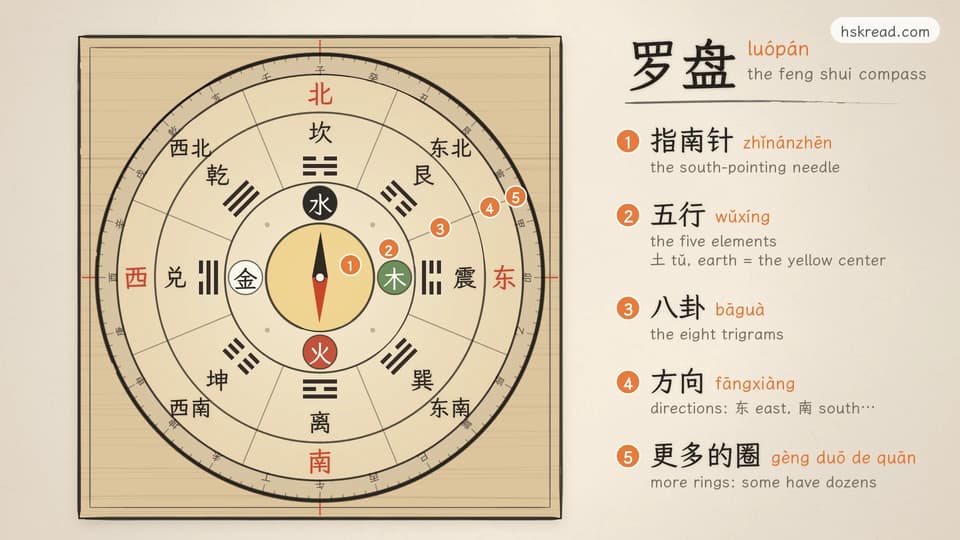
The everyday Chinese word for a compass is 指南针 (zhǐnánzhēn), literally "south-pointing needle"—Chinese compasses were thought of as pointing south, not north. And here is a surprising fact: China's earliest magnetic "compass," the 司南 (sīnán), is often pictured as a lodestone spoon spinning on a bronze plate (a famous modern reconstruction). Many historians believe early Chinese compasses were used for divination and siting buildings long before they were used to steer ships.
Feng shui in Chinese history
For most of history, feng shui was mainly about graves, 坟墓 (fénmù). Families believed that burying their 祖先 (zǔxiān, ancestors) in a good spot would bring blessings to their children and grandchildren. Emperors took this very seriously: the site of the Ming Tombs (明十三陵) north of Beijing was chosen with feng shui in mind, in a valley with mountains on three sides.
Cities and palaces followed the same ideas. The Forbidden City is the classic example. It faces south, and behind it stands 景山 (Jǐngshān), a hill built from the earth dug out for the palace moat. In front, the curving 金水河 (Jīnshuǐ Hé, Golden Water River) flows past the main gate. Mountain behind, water in front—built by hand when nature did not provide them.
In the 20th century, feng shui was criticized as 迷信 (míxìn, "superstition"), and for many years it almost disappeared from public life in mainland China. Today it is seen more as part of China's 传统 (chuántǒng, tradition) and folk culture. Some people believe in it strongly, many treat it as "better safe than sorry," and many young people see it as an interesting tradition rather than a rule.
Home feng shui: customs Chinese people talk about
When a Chinese family moves into a new apartment, someone—often a grandparent—will probably have opinions about where things go. Here are the customs you are most likely to hear about. They are traditional beliefs, explained the way people explain them, not proven facts.
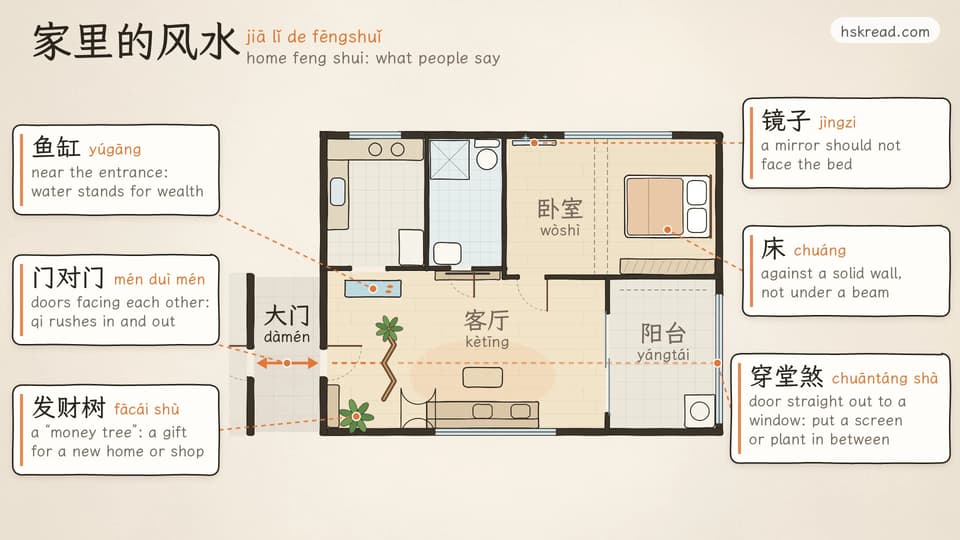
| Custom | What people say | The usual reason given |
|---|---|---|
| Front door | The front door should not face straight into another door or a long corridor. | Qi—or money—rushes in and out too fast. |
| Straight through | If you can see from the front door straight out of a back 窗户 (chuānghu, window) or 阳台 (yángtái, balcony), it is called 穿堂煞 (chuāntáng shà). | Good luck "flows straight out." People put a screen or plant in between. |
| Mirrors | Don't place a mirror (镜子) facing the bed. | It is said to disturb sleep and "reflect away" good energy; waking up to your own reflection at night can also be a fright. |
| Bed | Put the 床 (chuáng, bed) against a solid wall, not under a beam, and don't point your feet at the door. | A wall behind you feels safe; a beam overhead feels heavy; feet toward the door is how coffins were once carried out. |
| Fish tank | A 鱼缸 (yúgāng) near the entrance or in the 客厅 (kètīng, living room) is popular. | Water stands for wealth, and goldfish are lucky. |
| Plants | Green 植物 (zhíwù, plants) like the 发财树 (fācái shù, "money tree") are common gifts for a new home or shop. | Healthy plants mean growing luck; dead plants should be removed. |
| Clutter | Keep the entrance clean and bright. | Qi cannot flow through a messy, dark space. |
You may notice that many of these customs also make simple sense: a bright, tidy room with fresh air and a bed against a wall is just nice to live in. That is one reason feng shui survives—people can follow it without worrying too much about whether it "works."
Is feng shui real? Belief, custom and science
So, does feng shui work? There is no scientific evidence that the position of a door or a mirror changes your health, wealth or 运气 (yùnqi, luck). Scientists generally see feng shui as a traditional belief system, not 科学 (kēxué, science).
But feng shui is still worth learning about. It records how people in the past read the land—where the wind came from, where the sun shone, where water flowed. It shaped some of China's most beautiful buildings. And it lives on in the Chinese language. You can enjoy all of that without believing that a goldfish will make you rich.
If someone in China gives you feng shui advice, the polite answer is a smile and a "谢谢" (xièxie). It is usually a sign that they care about you.
Feng shui in everyday Chinese
Even people who do not believe in feng shui use these words all the time:
| Phrase | Pinyin | Meaning |
|---|---|---|
| 看风水 | kàn fēngshuǐ | to check the feng shui of a place |
| 风水先生 | fēngshuǐ xiānsheng | a feng shui master (traditional term) |
| 风水师 | fēngshuǐshī | a feng shui master (modern term) |
| 风水好 | fēngshuǐ hǎo | (a place) has good feng shui; is lucky |
| 风水宝地 | fēngshuǐ bǎodì | a treasure spot; a perfect place |
| 风水轮流转 | fēngshuǐ lúnliú zhuàn | luck takes turns; everyone's time will come |
风水轮流转 is especially useful. It means that good fortune moves around—today it is with you, tomorrow with someone else. You can use it to encourage a friend who just lost a game, or to remind a winner not to be too proud.
Useful vocabulary
| Chinese | Pinyin | English |
|---|---|---|
| 风水 | fēngshuǐ | feng shui; "wind and water" |
| 气 | qì | qi; vital energy |
| 阴阳 | yīnyáng | yin and yang |
| 五行 | wǔxíng | the five elements |
| 背山面水 | bèi shān miàn shuǐ | mountain behind, water in front |
| 坐北朝南 | zuò běi cháo nán | facing south |
| 罗盘 | luópán | feng shui compass |
| 风水宝地 | fēngshuǐ bǎodì | a treasure spot with good feng shui |
| 看风水 | kàn fēngshuǐ | to check the feng shui |
| 风水先生 | fēngshuǐ xiānsheng | feng shui master |
| 风水轮流转 | fēngshuǐ lúnliú zhuàn | luck takes turns |
| 镜子 | jìngzi | mirror |
| 鱼缸 | yúgāng | fish tank |
| 迷信 | míxìn | superstition; superstitious |
Wind, water and a little imagination: that is feng shui. Next time you hear someone say a place is a 风水宝地, you will know exactly what they mean.
Check your understanding
01What does feng shui mean?
风水 (fēngshuǐ) literally means "wind and water." It is a traditional Chinese practice of choosing and arranging places—graves, houses, rooms—so that they are believed to bring good fortune.
02Where does the word feng shui come from?
The word is traced to the Book of Burial (《葬书》), traditionally credited to Guo Pu of the Jin dynasty, which says qi "scatters when it rides the wind and stops when it meets water." Many scholars think the book was actually written later, in the Tang or Song dynasty.
03How do you pronounce feng shui?
In Mandarin it is fēngshuǐ, roughly "fung shway." The first syllable has a high, flat tone and the second a dipping tone.
04Is feng shui scientific?
No. Feng shui is a traditional belief and cultural custom, and there is no scientific evidence that it changes luck. Some of its rules overlap with common sense, like sunlight, fresh air and a tidy home.
05What does 风水宝地 mean?
风水宝地 (fēngshuǐ bǎodì) means "a treasure spot with good feng shui." People use it for a place that is beautiful, comfortable or lucky—a great home, a scenic town or even a good seat in the office.
06What does 风水轮流转 mean?
风水轮流转 (fēngshuǐ lúnliú zhuàn) means "feng shui takes turns." It says good luck does not stay with one person forever, so your turn will come. People use it to cheer someone up or to warn a winner not to be too proud.