The Terracotta Army (兵马俑): Facts, History and How to Visit It in Xi'an
Everything you need to know about the Terracotta Army—what 兵马俑 means, how farmers found it in 1974, how many warriors there are, the three pits, painted faces and bronze weapons, the unopened tomb and its mercury rivers, and tips for visiting Xi'an.
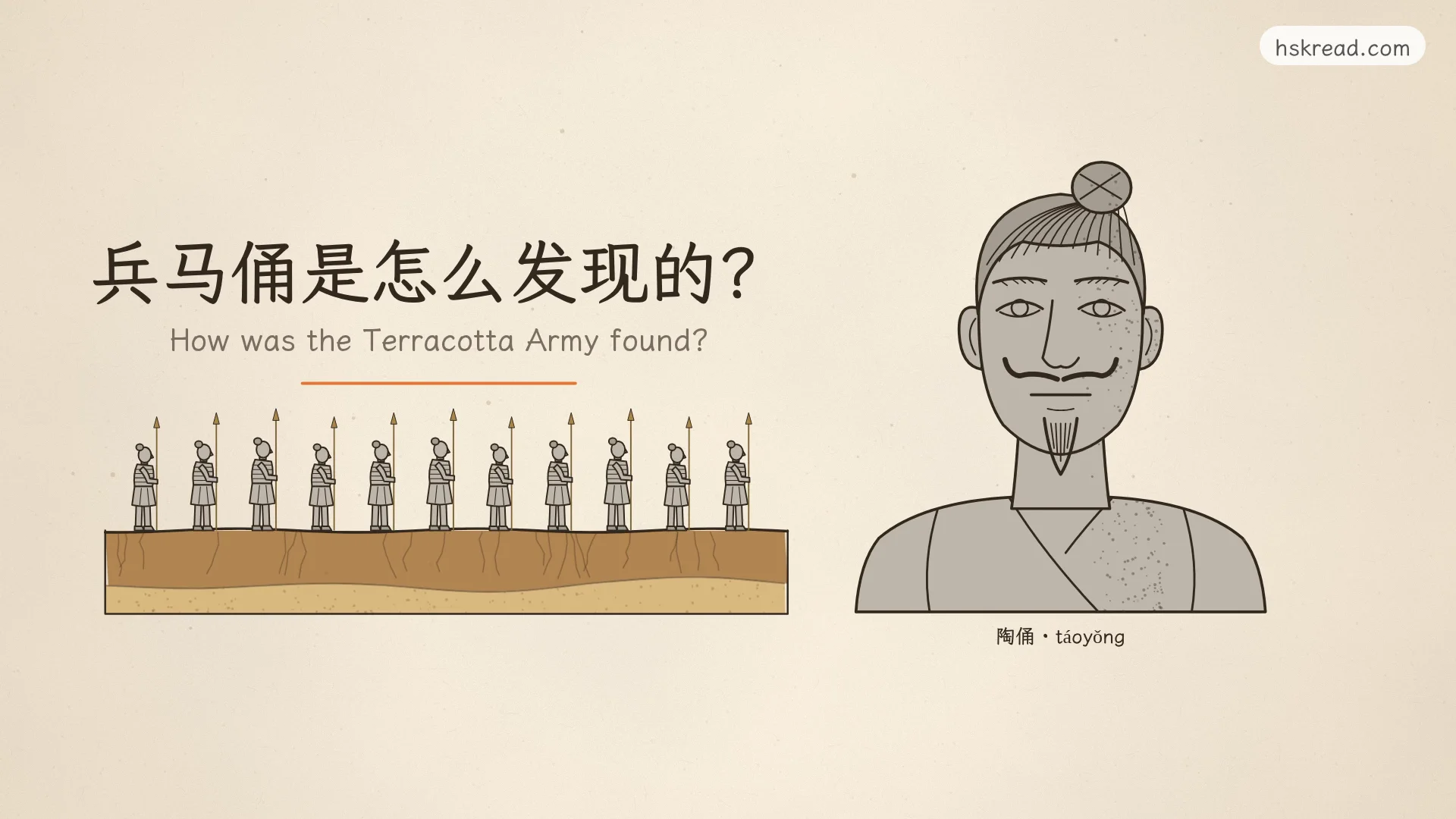
In the spring of 1974, the countryside east of Xi'an was suffering from a 干旱 (gānhàn, drought). Crops were dying, and the 农民 (nóngmín, farmers) of a small village decided to dig a well. About four meters down, one of them hit something hard: a clay head with open eyes. Nobody guessed it then, but they had found one of the greatest archaeological discoveries of the 20th century.
They had found the 兵马俑 (bīngmǎyǒng), the Terracotta Army: thousands of life-size clay soldiers and horses, buried more than 2,200 years ago to guard the tomb of China's first emperor. In this guide, you will learn what 兵马俑 means, how it was found, how many warriors there are, why every face is different, what is still hidden underground, and how to visit it in Xi'an.
Key takeaways
- 兵马俑 means “soldier and horse figures.” They were made for the tomb of 秦始皇, the first emperor of China.
- Farmers digging a well found the first pieces in March 1974.
- Three main pits hold an estimated 8,000+ soldiers, plus chariots and horses. Most are still underground.
- The figures were made with molds, but each face was finished by hand, and they were once brightly painted.
- The emperor's own tomb mound has never been opened. An ancient record says it holds rivers of mercury.
- The site became a UNESCO World Heritage Site in 1987. It is about an hour from central Xi'an.
What does 兵马俑 mean?
| Character | Pinyin | Meaning |
|---|---|---|
| 兵 | bīng | soldier |
| 马 | mǎ | horse |
| 俑 | yǒng | a figure buried in a tomb |
So 兵马俑 is literally “soldier and horse tomb figures.” The full name is 秦始皇兵马俑 (Qín Shǐhuáng bīngmǎyǒng), the “Terracotta Warriors and Horses of Qin Shi Huang.” In English, people say both Terracotta Army and Terracotta Warriors.
The character 俑 is rare in daily life. You will mostly see it in museums. The material, terracotta, is 陶 (táo), as in 陶瓷 (táocí, “ceramics”), so you will also hear 陶俑 (táoyǒng, “pottery figure”).
Who built the Terracotta Army—and why?
The army belongs to Qin Shi Huang (秦始皇), the king of Qin who unified China in 221 BC and made himself the first emperor. He died in 210 BC. (For his life, reforms and search for immortality, see our guide to Qin Shi Huang.)
Work on his tomb began when he became king as a teenager and went on for decades. According to the historian 司马迁 (Sīmǎ Qiān), more than 700,000 workers were involved. The most common explanation for the clay army is that the emperor wanted his soldiers with him in the afterlife: to protect him, and perhaps to let him keep ruling from his tomb. The soldiers in the main pits face east, the direction of the states he had conquered.
How was the Terracotta Army discovered?
In March 1974, a farmer named 杨志发 (Yáng Zhìfā), his brothers and a neighbor were digging a well near 西杨村 (Xīyáng Cūn, Xiyang Village) in Lintong (临潼), east of Xi'an. They found broken pieces of clay figures and bronze arrowheads. At first, some villagers thought the figure was a kind of temple god, and nobody knew how old it was.
A local museum worker, 赵康民 (Zhào Kāngmín), recognized that the pieces came from the Qin dynasty and started putting them back together. Soon, experts in 考古 (kǎogǔ, archaeology) arrived. Excavation of the first pit began the same year, and in 1979 the museum opened to the public above the pit where the soldiers were found.
Yang Zhifa later became a kind of celebrity at the museum, signing books for visitors. In 1998 he even met U.S. President Bill Clinton.
How many terracotta warriors are there?
Nobody knows the exact number, because most of the army is still 地下 (dìxià, underground). A widely cited estimate from 2007 says the three main pits hold more than 8,000 soldiers, 130 chariots with 520 horses, and 150 cavalry horses. The three pits are about 1.5 kilometers east of the emperor's tomb mound.
| Pit | Size | What is inside |
|---|---|---|
| Pit 1 | about 230 m × 62 m (14,260 m²) | the main army: an estimated 6,000+ infantry figures and horses in battle lines |
| Pit 2 | about 6,000 m² | a mixed force: kneeling and standing archers, cavalry and chariots |
| Pit 3 | about 520 m² | the command post: 68 figures, one chariot with four horses |
Pit 1 (一号坑, yī hào kēng) is the famous one: a hall the size of two football fields, with rows of soldiers standing in long trenches. Fewer than 2,000 of them have been excavated and put back on their feet. Pit 2 shows how different units worked together. Pit 3 is small, but it contains officers facing each other, as if holding a meeting. A fourth pit was dug but left empty, probably because work stopped when the Qin dynasty collapsed.
Many of the soldiers were found broken into pieces. Restorers have spent years putting them back together like 3D puzzles. This work is called 修复 (xiūfù, restoration), and it is still going on today.
Types of terracotta warriors
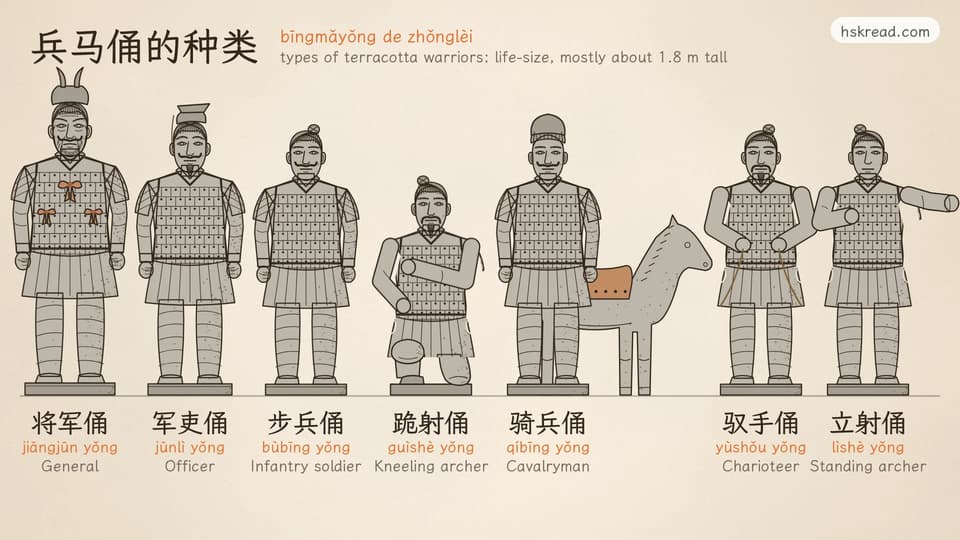
The 士兵 (shìbīng, soldiers) are life-size, mostly around 1.8 meters (about 6 feet) tall, and their uniforms, hairstyles and poses show their rank and job in the 军队 (jūnduì, army):
| Type | Chinese | Pinyin | How to recognize it |
|---|---|---|---|
| General | 将军俑 | jiāngjūn yǒng | the tallest, with a special hat and armor with ribbons |
| Officer | 军吏俑 | jūnlì yǒng | a flat hat, more detailed armor |
| Infantry soldier | 步兵俑 | bùbīng yǒng | standing, often with hair in a bun and no helmet |
| Kneeling archer | 跪射俑 | guìshè yǒng | kneeling on one knee, ready to shoot a crossbow |
| Standing archer | 立射俑 | lìshè yǒng | standing sideways, like an archer taking aim |
| Cavalryman | 骑兵俑 | qíbīng yǒng | standing next to a saddled horse |
| Charioteer | 驭手俑 | yùshǒu yǒng | arms stretched forward, holding the reins |
The kneeling archer from Pit 2 is a favorite. Its hair, clothes and even the tread on the soles of its shoes are clearly visible. One kneeling archer is often said to be the only figure found complete, without needing any repair.
Are all the terracotta warriors different?
This is one of the most common questions, and the answer is mostly yes. The bodies were made in parts, such as legs, bodies, arms and heads, using a limited number of molds, a bit like an ancient production line. Then 工匠 (gōngjiàng, craftsmen) added clay by hand and carved the details of each 脸 (liǎn, face): mustaches, 胡子 (húzi, beards), eyebrows, hairstyles and 表情 (biǎoqíng, facial expressions). Some faces look young, some look old; some look serious, some almost smile.
Researchers sort the faces into a few basic types, but so far nobody has found two that are exactly the same. Some people believe each face was based on a real soldier. It is a lovely idea, but there is no way to prove it.
Were the terracotta warriors painted?
Yes. Today they are all gray-brown, but they were once brightly colored. Their 颜色 (yánsè, colors) were part of what made each soldier look alive. Workers first covered each figure with a layer of lacquer (漆, qī), then painted it with colors like red, green, blue, pink, purple and white. One pigment was Han purple, a man-made color invented in ancient China.
Sadly, when archaeologists dig the figures out of the damp soil, the lacquer meets the dry 空气 (kōngqì, air), dries and curls up, and the paint can flake off within minutes. This is one reason excavation is so slow. Today, 科学家 (kēxuéjiā, scientists) use special chemicals to 保护 (bǎohù, protect) the colors on newly found figures, and some warriors with clear traces of paint are on display.
Real bronze weapons
The army carried real 武器 (wǔqì, weapons) made of bronze (青铜, qīngtóng): 剑 (jiàn, swords), spears, halberds, crossbow triggers and as many as 40,000 arrowheads. Some swords were still shiny when they were dug up.
For years, people said Qin craftsmen had invented a chromium coating to stop rust. A 2019 study by Chinese and British scientists showed this was a myth. The chromium came from the lacquer on nearby wooden parts, and the weapons survived mainly because of the soil and the bronze itself.
The emperor's tomb: still unopened
The Terracotta Army is only one part of a huge burial complex. At its center is the tomb mound of Qin Shi Huang, the 秦始皇陵 (Qín Shǐhuáng líng), a man-made hill about 50 meters high at the foot of Mount Li (骊山). It is covered with trees and looks like a natural hill. Nobody has entered the burial chamber.
Sima Qian described what is inside: palaces and treasures, a ceiling showing the stars, and the rivers and seas of China made with flowing mercury (水银, shuǐyín). He even wrote that crossbows were set up to shoot anyone who broke in.
Is it true? Nobody knows yet, but modern soil tests on the mound have found mercury levels much higher than normal, which fits his story. Archaeologists have decided not to open the tomb for now. They say today's 技术 (jìshù, technology) could not protect the fragile 文物 (wénwù, cultural relics) inside once they meet the air, and the mercury could be 危险 (wēixiǎn, dangerous).
Nearby, archaeologists have found other pits with clay acrobats, officials, birds and two half-size bronze chariots (铜车马, tóngchēmǎ), discovered in 1980. These beautiful chariots are on display in the museum.
A world wonder
In 1987, UNESCO added the Mausoleum of the First Qin Emperor, including the Terracotta Army, to its World Heritage List. It was one of the first World Heritage Sites in China.
People often call the army the 世界第八大奇迹 (shìjiè dì-bā dà qíjì), “the eighth wonder of the world.” The nickname is usually credited to Jacques Chirac, the former French prime minister, who visited in 1978.
How to visit the Terracotta Army in Xi'an
The Terracotta Army is in Lintong District, about 35–40 kilometers east of central 西安 (Xī'ān), the capital of Shaanxi Province. The official name of the site is 秦始皇帝陵博物院 (Qín Shǐhuángdì Líng Bówùyuàn, Emperor Qinshihuang's Mausoleum Site Museum).
Tickets. An adult ticket costs 120 yuan and covers both the Terracotta Army museum and Lishan Garden (丽山园), the park around the emperor's tomb mound. A shuttle bus links the two. You must book online with your real name; foreign visitors use their 护照 (hùzhào, passport) number. Bring the same passport on the day.
Opening hours. From mid-March to mid-November, the last entry is at 5:00 p.m.; in winter it is 4:30 p.m. The site opens at 8:30 a.m. Hours change on holidays, so check the official website or WeChat account before you go.
Getting there.
- Metro + bus: Take the Xi'an 地铁 (dìtiě, subway) Line 9 to Huaqingchi Station (华清池站), then a short local bus ride to the museum.
- Tourist bus: The direct tourist bus to the Terracotta Army, often signed 游5 (306), is cheap and popular. Use only the official bus and check the current departure point locally.
- Taxi or ride-hailing: About 45 minutes to an hour from the city center, depending on traffic.
Tips for your visit.
- Go early. Arrive at opening time to avoid the biggest crowds, especially in summer and during Chinese holidays.
- Plan half a day. The pits and exhibition halls take about two to three hours; Lishan Garden takes more.
- Save Pit 1 for last. Many guides suggest visiting Pit 3 and Pit 2 first, then ending with the huge army in Pit 1.
- Get a 导游 (dǎoyóu, tour guide) or audio guide. The pits look like rows of statues until someone explains what you are seeing.
- Combine your trip. The Huaqing Palace (华清宫), famous for its 温泉 (wēnquán, hot springs), is nearby, so many visitors see both on the same day.
While you are in Xi'an, don't miss the old 城墙 (chéngqiáng, city wall), which you can ride a 自行车 (zìxíngchē, bicycle) on top of, the food streets of the 回民街 (Huímín Jiē, Muslim Quarter), and local 小吃 (xiǎochī, snacks) like 肉夹馍 (ròujiāmó, a meat-filled flatbread) and 凉皮 (liángpí, cold noodles). Xi'an was the capital of China for many dynasties and is full of history.
Useful phrases for your trip:
| Chinese | Pinyin | English |
|---|---|---|
| 去兵马俑怎么走? | Qù Bīngmǎyǒng zěnme zǒu? | How do I get to the Terracotta Army? |
| 一张门票多少钱? | Yì zhāng ménpiào duōshao qián? | How much is one ticket? |
| 这是几号坑? | Zhè shì jǐ hào kēng? | Which pit is this? |
| 可以拍照吗? | Kěyǐ pāizhào ma? | Can I take photos? |
Useful vocabulary
| Chinese | Pinyin | English |
|---|---|---|
| 兵马俑 | bīngmǎyǒng | the Terracotta Army |
| 秦始皇 | Qín Shǐhuáng | Qin Shi Huang, the first emperor |
| 秦始皇陵 | Qín Shǐhuáng líng | the tomb of Qin Shi Huang |
| 士兵 | shìbīng | soldier |
| 陶俑 | táoyǒng | pottery tomb figure |
| 坑 | kēng | pit |
| 发现 | fāxiàn | to discover |
| 考古 | kǎogǔ | archaeology |
| 青铜 | qīngtóng | bronze |
| 水银 | shuǐyín | mercury |
| 博物馆 | bówùguǎn | museum |
| 门票 | ménpiào | admission ticket |
| 西安 | Xī'ān | Xi'an |
Two thousand years ago, these soldiers were buried to guard one man forever. Today, they welcome visitors from all over the world. 欢迎来西安!
Check your understanding
01What is the Terracotta Army?
The Terracotta Army (兵马俑, bīngmǎyǒng) is a huge collection of life-size clay soldiers, horses and chariots buried near the tomb of Qin Shi Huang, the first emperor of China, who died in 210 BC. It lies outside Xi'an in Shaanxi Province.
02When and how was the Terracotta Army discovered?
In March 1974, during a drought, farmers from Xiyang Village near Xi'an were digging a well. About four meters down they found pieces of a clay figure and bronze arrowheads. Archaeologists soon realized it was part of a vast underground army.
03How many terracotta warriors are there?
Archaeologists estimate the three main pits hold more than 8,000 soldiers, about 130 chariots with 520 horses, and 150 cavalry horses. Only part of them has been dug up; most are still underground.
04Are all the terracotta warriors different?
Their bodies were made from a limited number of molds, but craftsmen finished each face by hand, adding details like beards, eyebrows and hairstyles. So far, archaeologists have not found two faces that are exactly the same.
05Why hasn't Qin Shi Huang's tomb been opened?
Archaeologists worry they could not protect fragile objects, like painted surfaces and silk, once they are exposed to air. Soil tests also show unusually high levels of mercury, which fits an ancient record of rivers of mercury inside the tomb.
06How much is a ticket to the Terracotta Army?
An adult ticket to Emperor Qinshihuang's Mausoleum Site Museum costs 120 yuan and also covers Lishan Garden, the area around the tomb mound. You must book online with your real name and passport. Check the official channels for current prices and hours.