Beijing (北京): Name Meaning, History, Hutongs, Food and Dialect
What does Beijing mean, and why was it once called Peking? A learner-friendly guide to China's capital—its old names, how it became the capital, the Central Axis, hutongs, food, the Beijing accent and useful phrases.
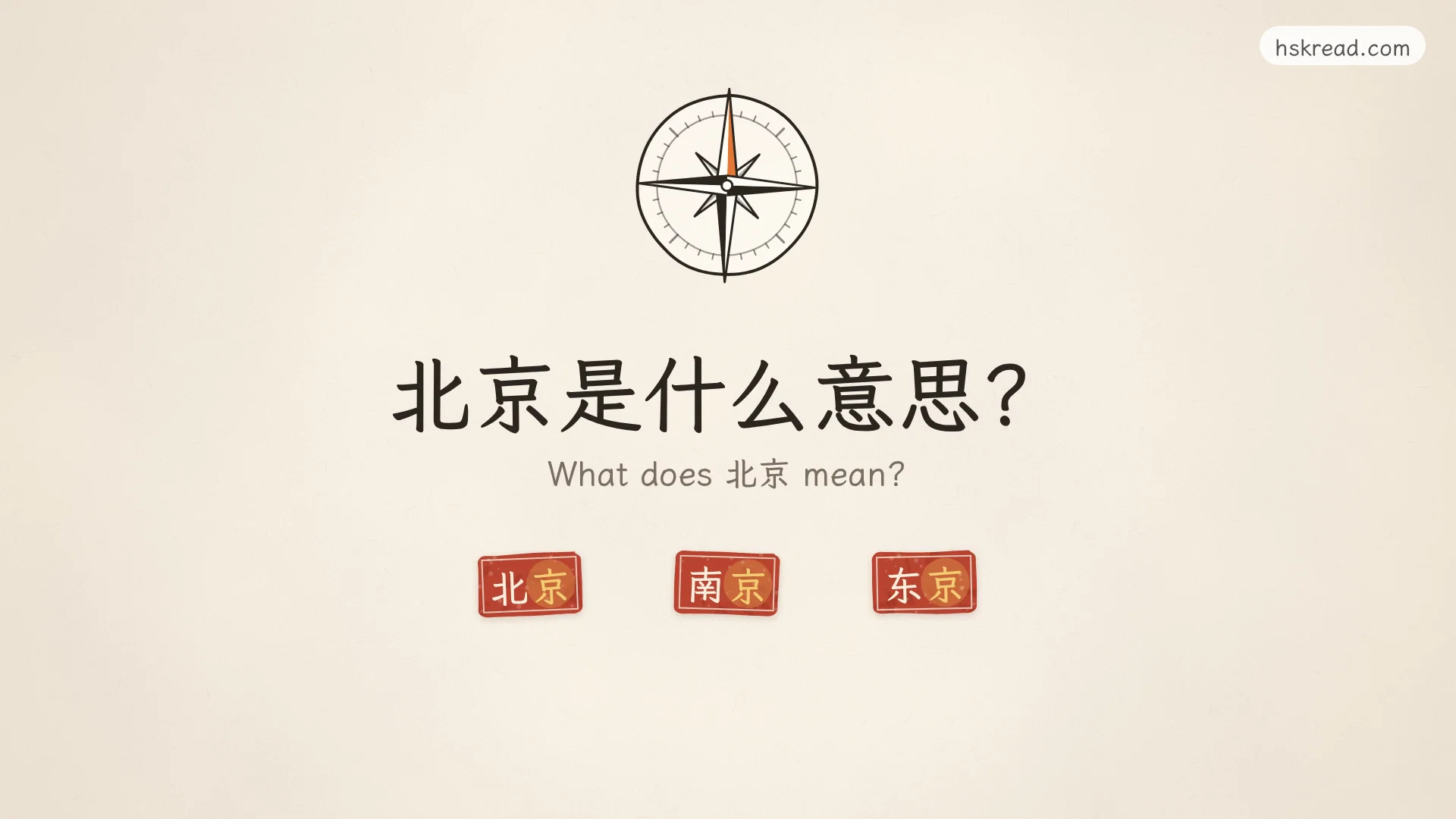
If you learn Chinese, you probably learned to say 北京 (Běijīng) in your very first week. It is the capital of China, a city of almost 22 million people and one of the oldest capitals in the world. But the name itself tells a story, and so do the old names the city used before it.
In this guide, you will learn what Beijing means, why English speakers once called it Peking, how it became China's capital, and what makes the city special today—its hutongs, its food and its famous "r" accent. Along the way, you will pick up words and phrases you can use on a trip.
Key takeaways
- 北京 means "northern capital": 北 = north, 京 = capital.
- "Peking" is an older spelling of the same name; "Beijing" is the pinyin spelling used since 1979.
- Beijing has had many names, including 燕京, 大都 and 北平.
- It was the capital of the Yuan, Ming and Qing dynasties, and has been the capital of the People's Republic of China since 1949.
- The 7.8 km Beijing Central Axis became a UNESCO World Heritage Site in 2024.
- Beijingers love 儿化, the "r" sound at the end of words like 哪儿 and 一点儿.
What does Beijing mean?
The name has just two characters:
| Character | Pinyin | Meaning |
|---|---|---|
| 北 | běi | north |
| 京 | jīng | capital city |
So 北京 simply means "northern capital." Once you know the character 京, you will see the same pattern in other city names:
| Name | Pinyin | Meaning | Today |
|---|---|---|---|
| 北京 | Běijīng | northern capital | China's capital |
| 南京 | Nánjīng | southern capital | capital of Jiangsu Province |
| 东京 | Dōngjīng | eastern capital | Tokyo, Japan |
Nanjing was the first capital of the Ming dynasty, so the "northern" and "southern" capitals were a real pair. Tokyo's name is written with the same characters in Japanese, meaning "eastern capital."
The character 京 still points to Beijing in many words. 京剧 (jīngjù) is Peking opera, 京腔 (jīngqiāng) is the Beijing accent, and the short name for Beijing on car license plates is simply 京.
The word for "capital city" in modern Chinese is 首都 (shǒudū). You would say:
Peking or Beijing?
Peking and Beijing are the same name, 北京, written in two different ways. "Peking" comes from older systems of spelling Chinese in Roman letters, used by missionaries and later by China's imperial post office. It also reflects an older pronunciation of 京.
In 1958, China adopted pinyin (拼音), the spelling system you use when you learn Chinese. From January 1, 1979, China used pinyin for names in its English-language publications, so Peking became Beijing. Western newspapers and broadcasters switched over the following years.
The old spelling still lives on in a few famous names: Peking duck, Peking opera, Peking University (北京大学) and Peking Man, the early human fossils found near the city.
Beijing's old names
Beijing has more than 3,000 years of history, and it has changed names many times. Here are the ones you are most likely to meet:
| Name | Pinyin | When | Meaning |
|---|---|---|---|
| 蓟 | Jì | over 3,000 years ago | the earliest recorded name of a city here |
| 燕京 | Yānjīng | an old literary name | "capital of Yan," after the ancient state of Yan |
| 大都 | Dàdū | Yuan dynasty (1200s–1300s) | "great capital"; the Mongols called it Khanbaliq |
| 北平 | Běipíng | 1368–1403, and again 1928–1949 | "northern peace" |
| 北京 | Běijīng | from 1403 | "northern capital" |
Notice the pattern: when the city was not the national capital, the character 京 disappeared and it became 北平, "northern peace." When it became the capital again, 京 came back.
The old name 燕京 is still everywhere. Beijing's best-known local beer is called 燕京啤酒 (Yānjīng píjiǔ), Yanjing Beer.
How Beijing became China's capital
Yuan dynasty: the "Great Capital"
In the 1260s, the Mongol ruler Kublai Khan (忽必烈, Hūbìliè) began building a grand new capital here, which the Chinese called 大都. This was the first time the city became the capital of all of China. The Italian traveler Marco Polo described it as "Cambaluc."
Ming dynasty: the Forbidden City and the move north
The Ming dynasty first made its capital in Nanjing and renamed this city 北平. Then the Yongle Emperor, who had lived here as a prince, renamed it 北京 in 1403 and moved the capital north. He built the Forbidden City between 1406 and 1420, and Beijing officially became the capital in 1421.
Qing dynasty
In 1644, the Manchu Qing dynasty took Beijing and kept it as the capital. The emperors lived in the same palace, and Beijing grew into one of the largest cities in the world. You can learn more about the emperors who ruled from here in our article on Chinese emperors.
The 20th century to today
After the last emperor gave up the throne in 1912, Beijing stayed the capital for a while. But in 1928 the national government was based in Nanjing, and Beijing became 北平 again. On October 1, 1949, the founding of the People's Republic of China was announced at 天安门 (Tiān'ānmén, Tiananmen), with Beijing as its capital.
Today Beijing is the political and cultural center of China, home to about 21.8 million permanent residents. It is also the first city in the world to host both the Summer Olympics (2008) and the Winter Olympics (2022).
The Beijing Central Axis: the city's backbone
Old Beijing was built around a straight north–south line called the 中轴线 (zhōngzhóuxiàn), the Central Axis. It runs for 7.8 kilometers, from the Bell and Drum Towers (钟鼓楼) in the north to 永定门 (Yǒngdìng Mén, Yongdingmen Gate) in the south. Along the way, it passes Jingshan Park, the Forbidden City, Tiananmen and Tiananmen Square, and Zhengyang Gate, with the Temple of Heaven to the east and the Altar of the God of Agriculture to the west.
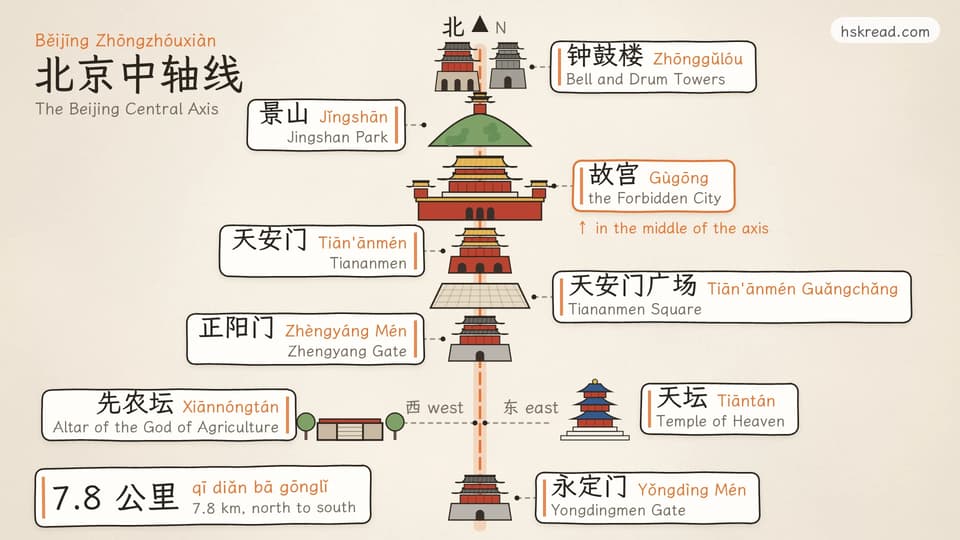
The idea comes from ancient Chinese city planning: the ruler sits in the middle, and everything else is arranged in balance on both sides. On July 27, 2024, UNESCO added the Beijing Central Axis to the World Heritage List.
The Forbidden City sits in the middle of the axis. We won't repeat its story here—read our guide to the Forbidden City for its name, history and visiting tips.
Hutongs and courtyard houses
Step off a big Beijing avenue and you may find yourself in a 胡同 (hútòng), a narrow lane lined with gray walls and red doors. Hutongs are the old alleys of Beijing, and many date back to the Yuan, Ming and Qing dynasties. A popular theory says the word comes from a Mongolian word for "well," but scholars still debate it.
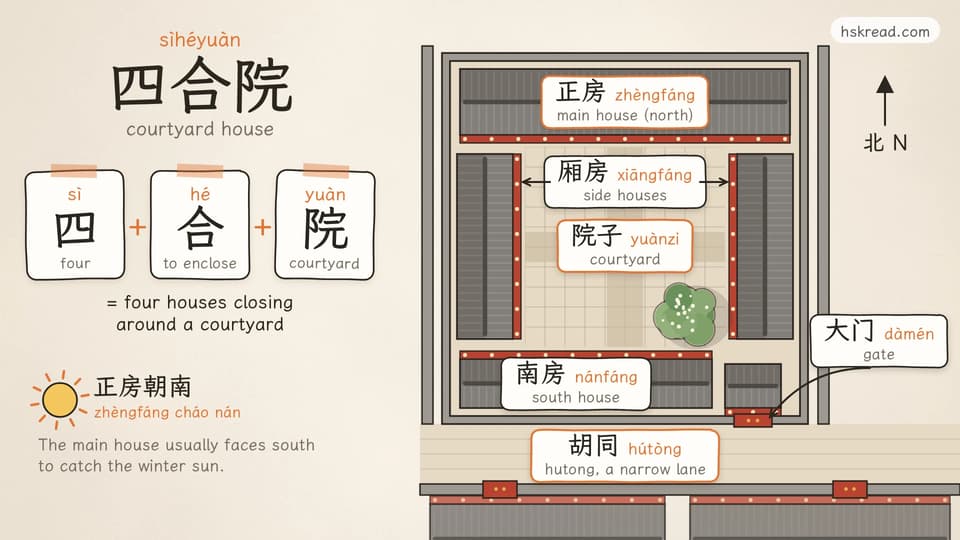
Along the hutongs stand 四合院 (sìhéyuàn), traditional courtyard houses. The name says it all:
| Part | Pinyin | Meaning |
|---|---|---|
| 四 | sì | four |
| 合 | hé | to close; to enclose |
| 院 | yuàn | courtyard |
A 四合院 has four buildings closing around a central courtyard. The main house usually faces south to catch the winter sun. In the past, one big family lived in each 四合院; later, many families shared one. Today some hutong areas, like 南锣鼓巷 (Nánluógǔ Xiàng), are busy with cafés and shops, while others are quiet neighborhoods where old men play chess and walk their birds.
What to eat in Beijing
| Dish | Pinyin | What it is |
|---|---|---|
| 北京烤鸭 | Běijīng kǎoyā | roast duck with crispy skin, wrapped in thin pancakes with sauce and scallions |
| 炸酱面 | zhájiàngmiàn | noodles with fried soybean paste and fresh vegetables |
| 涮羊肉 | shuàn yángròu | thin slices of mutton dipped in a copper hot pot |
| 冰糖葫芦 | bīngtáng húlu | candied hawthorn fruit on a stick, a classic winter snack |
| 豆汁 | dòuzhī | a sour, fermented drink made from mung beans |
Roast duck (烤鸭) is the city's most famous dish. Its history is often traced to the Ming dynasty, and one of the best-known restaurants, 全聚德 (Quánjùdé), opened in 1864. 豆汁, on the other hand, is a test of courage. Many old Beijingers love it with fried dough rings, but most visitors find its sour smell hard to accept on the first try.
The Beijing accent and 儿化
Standard Mandarin, 普通话 (pǔtōnghuà), takes Beijing pronunciation as its standard. But real Beijing speech has its own flavor, and the most famous feature is 儿化 (érhuà): adding an "r" sound to the end of a syllable.
| Word | Pinyin | Meaning |
|---|---|---|
| 哪儿 | nǎr | where |
| 这儿 | zhèr | here |
| 一点儿 | yìdiǎnr | a little |
| 玩儿 | wánr | to play; to have fun |
| 胡同儿 | hútòngr | hutong |
| 遛弯儿 | liùwānr | to go for a stroll |
In southern China, people usually say 哪里 (nǎlǐ) and 这里 (zhèlǐ) instead. Both are correct—儿化 is just a mark of northern, and especially Beijing, speech.
Beijingers also have their own slang. 倍儿 (bèir) means "very," as in 倍儿棒 ("really great"). 劳驾 (láojià) is a polite "excuse me," and older Beijingers use the respectful 您 (nín, "you") much more than people in other parts of China.
Useful phrases for a trip to Beijing
| Chinese | Pinyin | English |
|---|---|---|
| 劳驾,……怎么走? | Láojià, … zěnme zǒu? | Excuse me, how do I get to …? |
| 去天安门 | qù Tiān'ānmén | to go to Tiananmen |
| 地铁站在哪儿? | Dìtiě zhàn zài nǎr? | Where is the subway station? |
| 我想吃烤鸭。 | Wǒ xiǎng chī kǎoyā. | I'd like to eat roast duck. |
| 少放点儿辣。 | Shǎo fàng diǎnr là. | Not too spicy, please. |
| 这个多少钱? | Zhège duōshao qián? | How much is this? |
| 北京真大! | Běijīng zhēn dà! | Beijing is so big! |
Top sights in Beijing
| Sight | Chinese | Pinyin | Why go |
|---|---|---|---|
| Forbidden City | 故宫 | Gùgōng | the imperial palace of the Ming and Qing—see our guide |
| Tiananmen Square | 天安门广场 | Tiān'ānmén Guǎngchǎng | the huge square at the center of the city |
| Great Wall | 长城 | Chángchéng | sections such as 八达岭 (Bādálǐng) and 慕田峪 (Mùtiányù) are a day trip from the city |
| Temple of Heaven | 天坛 | Tiāntán | where emperors prayed for good harvests; a UNESCO site since 1998 |
| Summer Palace | 颐和园 | Yíhéyuán | a huge imperial garden with a lake and a long painted corridor; UNESCO since 1998 |
| Jingshan Park | 景山公园 | Jǐngshān Gōngyuán | the best view over the Forbidden City's roofs |
| Bell and Drum Towers | 钟鼓楼 | Zhōnggǔlóu | the northern end of the Central Axis, surrounded by hutongs |
There is an old saying about the Great Wall, from a 1935 poem by Mao Zedong: 不到长城非好汉 (bú dào Chángchéng fēi hǎohàn)—"If you haven't been to the Great Wall, you're not a true hero." You will see these words on T-shirts and souvenirs all along the Wall.
Useful vocabulary
| Chinese | Pinyin | English |
|---|---|---|
| 北京 | Běijīng | Beijing |
| 首都 | shǒudū | capital city |
| 北 | běi | north |
| 京 | jīng | capital |
| 南京 | Nánjīng | Nanjing |
| 北平 | Běipíng | Beiping, an old name of Beijing |
| 中轴线 | zhōngzhóuxiàn | central axis |
| 胡同 | hútòng | hutong, a narrow lane |
| 四合院 | sìhéyuàn | courtyard house |
| 烤鸭 | kǎoyā | roast duck |
| 长城 | Chángchéng | the Great Wall |
| 普通话 | pǔtōnghuà | Standard Mandarin |
| 儿化 | érhuà | adding an "r" sound to a syllable |
| 遛弯儿 | liùwānr | to go for a stroll |
| 劳驾 | láojià | excuse me (polite) |
From the "northern capital" of the Ming to the city of today, Beijing has worn many names—now you can say all of them, with or without the "r."
Check your understanding
01What does Beijing mean?
北京 (Běijīng) means "northern capital." 北 is "north" and 京 is "capital." The name was given in 1403 by the Yongle Emperor of the Ming dynasty.
02Why was Beijing called Peking?
"Peking" is an older way of writing 北京 in Roman letters, based on an older pronunciation. China switched to pinyin spellings for foreign use in 1979, and "Beijing" gradually replaced "Peking" in English. The old spelling survives in Peking duck and Peking University.
03When did Beijing become the capital of China?
Beijing was the capital of the Yuan dynasty as 大都 (Dadu), then the Ming capital from 1421 and the Qing capital from 1644. After a period when the capital was in Nanjing, it became the capital of the People's Republic of China in 1949.
04What is the Beijing Central Axis?
It is a 7.8-kilometer north–south line of historic buildings through the heart of Beijing, from the Bell and Drum Towers to Yongdingmen Gate, with the Forbidden City in the middle. UNESCO added it to the World Heritage List in July 2024.
05What is 儿化 in the Beijing accent?
儿化 (érhuà) means adding an "r" sound to the end of a syllable, as in 哪儿 (nǎr, "where") or 一点儿 (yìdiǎnr, "a little"). Beijing speakers use it a lot, which gives the accent its famous "rolling" sound.
06What food is Beijing famous for?
Beijing is best known for roast duck (北京烤鸭). Other local favorites include noodles with soybean paste (炸酱面), instant-boiled mutton hot pot (涮羊肉), candied hawthorn sticks (冰糖葫芦) and the sour fermented drink 豆汁.