Chinese Auspicious Days (黄道吉日): How the Almanac Picks Lucky Dates
Why do Chinese families "pick a good day" for weddings, moving house or opening a shop? Learn what 黄道吉日 means, how the traditional almanac (黄历) marks each day with 宜 and 忌, how to read a real almanac page, and why some dates cause wedding booms.
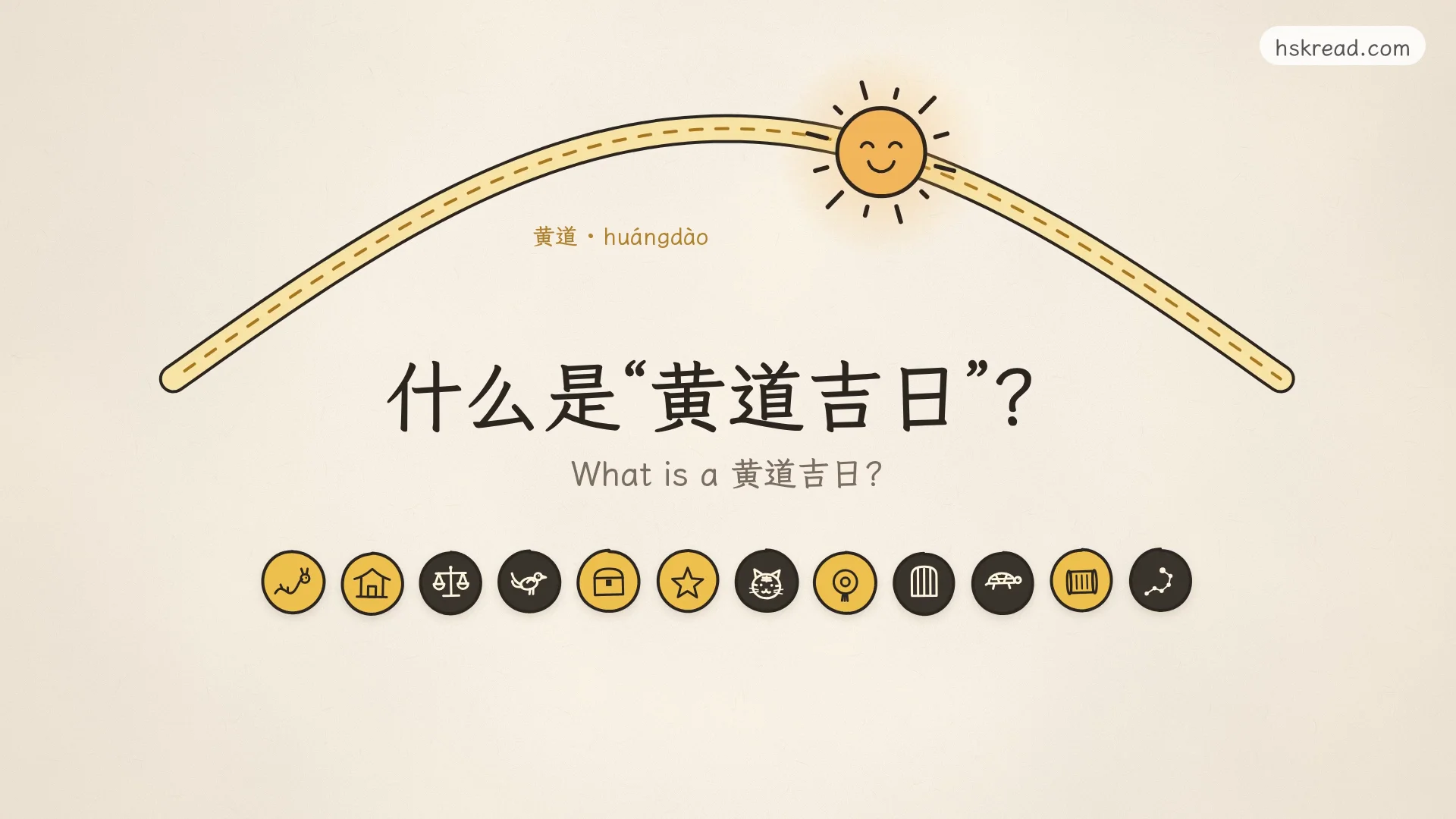
In China, when a couple announces they are getting married, one of the first questions from the family is not "Where?" but "哪天?"—"Which day?" A wedding, a move to a new apartment, the opening of a shop: for many families, these big moments should happen on a 好日子 (hǎo rìzi), a good day. And the most traditional way to find one is to look up a 黄道吉日 (huángdào jírì) in the Chinese almanac.
In this guide, you will learn what 黄道吉日 means, how the almanac marks each day as lucky or unlucky, how to read a real almanac page, and why some dates send thousands of couples to the marriage office at once. Like feng shui, choosing a lucky day is a traditional belief and custom—you do not have to believe in it to enjoy learning about it.
Key takeaways
- 黄道吉日 means "a lucky day on the Yellow Road"; today it simply means "an auspicious day."
- The traditional almanac is called the 黄历 (huánglì) or 老黄历.
- For each day, the almanac lists 宜 (good to do) and 忌 (best avoided).
- People most often pick dates for weddings, moving house, opening a business and renovations.
- Modern couples also love lucky-sounding numbers, like 520 ("I love you").
- Choosing auspicious days is a cultural custom, not science.
What does 黄道吉日 mean?
| Word | Pinyin | Meaning |
|---|---|---|
| 黄道 | huángdào | the "Yellow Road"; the ecliptic, the sun's path across the sky |
| 吉 | jí | lucky; auspicious |
| 日 | rì | day |
黄道 is a real 天文 (tiānwén, astronomy) word: it is the path the 太阳 (tàiyáng, sun) appears to follow through the stars over a year, called the ecliptic in English. The twelve signs of the Western zodiac are called 黄道十二宫 (huángdào shí'èr gōng) in Chinese for the same reason.
In traditional Chinese date selection, however, "黄道" has a second meaning. Each day is said to be watched over by one of twelve spirits (十二天神, shí'èr tiānshén), who take turns in a fixed order. Six of them are "yellow road" spirits—days when things go smoothly. The other six are "black road" spirits, 黑道 (hēidào)—days when things go wrong.
| Order | Spirit | Pinyin | Type |
|---|---|---|---|
| 1 | 青龙 | Qīnglóng | 黄道 yellow road |
| 2 | 明堂 | Míngtáng | 黄道 yellow road |
| 3 | 天刑 | Tiānxíng | 黑道 black road |
| 4 | 朱雀 | Zhūquè | 黑道 black road |
| 5 | 金匮 | Jīnguì | 黄道 yellow road |
| 6 | 天德 | Tiāndé | 黄道 yellow road |
| 7 | 白虎 | Báihǔ | 黑道 black road |
| 8 | 玉堂 | Yùtáng | 黄道 yellow road |
| 9 | 天牢 | Tiānláo | 黑道 black road |
| 10 | 玄武 | Xuánwǔ | 黑道 black road |
| 11 | 司命 | Sīmìng | 黄道 yellow road |
| 12 | 勾陈 | Gōuchén | 黑道 black road |
So a 黄道吉日 was originally a day guarded by a "yellow road" spirit. Over time, the phrase came to mean any lucky day. You will hear it in TV dramas, at weddings and in everyday jokes.
A similar phrase is 良辰吉日 (liángchén jírì), "a fine hour on a lucky day." It sounds a little more poetic and is popular on wedding invitations.
The 黄历: China's traditional almanac
The book that tells you which days are lucky is the 黄历 (huánglì), the traditional Chinese almanac. It follows both the Western calendar and the Chinese lunar calendar, and for every day of the year it gives the date, the stem-and-branch name of the day, the solar term, and lists of things to do and avoid.
Where does the name come from? There are a few explanations:
- 皇历 (huánglì, "the imperial calendar"): in imperial times, the calendar was calculated and published by the court's astronomers. Private calendars were often banned, so the official one was the "emperor's calendar."
- 黄历 (huánglì, "the yellow calendar"): some say the name honors the legendary Yellow Emperor (黄帝), and others say the books were printed on yellow paper.
Both names sound the same, and today 黄历 is the usual way to write it. People also say 老黄历 (lǎo huánglì), "the old almanac." Be careful: 老黄历 can also mean "old news" or "outdated rules," as in "那都是老黄历了" ("That's old news").
Paper almanacs are still sold before the Spring Festival (春节, Chūnjié), but most people now check the almanac on their phones. Many 日历 (rìlì, calendar) apps in China show the day's 宜 and 忌 right under the date.
宜 and 忌: how to read an almanac day
Every almanac day has two key lists:
| Word | Pinyin | Meaning |
|---|---|---|
| 宜 | yí | suitable; good to do today |
| 忌 | jì | to avoid; best not to do today |
The items on these lists use old, short words. Here are the ones you will see most often:
| Almanac word | Pinyin | Meaning |
|---|---|---|
| 嫁娶 | jiàqǔ | to marry (a wedding) |
| 纳采 | nàcǎi | to send betrothal gifts |
| 入宅 | rùzhái | to move into a new home |
| 移徙 | yíxǐ | to move house |
| 开市 | kāishì | to open a shop or start business |
| 动土 | dòngtǔ | to break ground; start construction |
| 安床 | ānchuáng | to set up a new bed |
| 出行 | chūxíng | to set out on a journey |
| 祭祀 | jìsì | to make offerings to ancestors |
| 安葬 | ānzàng | to bury (a funeral) |
| 理发 | lǐfà | to get a haircut |
| 馀事勿取 | yúshì wù qǔ | "nothing else"—avoid everything not listed |
| 诸事不宜 | zhūshì bù yí | nothing is suitable today |
A real example: Saturday, October 10, 2026
Here is what a standard almanac calculation shows for October 10, 2026. (Almanacs from different publishers can differ slightly.)
| Almanac line | What it says | What it means |
|---|---|---|
| 公历 | 2026年10月10日 星期六 | Saturday, October 10, 2026 |
| 农历 | 九月初一 | the 1st day of the 9th lunar month |
| 干支 | 丙午年 戊戌月 丁巳日 | the year, month and day in the stem-and-branch system (a Horse year) |
| 值神 | 明堂(黄道) | the day's spirit is Mingtang, a yellow-road spirit—a 黄道吉日 |
| 建除 | 危 | the day's "officer" is 危 (wēi), one of a second set of twelve |
| 宜 | 嫁娶、纳采、求嗣、纳财、会亲友… | good for weddings, betrothal gifts, praying for children, receiving money, meeting family and friends |
| 忌 | 出行、安葬、上梁、作灶、理发… | avoid journeys, burials, raising a roof beam, building a stove, haircuts |
| 冲 / 煞 | 冲猪 煞东 | "clashes with the Pig": people born in a Year of the Pig—one of the twelve 生肖 (shēngxiào, zodiac animals)—should be careful; the bad influence is in the east |
So if you believed in the almanac, October 10, 2026 would be a good Saturday for a wedding banquet—but not for a haircut or a long trip!
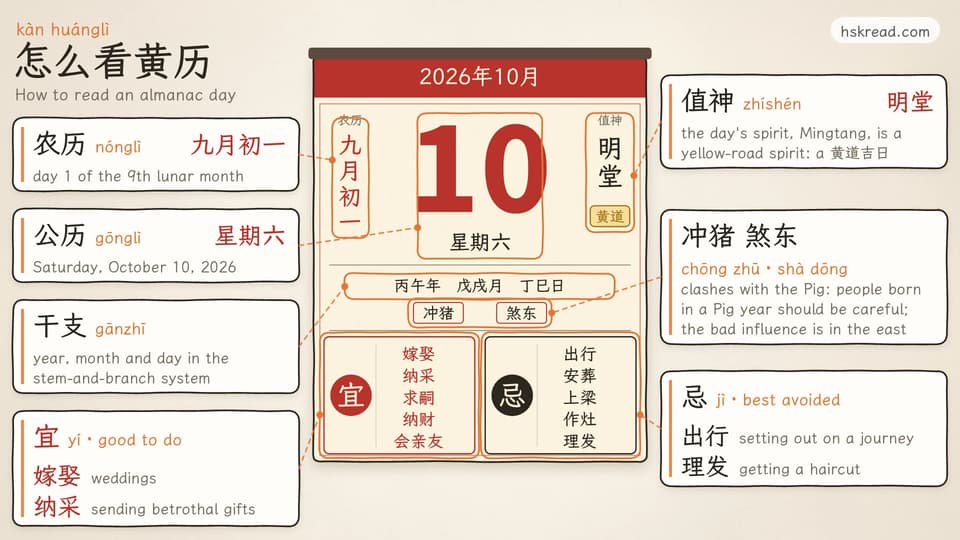
Notice that the almanac has more than one system. The twelve spirits decide whether a day is 黄道 or 黑道, but there is another cycle of twelve "day officers" (建、除、满、平、定、执、破、危、成、收、开、闭). A 破日 (pòrì, "breaking day") is traditionally seen as bad for big events. For example, the almanac calculation for October 9, 2026 shows a yellow-road spirit, 青龙, but it is also a 破日, and the 忌 list says simply 诸事不宜: "nothing is suitable today." That is why people look at the whole page, not just one word.
What do Chinese people choose lucky days for?
Choosing a date is called 择日 (zérì) in formal Chinese, or more casually 看日子 (kàn rìzi, "to look at the days") or 挑日子 (tiāo rìzi, "to pick a day"). These are the occasions people care about most:
| Occasion | Chinese | Pinyin | What people do |
|---|---|---|---|
| Wedding | 结婚 | jiéhūn | pick a 宜嫁娶 day for the 婚礼 (hūnlǐ, wedding ceremony), often a weekend |
| Moving into a home | 搬家 / 入宅 | bānjiā / rùzhái | move in on a 宜入宅 day, sometimes at a "lucky hour" in the morning |
| Opening a business | 开业 | kāiyè | open on a 宜开市 day, often with 鞭炮 (biānpào, firecrackers) or a lion dance |
| Renovation | 装修 | zhuāngxiū | start work on a 宜动土 day |
| Long trip | 出行 | chūxíng | some older people avoid 忌出行 days |
| Funeral | 安葬 | ānzàng | burial dates are chosen carefully in many families |
Weddings are by far the biggest reason. Wedding venues in Chinese cities are often booked months in advance for popular lucky days, especially in spring and autumn. Families sometimes ask an older relative or a fortune-teller to find a date that also fits the bride's and groom's birth years.
Lucky numbers and "homophone dates"
Not every lucky date comes from the almanac. Many modern couples choose dates by how the 数字 (shùzì, numbers) sound. Chinese has lots of words that sound alike, and some numbers sound like happy words:
| Number | Sounds like | Meaning |
|---|---|---|
| 8 八 bā | 发 fā (as in 发财) | to get rich; to prosper |
| 6 六 liù | 溜 / 顺 (as in 六六大顺) | smooth; everything goes well |
| 9 九 jiǔ | 久 jiǔ | long-lasting; forever |
| 4 四 sì | 死 sǐ | death—so 4 is avoided |
This is why the 2008 Beijing Olympics opened on August 8, 2008, at 8:08 p.m., and why some buildings in China skip the fourth floor.
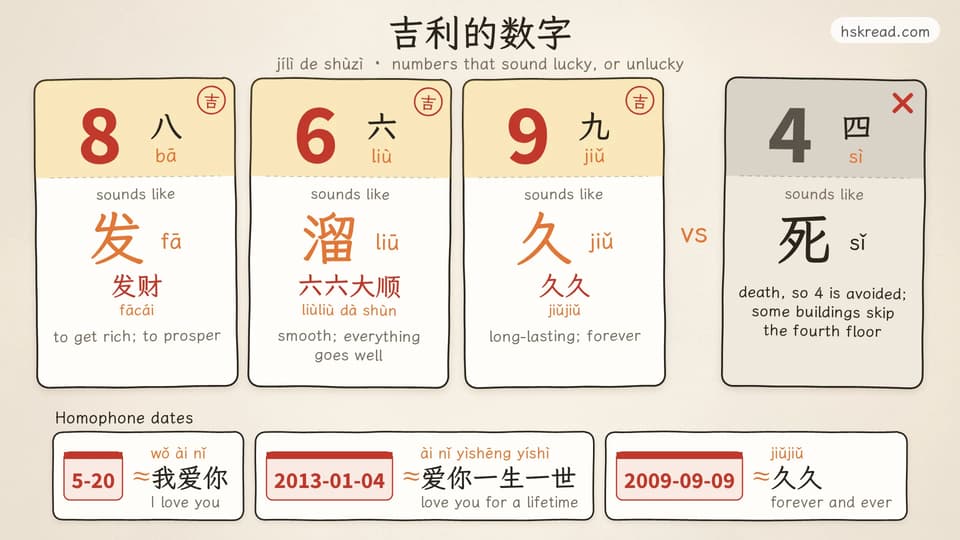
Number dates can create real wedding booms:
- 2009-09-09 (久久, "forever and ever") was one of the busiest wedding-registration days of its time.
- 2013-01-04 sounded like 爱你一生一世 (ài nǐ yìshēng yíshì), "love you for a lifetime." Couples lined up outside marriage offices across China; in Hangzhou alone, 5,152 couples registered that day, the city's highest one-day total in years.
- May 20 (5-20) sounds like 我爱你 (wǒ ài nǐ), "I love you." It has become an unofficial Valentine's Day, and every year marriage offices see a rush. On May 20, 2026, Shanghai registered 3,729 couples, its highest 520 total in nine years.
Here is a fun twist: according to the same almanac calculation used above, January 4, 2013 was a 破日 with "馀事勿取"—not a day the almanac recommended for weddings. For many young couples, the sweet sound of the numbers mattered more than the old book. Many families now combine both: they register their marriage (领证, lǐngzhèng, or more formally 登记, dēngjì) on a 浪漫 (làngmàn, romantic) number date and hold the wedding banquet on a 黄道吉日.
Belief, custom or just fun?
Do Chinese people really believe in lucky days? The honest answer is: some do, some don't, and many are somewhere in between. Some people call it 迷信 (míxìn, superstition); others see it as a harmless 习俗 (xísú, custom).
For older generations, choosing a good day shows respect for tradition and care for the family. For many younger people, checking the almanac is half-serious, like reading a horoscope. And the almanac has become an internet joke too: on a tired Monday, people post screenshots saying 今日不宜上班—"today is not suitable for going to work."
Choosing a lucky day does not change what happens—that depends on people, not dates. But it is a window into Chinese values: family, harmony, a wish for good beginnings, and a love of words that sound lucky.
Useful vocabulary
| Chinese | Pinyin | English |
|---|---|---|
| 黄道吉日 | huángdào jírì | auspicious day |
| 好日子 | hǎo rìzi | a good day; a lucky day |
| 良辰吉日 | liángchén jírì | a fine hour on a lucky day |
| 黄历 | huánglì | the Chinese almanac |
| 老黄历 | lǎo huánglì | the old almanac; old news |
| 宜 | yí | suitable; good to do |
| 忌 | jì | to avoid |
| 吉利 | jílì | lucky; auspicious |
| 择日 | zérì | to choose a date |
| 挑日子 | tiāo rìzi | to pick a day |
| 结婚 | jiéhūn | to get married |
| 搬家 | bānjiā | to move house |
| 开业 | kāiyè | to open a business |
| 装修 | zhuāngxiū | to renovate |
| 领证 | lǐngzhèng | to register a marriage |
Whether you follow the almanac or not, now you know how to ask the most important wedding question in Chinese: 你们挑好日子了吗?—"Have you picked your day yet?"
Check your understanding
01What does 黄道吉日 mean?
黄道吉日 (huángdào jírì) means "an auspicious day on the Yellow Road." In the traditional almanac, each day is guarded by one of twelve spirits; six of them are "yellow road" (lucky) and six are "black road" (unlucky). Today the phrase simply means "a lucky day."
02What is the Chinese almanac called?
It is called 黄历 (huánglì) or 老黄历 (lǎo huánglì). It was once also written 皇历, "the imperial calendar," because the court published it. In English it is sometimes called the Tong Shu.
03What do 宜 and 忌 mean in the almanac?
宜 (yí) lists activities that are considered suitable for that day, such as 嫁娶 (weddings) or 入宅 (moving into a new home). 忌 (jì) lists activities that are best avoided, such as 出行 (setting out on a journey) or 安葬 (burials).
04What do Chinese people choose auspicious days for?
Most often for weddings, moving into a new home, opening a business, starting renovations and sometimes for long trips or funerals. Many families check the almanac; others simply choose a date with lucky-sounding numbers.
05Why do so many Chinese couples marry on 520?
520 (May 20) sounds like 我爱你, "I love you," in Chinese. Every year, marriage registration offices across China see many more couples than usual on that day. Similar booms happened on 2013-01-04, which sounds like "love you for a lifetime."
06Are auspicious days real?
Auspicious days are a cultural tradition and a belief, not a scientific fact. Many people follow them out of respect for family and custom, or simply for peace of mind.