Acupuncture (针灸) in Chinese Culture: Meaning, History, Acupoints and Key Words
A learner-friendly guide to 针灸—why the Chinese word means both acupuncture and moxibustion, what acupoints are in TCM, the Song-dynasty bronze figure used for exams, what a session in China is like and the needle idioms you will hear in everyday Chinese.
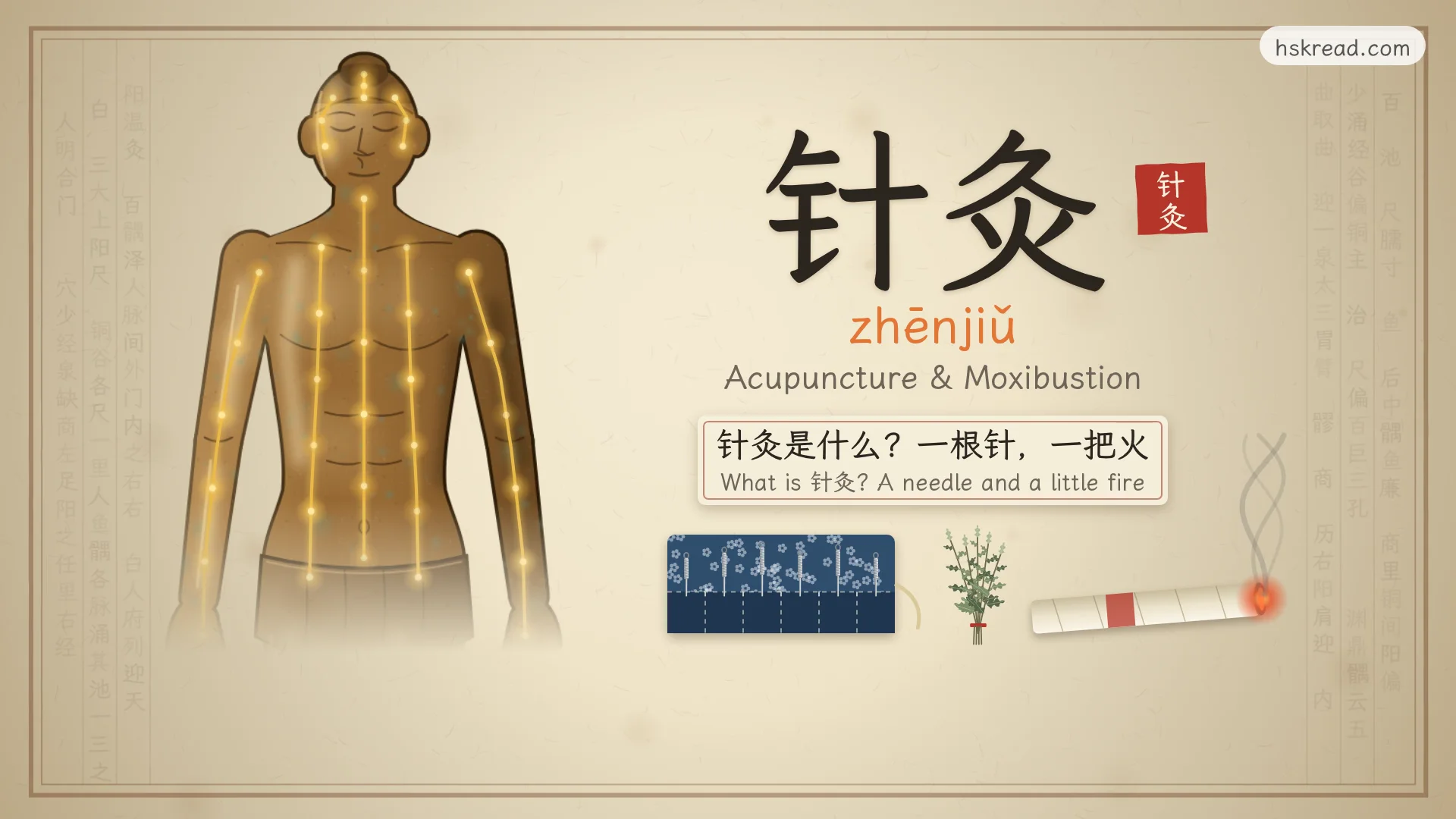
Most people outside China know half of this word. In English, 针灸 (zhēnjiǔ) is usually translated as “acupuncture,” but the Chinese name actually describes two different practices. 针 (zhēn) is the needle. 灸 (jiǔ) is moxibustion, the warming of points on the body with burning dried mugwort. For more than two thousand years, Chinese doctors have used the two together, so the language keeps them together too.
In this guide, you will learn what each character means, what acupoints are in traditional Chinese medicine, the amazing story of the Song-dynasty bronze man who was used to test doctors, what a session in China is like—and the needle idioms that show up in everyday Chinese.
A quick note: This article explains 针灸 as part of Chinese culture and language. It is not medical advice and does not say whether acupuncture or moxibustion works for any condition. For any health question, please talk to a qualified doctor.
Key takeaways
- 针灸 = 针 (needles, acupuncture) + 灸 (moxibustion, warming with burning mugwort).
- In TCM thinking, needles and heat are applied at 穴位 (acupoints) along 经络 (meridians), channels through which qi is believed to flow.
- Many acupoints have poetic names, and two of them, 太阳穴 (your temples) and 人中, are part of everyday Chinese.
- Almost every Chinese student has done 眼保健操, school eye exercises based on pressing acupoints.
- About a thousand years ago, Song-dynasty students were tested on a bronze man covered in wax and filled with water.
- A session in China means thin single-use needles, 20–30 minutes lying still, and a feeling people call 得气.
- The story goes back more than 2,000 years—to gold needles in a Han-dynasty tomb—and reached UNESCO's heritage list in 2010.
- In everyday Chinese, 扎针 means acupuncture, but 打针 means getting a shot—and needle idioms like 一针见血 are everywhere.
What does 针灸 mean?
Let's look at the two characters:
| Character | Pinyin | Parts | Meaning |
|---|---|---|---|
| 针 | zhēn | 钅 (metal) + 十 | needle; acupuncture; an injection |
| 灸 | jiǔ | 久 (sound) + 火 (fire) | to warm the body by burning moxa; moxibustion |
The character 针 has the metal radical 钅 on the left, which makes sense for a needle. In 灸, the bottom part 火 means “fire,” and the top part 久 (jiǔ, “long time”) gives the sound. So 灸 is literally a “fire” word pronounced jiǔ—a needle and a little fire, all in one word.
Put together, 针灸 is both a noun (“acupuncture and moxibustion”) and a verb (“to give or have acupuncture”). In conversation, people often say 扎针 (zhā zhēn), “to stick needles,” for an acupuncture session.
A tip for learners: be careful with 打针 (dǎ zhēn). It does not mean acupuncture—it means getting a shot or an injection. 我去扎针 means “I'm going for acupuncture,” but 我去打针 means “I'm going to get a shot.” Mix them up, and your Chinese friends will be very confused about where you are going.
What is moxibustion?
Moxibustion is the half of 针灸 (acupuncture and moxibustion) that most foreigners have never heard of. It uses 艾草 (àicǎo), mugwort, a plant with soft gray-green leaves and a strong herbal smell.
Here is how the plant becomes moxa:
- The leaves are picked, dried and stored, often for a long time.
- They are ground and sifted until they become soft, fluffy fibers called 艾绒 (àiróng), “moxa wool.”
- The moxa is rolled into a stick, 艾条 (àitiáo), which looks like a thick cigar, or shaped into small cones.
- The practitioner lights the moxa and holds it a short distance above a chosen point, or places a cone on the point, to warm the area.
Moxibustion in general is called 艾灸 (àijiǔ). In TCM thinking, its warmth is used especially for conditions described as “cold.” An old medical classic even says moxibustion was born in China's cold north, where people warmed themselves by the fire—which makes a lot of sense if you have ever spent a winter in northern China.
If you walk past a TCM clinic or a wellness shop in China, you may notice the smell before you see the sign: moxa smoke smells a little like burning sage or incense. And you may already know 艾草 from another tradition. During the Dragon Boat Festival, many families hang bunches of mugwort on their doors. (See our guide to Chinese traditional festivals.)
Acupoints and meridians
To understand 针灸, you need two key TCM ideas. They are traditional concepts, not structures that appear in a modern anatomy book—but you will hear the words often.
| Word | Pinyin | Meaning |
|---|---|---|
| 经络 | jīngluò | meridians: channels through which qi is believed to flow |
| 穴位 | xuéwèi | acupoints: specific spots along the meridians |
| 气 | qì | qi, the vital energy that TCM says flows through the body |
Think of the meridians as rivers across a map of the body, and the acupoints as little stations along them. Traditional charts show hundreds of points from head to toe.
穴位 is a great word to know: 穴 (xué) means “cave” or “hole,” and 位 (wèi) means “place.” Each acupoint also has its own Chinese name, and many of them sound more like places in a fantasy novel than spots on your body:
| Acupoint | Pinyin | Literal meaning | Where it is |
|---|---|---|---|
| 合谷 | hégǔ | Joining Valley | on the back of the hand, between thumb and index finger |
| 足三里 | zúsānlǐ | Leg Three Li | on the outer leg, below the knee |
| 百会 | bǎihuì | Hundred Meetings | on the very top of the head |
| 涌泉 | yǒngquán | Gushing Spring | on the sole of the foot |
| 人中 | rénzhōng | Middle of the Person | between the nose and the upper lip |
| 太阳 | tàiyáng | Great Yang; the sun | on the temples |
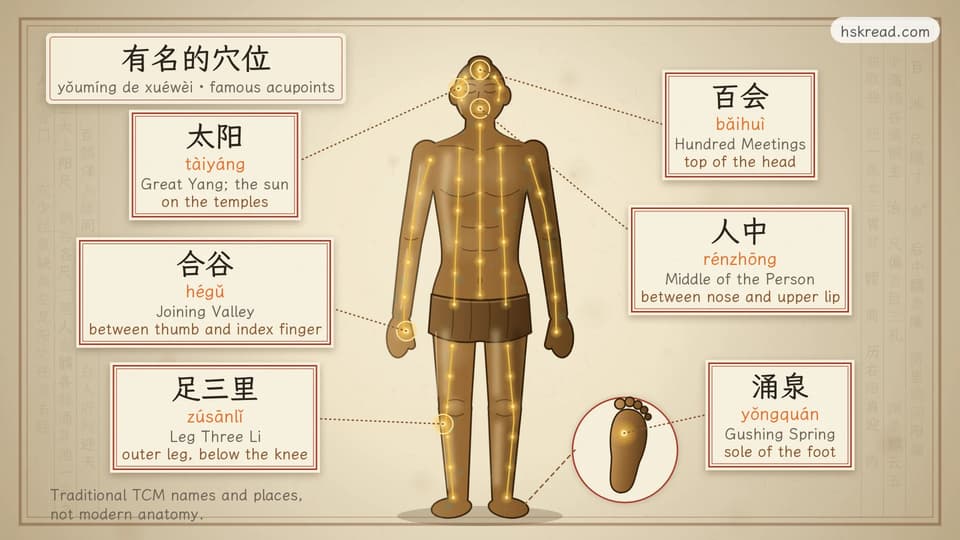
Two of these are part of everyday Chinese:
- 太阳穴 (tàiyángxué) is simply the normal word for your temples. If you have a headache (头疼, tóuténg), you might rub your 太阳穴.
- 人中 (rénzhōng) is famous from Chinese TV dramas. When a character faints, someone almost always rushes in and pinches the spot under the nose—掐人中 (qiā rénzhōng)—and the character wakes up with a gasp. Once you know it, you will spot this scene everywhere.
Eye exercises: acupoints at every Chinese school
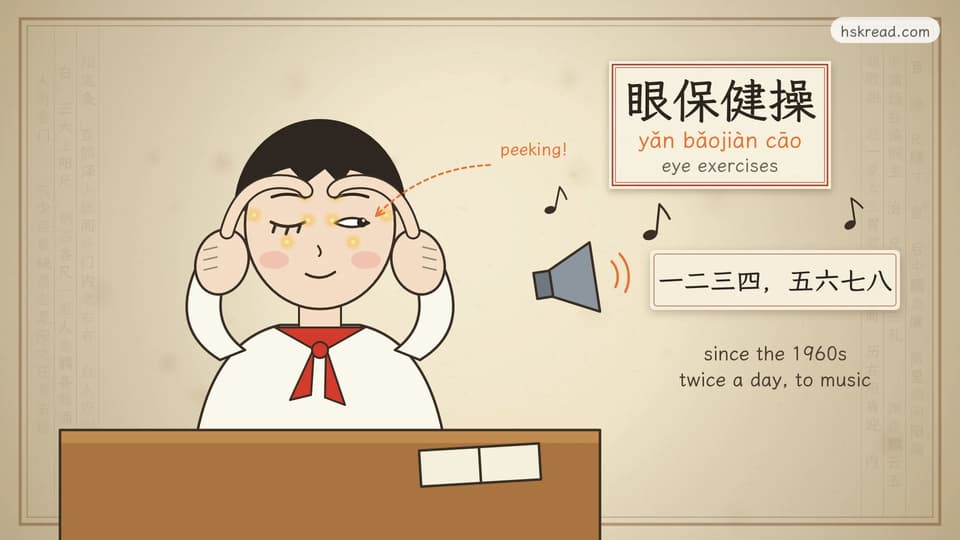
Almost every Chinese adult pressed acupoints at school—twice a day, to music. Acupoints (穴位, xuéwèi) are the special spots on the body used in 针灸, and the school version is called 眼保健操 (yǎn bǎojiàn cāo), “eye exercises.”
Since the 1960s, Chinese schools have had students close their eyes and press points around them in time to music, usually once in the morning and once in the afternoon.
It is a form of 穴位按摩 (xuéwèi ànmó), acupressure. Whether it helps eyesight is debated, but ask any Chinese adult and they can probably still hum the music and the calm voice counting “一二三四,五六七八.” (Many will also admit they peeked.)
The acupuncture bronze man: a 1,000-year-old wax-and-water exam
About a thousand years ago, Chinese medical students took one of the cleverest exams in history—on a bronze statue filled with water.
In the Song dynasty, there was a problem: old acupuncture books had been copied by hand so many times that they were full of mistakes, and doctors did not agree on where the acupoints (the special spots used for needles) were. The emperor asked a court doctor named 王惟一 (Wáng Wéiyī) to fix it.
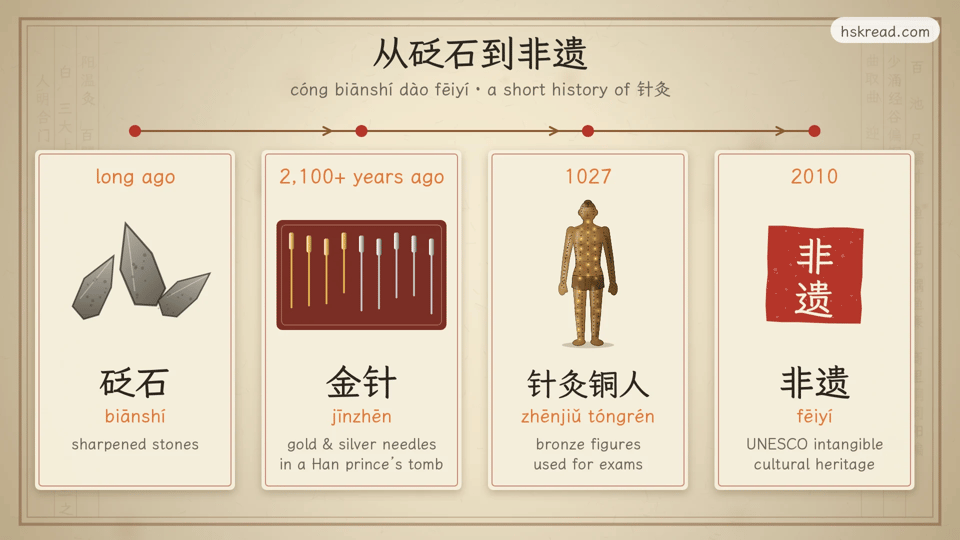
Wang made a clear illustrated guide to the acupoints. Then, in 1027, he did something amazing: he had two life-size bronze figures cast, known as the 针灸铜人 (zhēnjiǔ tóngrén), “acupuncture bronze men.” The figures were hollow, had the organs inside, and showed hundreds of acupoints as tiny holes on the surface.
Then came the clever part. According to historical accounts, the bronze men were used for exams. The figure was covered in wax (蜡, là) so the holes disappeared, and filled with water.
The examiner named a point, and the student had to find it with a needle. If the needle went into the right hole, water came out. If not—ding—the needle just hit bronze. Imagine taking a test where everyone can see whether you got the answer right!
What is an acupuncture session like?
In China, you can find 针灸 at TCM hospitals, in the 针灸科 (zhēnjiǔ kē, acupuncture department) of many general hospitals and at private clinics (诊所, zhěnsuǒ). At a hospital, you first register at the front desk, which is called 挂号 (guàhào). Walk into a busy acupuncture department in the morning and you may see a row of beds with grandpas and grandmas lying quietly, needles in place, chatting with each other or scrolling on their phones.
A typical visit, described in general terms, looks like this:
- Questions first. The practitioner asks about your problem and may look at your tongue and feel your pulse, as in other kinds of TCM (中医). (Our guide to traditional Chinese medicine explains these four examinations.)
- Lying down. You lie on a treatment bed, and the practitioner disinfects the skin (消毒, xiāodú).
- The needles. Modern acupuncture needles are very thin and usually sterile and single-use (一次性). They are much thinner than the needles used for shots—many first-timers are surprised by how thin they are.
- Waiting. The needles usually stay in for around 20–30 minutes. Some clinics connect them to a small electric device; this is called 电针 (diànzhēn), electroacupuncture.
- Moxa or other extras. Some sessions add a moxa stick, cupping or massage.
TCM practitioners talk about a feeling called 得气 (dé qì), “obtaining qi.” Patients often describe it as a dull ache, heaviness or tingling around the needle. In Chinese, people describe it with words like 酸 (suān, aching), 麻 (má, tingling), 胀 (zhàng, swollen) and 重 (zhòng, heavy).
What does research say?
Scientists around the world have studied acupuncture for decades, and the results are mixed and still debated. That is why this article only describes the tradition and does not recommend it for any condition.
A short history of 针灸: from sharp stones to UNESCO
Some of the oldest acupuncture needles ever found were made of gold—and buried with a prince.
From sharp stones to gold needles
Long before metal needles, people in ancient China used sharpened stones called 砭石 (biānshí) to press and lance the body. Some books call them the ancestors of acupuncture needles, though historians aren't sure how the two are connected.
Some of the earliest known metal needles come from a very famous tomb. The Han-dynasty prince 刘胜 (Liú Shèng) was buried more than 2,100 years ago in a suit made of over 2,000 pieces of jade sewn together with gold thread. Next to him, archaeologists found four gold needles and five silver ones, believed to be medical needles. Even in the afterlife, it seems, a prince wanted his acupuncture kit.
By then, the great medical classic 黄帝内经 (Huángdì Nèijīng) was already describing needles, meridians and points. Chinese doctors kept writing about 针灸 for centuries after that.
针灸 goes global
针灸 spread to Korea and Japan more than a thousand years ago, and much later to Europe and America. In 1971, an American journalist wrote about his acupuncture experience after surgery in Beijing, and many Americans became curious. Today you can find acupuncture clinics from London to New York.
In 2010, UNESCO added Acupuncture and moxibustion of traditional Chinese medicine to its list of the Intangible Cultural Heritage of Humanity. In Chinese, intangible cultural heritage is 非物质文化遗产, often shortened to 非遗 (fēiyí).
Related practices you will hear about
针灸 is part of a larger family of TCM practices (see our guide to traditional Chinese medicine). These words often come up together:
| Word | Pinyin | Meaning |
|---|---|---|
| 拔罐 | báguàn | cupping: suction cups on the skin, leaving round purple marks |
| 推拿 | tuīná | Chinese therapeutic massage (a kind of 按摩, massage) |
| 刮痧 | guāshā | scraping the skin with a smooth tool |
| 穴位按摩 | xuéwèi ànmó | acupressure: pressing acupoints with the fingers |
Cupping became world-famous in 2016, when American swimmer Michael Phelps won Olympic gold in Rio with big purple circles on his shoulders. Suddenly everyone was asking, “What are those marks?”
Needle idioms in everyday Chinese
Even if you never try 针灸, you will meet 针 in common idioms:
| Idiom | Pinyin | Literal meaning | Real meaning |
|---|---|---|---|
| 一针见血 | yì zhēn jiàn xiě | one needle, and blood appears | to hit the nail on the head; spot-on |
| 针锋相对 | zhēnfēng xiāngduì | needle point against needle point | tit for tat; to oppose each other sharply |
| 见缝插针 | jiàn fèng chā zhēn | see a gap, stick in a needle | to make use of every spare moment or space |
| 大海捞针 | dàhǎi lāo zhēn | fish for a needle in the sea | to look for a needle in a haystack |
And one more needle saying comes with a story every Chinese child hears. Legend says the young poet Li Bai once skipped school and met an old woman rubbing a thick iron rod on a stone. When he asked why, she said she was grinding it into a needle. Li Bai was so impressed that he went back to his books.
That is the saying 只要功夫深,铁杵磨成针 (zhǐyào gōngfu shēn, tiěchǔ mó chéng zhēn): “with enough effort, an iron rod can be ground into a needle”—perfect for anyone learning Chinese characters.
Useful vocabulary
| Chinese | Pinyin | English |
|---|---|---|
| 针灸 | zhēnjiǔ | acupuncture and moxibustion; acupuncture |
| 针 | zhēn | needle |
| 灸 / 艾灸 | jiǔ / àijiǔ | moxibustion |
| 艾草 | àicǎo | mugwort |
| 艾条 | àitiáo | moxa stick |
| 穴位 | xuéwèi | acupoint |
| 经络 | jīngluò | meridians |
| 扎针 | zhā zhēn | to have or give acupuncture |
| 打针 | dǎ zhēn | to get or give a shot |
| 针灸科 | zhēnjiǔ kē | acupuncture department |
| 太阳穴 | tàiyángxué | temple (side of the head) |
| 针灸铜人 | zhēnjiǔ tóngrén | bronze acupuncture figure |
| 一针见血 | yì zhēn jiàn xiě | to hit the nail on the head |
Now you know both halves of 针灸—the needle and the fire—and a few needle idioms to use the next time someone says something truly 一针见血.
Check your understanding
01What does 针灸 mean?
针灸 (zhēnjiǔ) combines two traditional Chinese therapies. 针 means “needle” and stands for acupuncture; 灸 means moxibustion, warming points on the body with burning dried mugwort (艾草). In English, 针灸 is usually translated simply as “acupuncture.”
02What is moxibustion?
Moxibustion (灸, jiǔ, or 艾灸, àijiǔ) is a traditional Chinese practice in which dried, fluffy mugwort, called moxa, is burned on or near the skin to warm chosen points. The most common form today is a moxa stick (艾条) held a short distance above the skin.
03What is the history of acupuncture in China?
Chinese medical classics compiled over 2,000 years ago already describe needles, meridians and points. About a thousand years ago, in the Song dynasty, the doctor Wang Weiyi had life-size bronze figures cast with the acupoints marked on them, and they were later used to test students. UNESCO added Chinese acupuncture and moxibustion to its intangible heritage list in 2010.
04What are acupoints and meridians?
In traditional Chinese medicine, meridians (经络, jīngluò) are channels through which qi is believed to flow, and acupoints (穴位, xuéwèi) are spots along them used in acupuncture. TCM describes hundreds of acupoints, many with poetic names. They are traditional concepts, not structures found in modern anatomy.
05What is the difference between 扎针 and 打针?
扎针 (zhā zhēn) usually means to have or give acupuncture, while 打针 (dǎ zhēn) means to get a shot or injection. So 我去扎针 suggests an acupuncture session, but 我去打针 means you are getting a shot.
06Is this article medical advice?
No. This article explains acupuncture and moxibustion as part of Chinese culture and language. It does not say whether they work for any condition. If you have a health problem, please talk to a qualified doctor.