Traditional Chinese Medicine (中医): Meaning, Key Ideas, Stories and Everyday Words
A learner-friendly guide to traditional Chinese medicine—what 中医 means, yin-yang and qi, what a visit to a TCM doctor is like (望闻问切 and 把脉), bitter herbal soup, the stories of Shennong, Hua Tuo and Tu Youyou, and everyday phrases like 上火 and 多喝热水.
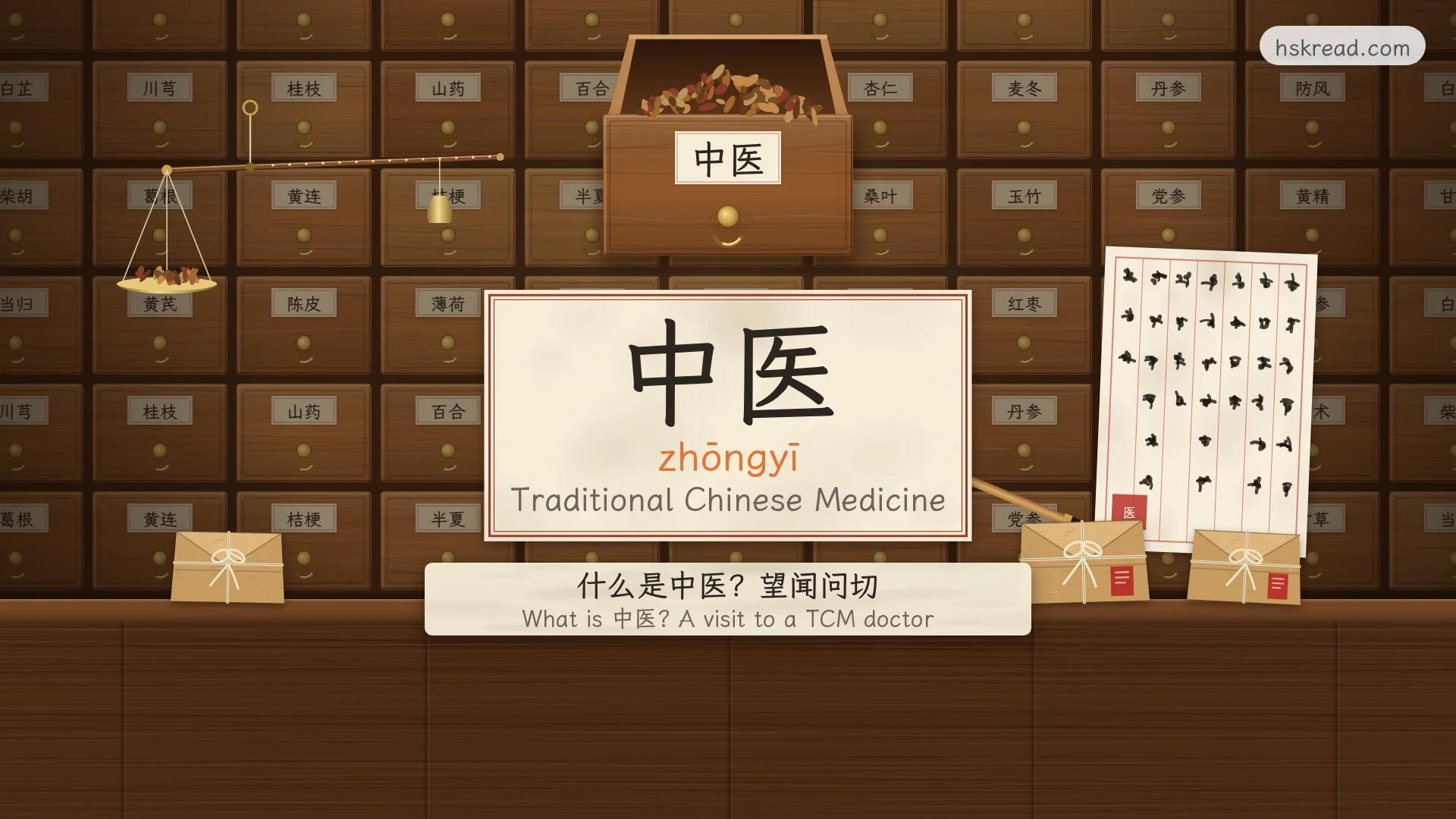
Tell a Chinese friend that you have a sore throat, and you may get two answers. The first is 多喝热水 (duō hē rèshuǐ): “drink more hot water.” The second is a diagnosis: 你上火了 (nǐ shànghuǒ le), “you have too much internal heat.” Neither one comes from a Western medical textbook. They come from 中医 (zhōngyī), traditional Chinese medicine, or TCM.
TCM is more than a way of treating illness. Its ideas about yin and yang, hot and cold food, and keeping the body in balance are part of daily life and daily language in China. In this guide, you will learn what 中医 means, what really happens when you visit a TCM doctor, a few great stories from its long history, and the everyday words you will hear at the dinner table.
A quick note: This article explains traditional Chinese medicine as part of Chinese culture and language. It is not medical advice and does not say whether any treatment works. For any health question, please talk to a qualified doctor.
Key takeaways
- 中医 means traditional Chinese medicine (or a TCM doctor); its partner word is 西医, Western medicine.
- A TCM doctor traditionally examines you in four ways, 望闻问切: look, listen and smell, ask, and feel the pulse. Be ready to stick out your tongue!
- Herbal medicine is often a very bitter soup, and Chinese has a saying for that: 良药苦口, “good medicine tastes bitter.”
- Everyday Chinese is full of TCM words: 上火, 养生, “hot” and “cool” foods, and 多喝热水.
- History comes with great stories, from Shennong tasting a hundred herbs to the dumpling legend—and in 2015, 屠呦呦 (Tu Youyou) won a Nobel Prize for a malaria drug, with a clue from a 1,600-year-old Chinese book.
- TCM is built on old Chinese ideas: 阴阳 (yin and yang), 气 (qi), 五行 (the five phases) and 经络 (meridians).
What does 中医 mean?
The word has two characters:
| Character | Pinyin | Meaning |
|---|---|---|
| 中 | zhōng | China; Chinese |
| 医 | yī | medicine; doctor; to treat |
So 中医 is “Chinese medicine.” Like many Chinese words, it can mean both the field and the person: 看中医 (kàn zhōngyī) means “to see a TCM doctor,” and 他是中医 means “he is a TCM doctor.” The medicines are called 中药 (zhōngyào), “Chinese medicine” in the sense of herbs and remedies.
The partner word is 西医 (xīyī), “Western medicine,” which is what most hospitals in China mainly practice. When people talk about using both together, they say 中西医结合 (zhōng-xīyī jiéhé), “combining Chinese and Western medicine.”
Here is a fun fact for word lovers: about 2,000 years ago, 中医 meant something completely different—a “middle-level doctor,” not great, not terrible. The modern meaning only appeared in the 1800s, after Western medicine arrived in China and people needed a word for “our own kind of medicine.”
Traditional Chinese medicine vs Western medicine
The two systems grew from very different ideas. Here is a simple comparison of how they are usually described in China:
| 中医 (TCM) | 西医 (Western medicine) | |
|---|---|---|
| Basic ideas | yin and yang, qi, the five phases, meridians | anatomy, biology, chemistry |
| How it examines | looking, listening, asking, feeling the pulse | physical exams, lab tests, X-rays and scans |
| Main focus | in TCM thinking, the balance of the whole body | finding and treating a specific disease |
| Typical methods | herbal medicine, acupuncture, cupping, massage, diet | drugs, surgery, other modern treatments |
| Where its knowledge comes from | classic texts and experience passed down by doctors | scientific research and clinical trials |
| Where you see it | TCM hospitals (中医院), TCM departments, old pharmacies | almost every hospital and clinic |
In practice, many Chinese families use both. Someone might go to a hospital for an X-ray and a prescription, and then drink a bowl of herbal soup at home because grandma recommends it. Scientists continue to study TCM methods, and the results are mixed and much debated. This article only explains the ideas; it does not judge which treatments work.
A visit to a TCM doctor: 望闻问切
A visit to a TCM doctor feels quite different from a visit to a Western clinic. You might go to a big 中医院 (zhōngyīyuàn, TCM hospital) or a small clinic with an old doctor in a white coat. Traditionally, the doctor examines you in four ways, summed up in four characters:
| Method | Pinyin | Meaning | What the doctor does |
|---|---|---|---|
| 望 | wàng | to look | looks at your face, skin and especially your tongue |
| 闻 | wén | to listen; to smell | listens to your voice and breathing, notices any smell |
| 问 | wèn | to ask | asks about sleep, appetite, feeling hot or cold, and so on |
| 切 | qiè | to touch; to feel | feels your pulse at the wrist |
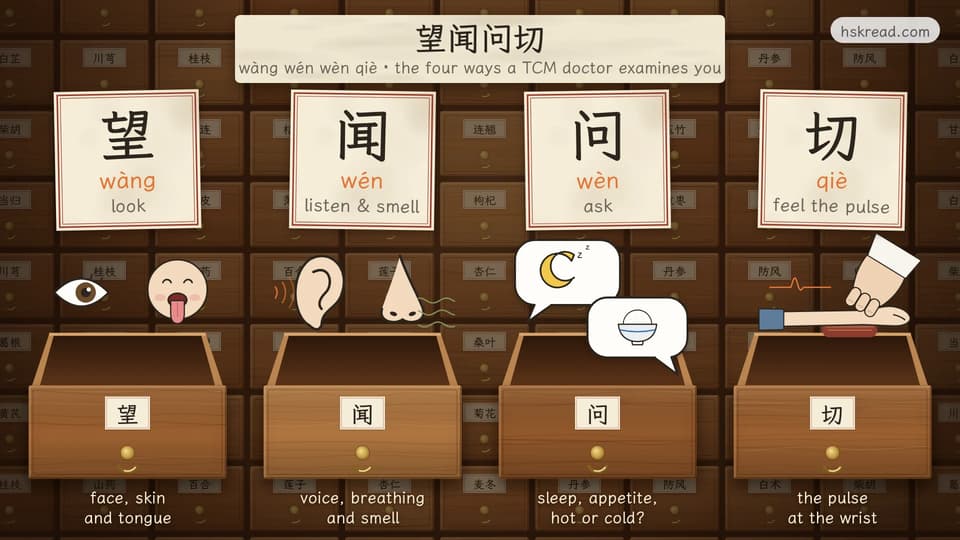
Together they make the four-character phrase 望闻问切. Here is what it often looks like in real life.
First, the doctor may say 伸舌头 (shēn shétou), “stick out your tongue,” before you have even explained why you came. Looking at the tongue (舌头) is a big deal in TCM: the doctor checks its color and the coating on it, called 舌苔 (shétāi).
Then comes the famous part: 把脉 (bǎmài), feeling the pulse. You rest your wrist on a small cushion on the desk. The doctor places three fingers on it, closes their eyes for a moment, and the room goes quiet. Then they switch to your other wrist.
In TCM thinking, the pulse can be “floating,” “deep,” “slippery,” “wiry” and so on—so don't be surprised if the doctor says your pulse is a little “slippery”!
The doctor will also ask lots of questions: Do you sleep well? Do you feel cold easily? Do you like cold drinks? (The answer “yes, I love iced water” usually gets a worried look.)
中药: bitter soup and a wall of drawers
Why does Chinese herbal medicine taste so bitter—and what is that giant wall of tiny drawers? At the end of a visit, a TCM doctor usually writes a 药方 (yàofāng), a prescription that combines many ingredients. Then you go to the pharmacy to 抓药 (zhuāyào), literally “grab medicine.”
In an old-style pharmacy, this is fun to watch: the pharmacist pulls open small wooden drawers in a giant wall cabinet, grabs a handful of roots, leaves or flowers from each one, weighs them on a tiny hand scale and wraps everything in paper packets.
Chinese medicine comes in two common forms:
| Word | Pinyin | Meaning |
|---|---|---|
| 汤药 | tāngyào | herbal decoction; herbs boiled in water for a long time |
| 中成药 | zhōngchéngyào | ready-made Chinese medicine: pills, powders, granules, syrups |
Making 汤药 at home is called 熬药 (áoyào). Ask any Chinese person about it and they will tell you about the strong smell filling the whole apartment—and the taste. Herbal soup is famously, unforgettably bitter. Kids are often given a sweet afterwards to get rid of the taste. Today many hospitals will boil the herbs for you and hand you a stack of sealed pouches, but the bitterness is the same.
That bitterness gave Chinese a great saying: 良药苦口 (liángyào kǔkǒu), “good medicine tastes bitter.” People use it to mean that honest advice can be hard to hear.
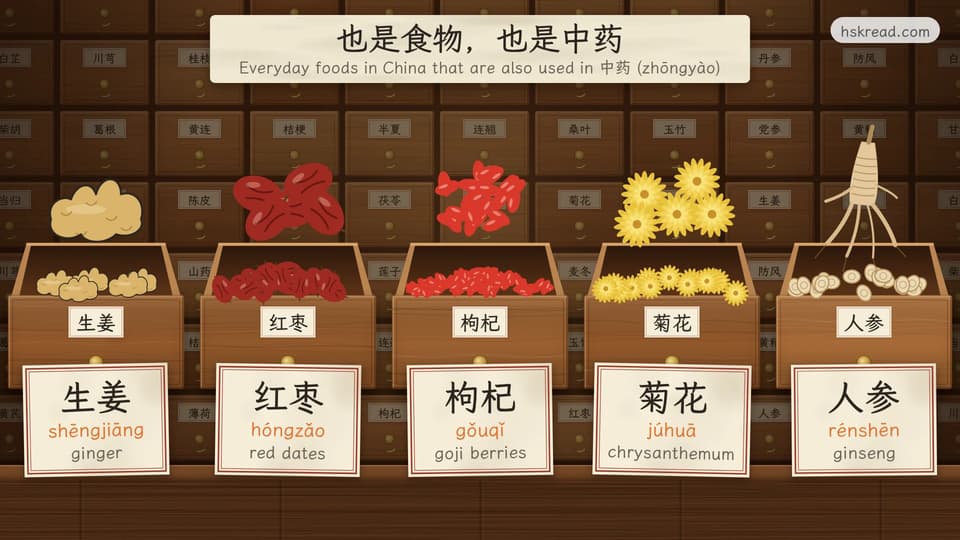
Many 中药 ingredients are also everyday foods in China: ginger (生姜), red dates (红枣), goji berries (枸杞), chrysanthemum flowers (菊花) and ginseng (人参). That is why the line between food and medicine can feel blurry in Chinese culture—your grandma's chicken soup may come with a few roots floating in it.
If you visit Beijing, walk down Dashilan street near Qianmen and look for 同仁堂 (Tóngréntáng). This famous TCM pharmacy opened in 1669 and once supplied medicine to the emperors' palace. Inside, you can still see the old drawers and smell the herbs. (Read more about the city in our Beijing guide.)
上火 and “hot” vs. “cool” foods: TCM at the dinner table
Even people who never see a TCM doctor use TCM ideas every day—especially at the dinner table. These are the words you are most likely to hear over a meal.
上火: “heatiness”
上火 (shànghuǒ) literally means “fire goes up.” It is usually translated as “heatiness” or “internal heat.” People say they have 上火 when they get a sore throat, mouth ulcers, pimples or dry lips—often after eating spicy hotpot, fried food or too much chocolate.
The usual response is to eat “cooling” food or drink herbal tea (凉茶, liángchá), especially in southern China, where you will see herbal tea shops and cans of herbal tea everywhere.
Hot and cool foods
In TCM thinking, foods have a “nature” (性, xìng)—not their temperature on the plate, but the effect they are believed to have on the body. People often talk about 热性 (rèxìng, “hot” nature) and 凉性 (liángxìng, “cool” nature) foods:
| “Cooling” foods (凉性) | “Warming” foods (热性) |
|---|---|
| watermelon (西瓜) | lamb (羊肉) |
| pear (梨) | ginger (生姜) |
| cucumber (黄瓜) | chili pepper (辣椒) |
| bitter melon (苦瓜) | lychee (荔枝) |
| mung beans (绿豆) | longan (桂圆) |
This is why Chinese families drink mung bean soup in summer and eat lamb hotpot in winter. A popular saying even warns that 一颗荔枝三把火, “one lychee, three fires.” Using food this way is called 食疗 (shíliáo), “food therapy.”
多喝热水, 养生 and cupping marks: everyday TCM habits
Why do Chinese people drink hot water in summer, and why did Michael Phelps swim with purple circles on his shoulders? Here are the TCM habits you will notice in daily life.
多喝热水: drink more hot water
Many visitors notice that Chinese people drink hot or warm water, even in summer. Restaurants often serve it for free, and trains, airports and offices have hot water machines. The habit has two roots. TCM thinking has long preferred warm drinks to cold ones. Then, in the 1950s, when tap water was often unsafe, public health campaigns taught people to boil their water before drinking.
Today, 多喝热水 is also a famous internet joke: it is what a boyfriend says when his girlfriend feels sick and he doesn't know what else to say. (Pro tip: it is not the right answer.)
养生: the art of “nourishing life”
养生 (yǎngshēng) means taking care of your health through daily habits: sleeping early, eating well, exercising gently and keeping calm. Tai chi, herbal tea and foot soaks are all part of 养生 culture.
The symbol of 养生 is the thermos cup. In 2017, a photo of a former hard-rock drummer from the famous band Black Panther (黑豹) holding a thermos went viral, and the internet decided that middle age means 保温杯里泡枸杞—goji berries soaking in your thermos. Young people now joke about 朋克养生 (péngkè yǎngshēng), “punk wellness”: staying up all night, but drinking goji tea to make up for it.
Cupping, scraping and massage
- 拔罐 (báguàn, cupping): cups are placed on the skin with suction, leaving round purple marks. The world noticed in 2016, when American swimmer Michael Phelps competed at the Rio Olympics with big round cupping marks on his shoulders. In summer in China, you may spot the same circles on people's backs at the swimming pool.
- 刮痧 (guāshā, scraping): the skin is scraped with a smooth tool, leaving red marks. In the West, “gua sha” is now best known as a face-care stone on beauty videos.
- 推拿 (tuīná): a form of Chinese therapeutic massage, literally “push and grab.”
- 针灸 (zhēnjiǔ): acupuncture and moxibustion—see our full guide.
Chinese medicine legends: Shennong, Hua Tuo and the dumpling doctor
Chinese medicine has a history of more than 2,000 years, and its oldest classic, the 黄帝内经 (Huángdì Nèijīng, Yellow Emperor's Inner Canon), is written as a conversation between a legendary emperor and his doctors. But the best way into this history is through its stories.
Shennong tastes a hundred herbs
According to legend, a mythical ruler named 神农 (Shénnóng), the “Divine Farmer,” wanted to know which plants were food and which were medicine. So he tasted them—hundreds of them, sometimes poisoning himself several times in a single day. The story is called 神农尝百草 (Shénnóng cháng bǎi cǎo), “Shennong tastes a hundred herbs,” and every Chinese child knows it.
Hua Tuo, the ancient surgeon
华佗 (Huà Tuó) lived at the end of the Han dynasty and is remembered as a brilliant doctor. Old records say he used an anesthetic called 麻沸散 to put patients to sleep before surgery, though the recipe is now lost. He also created 五禽戏 (wǔqínxì), the “Five Animals Exercise,” in which you move like a tiger, a deer, a bear, a monkey and a bird. Some people in Chinese parks still practice it today.
In the novel 三国演义 (Romance of the Three Kingdoms), Hua Tuo even scrapes poison from the bone of the general 关羽's arm—while Guan Yu calmly plays a board game and drinks wine. Today, the highest praise for a great doctor is 华佗再世 (Huà Tuó zàishì), “Hua Tuo born again.”
Zhang Zhongjing and the dumpling legend
张仲景 (Zhāng Zhòngjǐng) is honored as the “Sage of Medicine.” A popular legend says that one freezing winter he saw poor people with frostbitten ears, so he cooked mutton, chili and herbs, wrapped them in dough shaped like little ears and gave them out with hot soup. The story says this is where 饺子 (jiǎozi, dumplings) come from—and why many northern Chinese still say you should eat dumplings on the winter solstice (冬至, dōngzhì), or your ears will freeze!
From an old herb book to a Nobel Prize: Li Shizhen and Tu Youyou
One doctor fixed the mistakes in old medicine books; one scientist found a lifesaving clue in one. Here are two true stories, centuries apart.
Li Shizhen, the herb detective
In the Ming dynasty, the doctor 李时珍 (Lǐ Shízhēn) noticed that the old medicine books were full of mistakes. So he spent about 27 years traveling, talking to farmers, hunters and fishermen, and checking plants with his own eyes. The result was the giant 本草纲目 (Běncǎo Gāngmù), the Compendium of Materia Medica, which describes almost 1,900 medicinal plants, animals and minerals.
Tu Youyou and the Nobel Prize
In the 1960s and 70s, malaria was a deadly problem, and China set up a secret research project to find new drugs. The scientist 屠呦呦 (Tú Yōuyōu) and her team searched old medical books and tested hundreds of plant extracts. One plant, sweet wormwood (青蒿, qīnghāo), looked promising, but the extract kept failing.
The clue came from a book written about 1,600 years ago. It told readers to soak the plant in cold water and squeeze out the juice—no boiling. Tu realized that heat might be destroying the active ingredient, so her team switched to a low-temperature method.
It worked. The result, artemisinin (青蒿素), became an important malaria drug, and in 2015 Tu Youyou shared the Nobel Prize in Physiology or Medicine—the first Chinese scientist to win that prize.
The core ideas of TCM
TCM borrows its key ideas from classical Chinese philosophy. You do not need to believe in them to understand them—and knowing them will help you understand a lot of Chinese culture, from tai chi to feng shui.
阴阳: yin and yang
阴阳 (yīnyáng) are two opposite but connected forces: dark and bright, cold and hot, still and moving. (Our tai chi guide explains the famous yin-yang symbol.) In TCM thinking, health means yin and yang are in balance. Too much “heat” or too much “cold” is seen as a sign that the balance is off.
气: qi
气 (qì) is one of the hardest Chinese words to translate. In daily life it means air, gas or breath. In TCM, it is the vital energy believed to flow through the body. You will see 气 in many everyday words: