Chinese Window Paper Cuts (窗花): Meaning, Patterns and How to Make Them
What are 窗花, the red paper cuts on Chinese windows at New Year? Learn when and why families put them up, what the fish, magpie and 福 patterns mean, where they go on the window, and how to cut a simple one yourself.
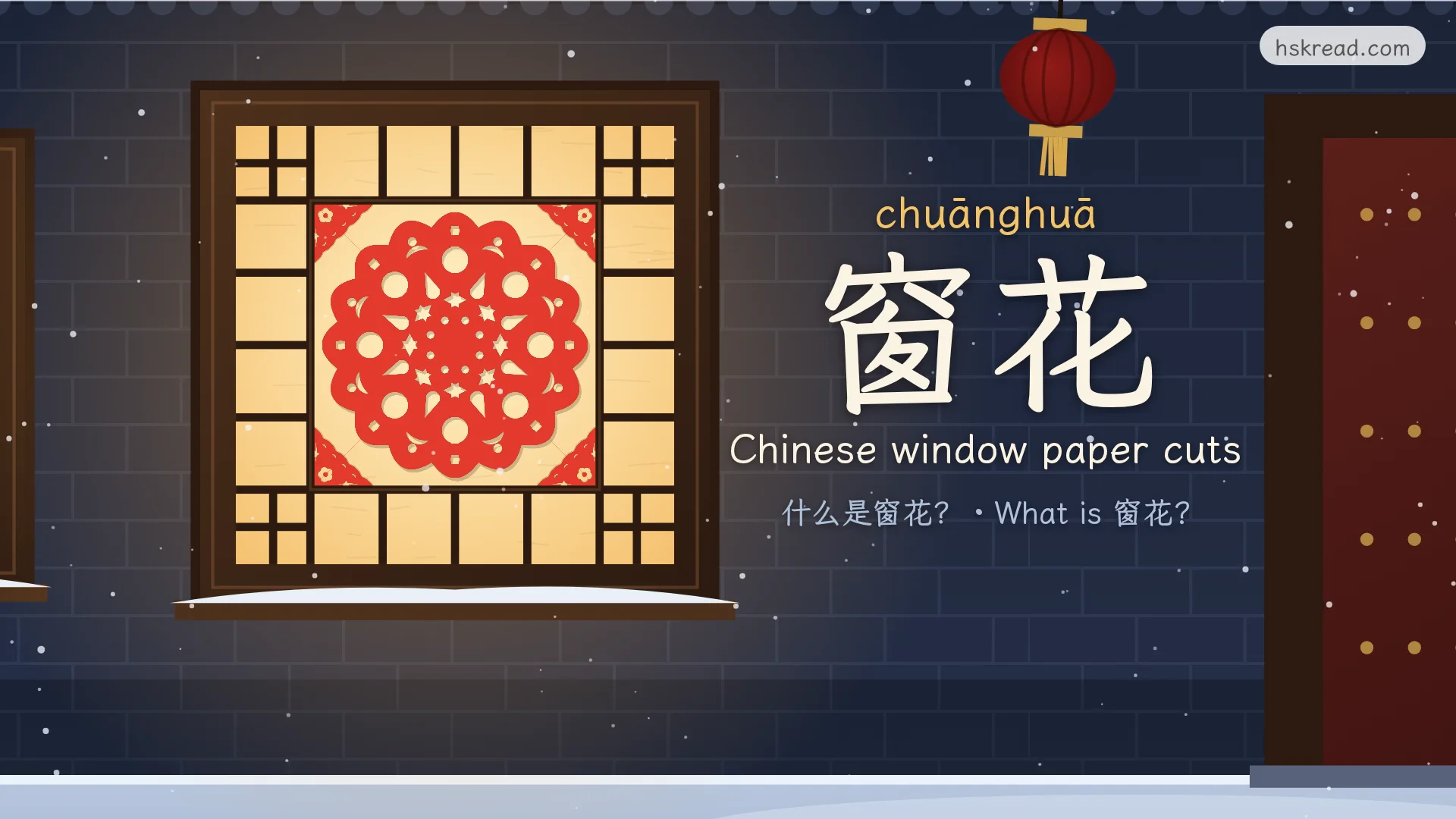
A few days before Chinese New Year, something changes in Chinese homes. Bright red pictures appear on the windows: a fat fish, a magpie on a plum branch, a round flower as big as a plate, or the character 福 for good fortune. At night, when the lights are on inside, the red shapes glow against the dark street.
These are 窗花 (chuānghuā), Chinese window paper cuts.
Putting them up is one of the happiest little jobs of 过年 (guònián, celebrating the New Year). In this guide, you will learn what 窗花 means, what the most common patterns mean, why and when people paste them on their windows, and how to cut a simple one yourself—plus the Chinese words you need to talk about them. Each section stands on its own, so skip to the part you like.
Key takeaways
- What it is: 窗花 means "window flowers": paper cuts, usually red, pasted on windows for the Spring Festival. It is one branch of the bigger art of Chinese paper cutting (剪纸).
- Patterns: most are lucky puns: 鱼 (fish) sounds like 余 (surplus), and 蝠 (bat) sounds like 福 (fortune).
- Why windows: old Chinese windows were made of paper, and red paper cuts let the light through while bringing good luck.
- When: putting them up is called 贴窗花 (tiē chuānghuā). A folk rhyme says it happens on the 28th day of the last lunar month.
- Where: round 团花 go in the middle of the window; small 角花 go in the corners.
- Make or buy: you can make a simple 窗花 with one sheet of red paper, a pair of scissors and a few folds—or pick up a set at a New Year market.
What is 窗花?
Start with the name: 窗花 literally means "window flower," and the two characters tell you almost everything.
The word has two characters:
| Character | Pinyin | Meaning |
|---|---|---|
| 窗 | chuāng | window |
| 花 | huā | flower; a decorative pattern or design |
The 花 here does not have to be a real flower. Like the English word "pattern" (花纹, huāwén), it can mean any pretty design: animals, characters, people or flowers.
窗花 are a kind of 剪纸 (jiǎnzhǐ), the Chinese art of paper cutting. Folk artists often call 窗花 the most common and widespread type of paper cut, because almost every family in northern China used to make or buy them for New Year. (For the history, tools and famous schools of the art, see our guide to Chinese paper cutting.)
Here are the verbs that go with 窗花:
| Chinese | Pinyin | Meaning |
|---|---|---|
| 剪窗花 | jiǎn chuānghuā | to cut window paper cuts |
| 贴窗花 | tiē chuānghuā | to paste them on the window |
| 买窗花 | mǎi chuānghuā | to buy them |
The measure word is 张 (zhāng), the same one used for paper and photos: 一张窗花, "one window paper cut."
Common window paper cut patterns and their meanings
Almost every 窗花 (window paper cut) hides a wish. Many of them work like a picture riddle: you draw a thing whose name sounds like a lucky word. Chinese has many words with the same sound, so this kind of pun, called 谐音 (xiéyīn), is everywhere in New Year decorations.
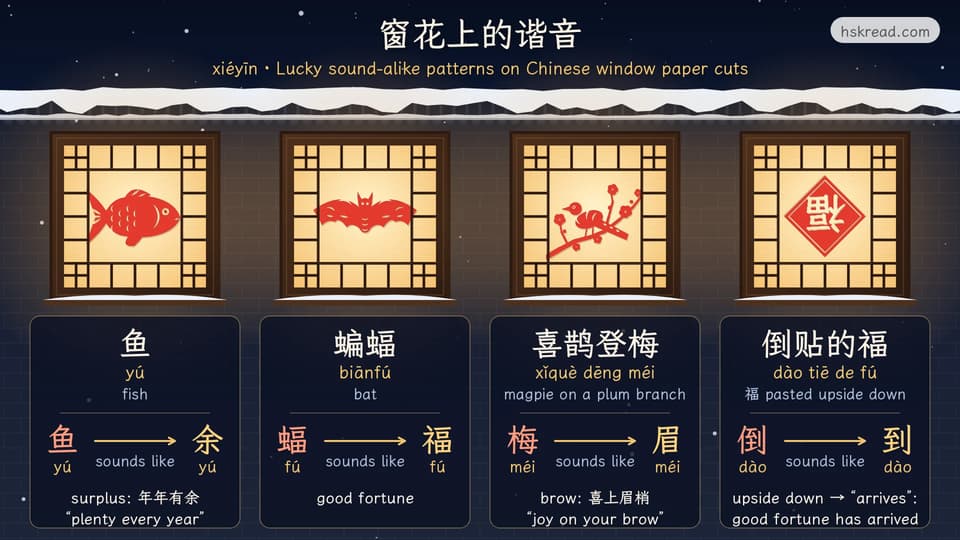
| Pattern | Chinese | Pinyin | The wish |
|---|---|---|---|
| fish | 鱼 | yú | sounds like 余 (yú, surplus): 年年有余, "plenty every year" |
| lotus and fish | 莲 + 鱼 | lián + yú | 莲 sounds like 连 (lián, in a row): 连年有余, "plenty year after year" |
| bat | 蝙蝠 | biānfú | 蝠 sounds like 福 (fú): good fortune |
| magpie on a plum branch | 喜鹊登梅 | xǐquè dēng méi | 梅 (plum) sounds like 眉 (eyebrow): 喜上眉梢, "joy on your brow" |
| the character 福 | 福 | fú | good fortune; often pasted upside down, because 倒 sounds like 到 |
| the zodiac animal | 生肖 | shēngxiào | the animal of the coming year, e.g. a goat for 2027 |
| peony | 牡丹 | mǔdan | wealth and honor (富贵, fùguì) |
| pomegranate | 石榴 | shíliu | its many seeds stand for many children |
| "double happiness" | 囍 | xǐ | two 喜 joined together: used for weddings |
Four favorite patterns, up close
Why a fish? Why a magpie on a plum branch? Here are the stories behind four patterns you will see on Chinese windows again and again.
- Fish. A fish is probably the most popular 窗花 (window paper cut) of all. 鱼 (yú) and 余 (yú, "surplus; something left over") sound exactly the same, so a fish means "may you have more than you need." Families also eat fish at the New Year's Eve dinner for the same reason.
- The magpie and the plum. The 喜鹊 (xǐquè, magpie) is a "bird of joy"—its name even starts with 喜, "happiness." Plum blossoms open at the end of winter, so they announce spring. Put them together and you get 喜上眉梢 (xǐ shàng méishāo), an idiom for a face so happy that the joy shows on the eyebrows.
- The zodiac animal. Every year, shops fill with paper cuts of the new 生肖 (shēngxiào, zodiac animal). 2027 is the Year of the Goat, so expect lots of paper goats. Goats are a lucky pattern too, because 羊 (yáng, goat) sounds like 阳 (yáng, sunshine; yang), giving the pun 三羊开泰, "three goats bring peace," a play on the old New Year greeting 三阳开泰, “the return of spring brings good luck.”
- Stories. In northern villages, 窗花 often show scenes from old stories and local operas: heroes of the Three Kingdoms, or the Monkey King from Journey to the West. A set of several windows can tell a whole story.
Why paste paper cuts on windows?
Why windows, and why red? The answer starts with what Chinese windows used to be made of.
Paper windows and winter light
For most of Chinese history, ordinary homes did not have glass windows. A wooden window frame had a grid of thin wooden bars, called 窗格 (chuānggé), and people covered it with thin white 窗户纸 (chuānghuzhǐ, window paper). The paper let in light and kept out the cold wind.
A plain white window in the gray northern winter looks a little sad. A red paper cut pasted on it changes everything.
During the day, sunlight shines through the cut-out holes. At night, the lamp inside makes the whole pattern glow for people walking past. That is why 窗花 are usually small and full of holes: they decorate the window without blocking too much light.
Glass windows slowly replaced paper ones in the 20th century, but the custom (习俗, xísú) stayed. Today 窗花 (window paper cuts) go straight onto the glass (玻璃, bōli).
Red for joy and good luck
Red (红, hóng) is the color of joy, good luck (吉祥, jíxiáng) and celebration in Chinese culture, and it is the main color of the Spring Festival. In folk belief, red also keeps bad luck away. So when a home is covered in red paper—couplets on the door, 窗花 on the window, lanterns at the gate—it is ready to welcome a lucky new year.
Who made 窗花? A winter job and a test of skill
Long before you could buy them in a shop, window paper cuts were how village women showed off their skill.
People in China were cutting paper and silk into shapes for festivals more than 1,400 years ago, long before 窗花 had their name. Over the centuries, cutting window flowers became a winter job for the women of northern villages. It was also a quiet competition.
In the countryside of Shaanxi, people used to say that when you check out a new bride, “first look at her windows, then at her door curtain” (一看窗子二看帘)—her paper cuts and her embroidery showed how clever her hands were. At New Year, women walked from house to house admiring each other's 窗花 and copying the best designs to take home.
Today the custom is strongest in the north. In some northern villages, people say that a house with no 窗花 (window paper cuts) at New Year makes the neighbors wonder whether something bad has happened. In many parts of southern China, families are more likely to use paper cuts for weddings than for the New Year windows.
When do people put up window paper cuts?
There is a special day for it—and a folk rhyme to remind you.
窗花 (chuānghuā, window paper cuts) belong to the Spring Festival (春节, Chūnjié), also called Chinese New Year or Lunar New Year. The holiday follows the Chinese lunar calendar, so its date changes every year. (For the other festivals of the year, see our overview of Chinese traditional festivals.)
The last days of the old year are full of jobs, and a well-known folk rhyme gives each day its task. In many versions, one line goes:
二十八,贴花花。
"On the 28th, put up the decorations."
The "28th" is the 28th day of the last lunar month, called 腊月 (làyuè).
花花 is a cute, childlike word for all the red decorations: 窗花 on the windows, 春联 (chūnlián, spring couplets) on both sides of the door, an upside-down 福 and colorful New Year pictures (年画, niánhuà).
The rhyme changes from place to place, so not every family follows it exactly, but the idea is the same: put the red up before New Year's Eve (除夕, chúxī), not on the last day. Some people joke that if you wait until New Year's Eve to put up your 窗花, you have "run out of days."
| Year | 28th day of 腊月 | New Year's Eve (除夕) | Chinese New Year | Zodiac animal |
|---|---|---|---|---|
| 2026 | Feb 15 | Feb 16 | Feb 17 | Horse 马 |
| 2027 | Feb 4 | Feb 5 | Feb 6 | Goat 羊 |
| 2028 | Jan 24 | Jan 25 | Jan 26 | Monkey 猴 |
Families often clean the whole house first, wash the windows, and only then paste on the new 窗花. Old, faded ones from last year come down, and fresh red ones go up: a small, bright way of saying goodbye to the old year.
Where do 窗花 go on the window?
Round flowers in the middle, little triangles in the corners: here is how a Chinese family lays out its window paper cuts. There are no strict rules, but most families follow a simple layout:
| Type | Chinese | Pinyin | Where it goes |
|---|---|---|---|
| round flower | 团花 | tuánhuā | the center of a window pane; cut from folded paper |
| corner flower | 角花 | jiǎohuā | the four corners, as a matching set of triangles |
Between them go single pictures: a fish, the zodiac animal or a 福 in the middle of a pane.
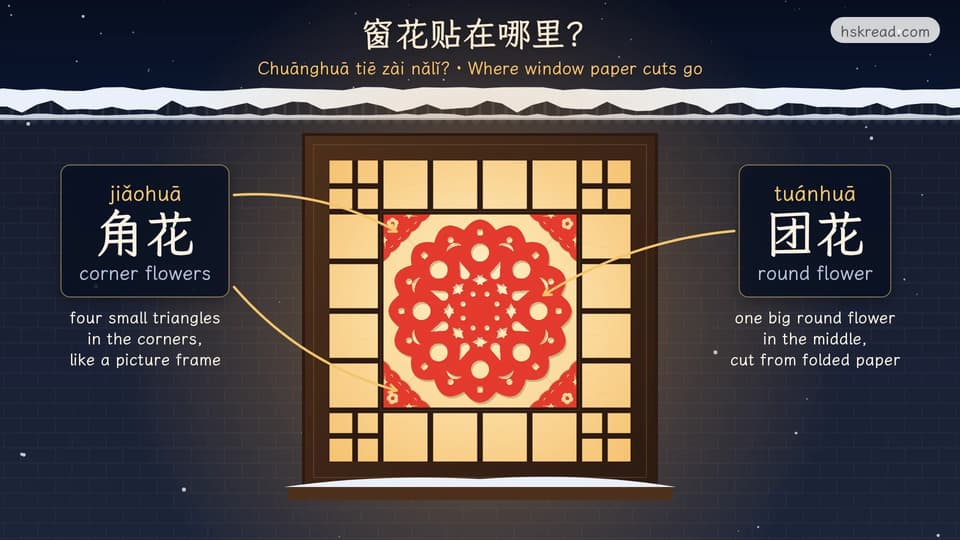
The 团花 (tuánhuā, round flower) is the classic. You fold the paper several times, cut once, and open it to find a perfectly symmetrical (对称, duìchèn) circle. It is also one of the oldest designs: the earliest surviving Chinese paper cuts, more than 1,400 years old, are round flowers of this kind.
Many families also like balance and pairs. If one window has a fish swimming left, the window next to it may have a fish swimming right. A window with a big 团花 in the middle often has four small 角花 (jiǎohuā) in its corners, like a picture frame.
Doors get their own decorations. Spring couplets go on both sides, and a 福 goes in the middle. In Tianjin, people also hang rows of long paper cuts called 吊钱 (diàoqián) from the top of the door frame or window; they flutter in the wind and carry wishes like 四季平安, "peace in all four seasons."
How to make a simple 窗花, step by step
You do not need to be an artist to make a window paper cut. A basic 团花 (tuánhuā, round paper-cut flower) takes about ten minutes, and the moment you unfold it always feels a little like magic.
You need: a square of thin red paper (about 15 × 15 cm), a pair of small sharp 剪刀 (jiǎndāo, scissors), and a pencil.
- Fold in half. Fold the square along the diagonal to make a triangle.
- Fold again. Fold the triangle in half to make a smaller triangle.
- Fold once more. Fold it in half one more time. You now have a thin triangle with eight layers. The point at the bottom is the center of your 团花.
- Draw. With the pencil, draw a few simple shapes along both folded edges: half-moons, small triangles, little teardrops. Draw a curve across the top to make the outside round.
- Cut. Cut out the shapes you drew. Do not cut all the way across the paper from one fold to the other, or it will fall apart.
- Open it carefully. Unfold slowly. Every cut repeats eight times, and a round, symmetrical flower appears.
- Press it flat. Put it under a heavy book for a while so it lies flat on the glass.
- Paste it up. Wet the window glass a little and press the paper cut on, or use tiny pieces of tape at the back.
Bonus: 囍 for a wedding. Fold a rectangle of red paper in half, then in half again the same way. Along the folded edge, draw half of the character 喜 (xǐ, joy), with its horizontal strokes touching the fold. Cut and open it, and you will get two 喜 joined side by side: 囍, "double happiness," the classic decoration for a Chinese wedding.
Buying window paper cuts today
Want some for your own window? Here is where people in China get theirs.
Most city families today buy their 窗花 instead of cutting them. A few weeks before the Spring Festival, they are everywhere:
- New Year markets and street stalls. 年货 (niánhuò, New Year shopping) markets sell piles of 窗花, couplets and 福 characters side by side.
- Supermarkets and online shops. You can find whole sets with matching 团花 (round center pieces) and 角花 (corner pieces), often with the new year's zodiac animal.
- Machine-cut vs. hand-cut. Cheap 窗花 are usually cut by machine, dozens at a time. Hand-cut (手工, shǒugōng) pieces from folk artists cost more but have softer, more lively lines—you can see small differences between them.
- Window clings. Many people now use 窗贴 (chuāngtiē), plastic or static-cling stickers printed with 窗花 designs. They stick without glue, peel off easily and can be used again next year.
- Paper cutting workshops. Museums, cultural centers and some schools hold 窗花 classes before the New Year, and they are a fun thing to try if you are in China in winter.
A set of paper 窗花 is also one of the easiest souvenirs to bring home from China: light, flat, cheap and beautiful.
Regional styles in brief
Bold farm animals in the northwest, bright dyed colors in Hebei, fine lace-like lines in the south: paper cuts look different across China. Here is a very short tour (the full story is in our paper cutting guide):
- Northwest China (Shaanxi, Shanxi, Gansu): Bold, simple shapes cut with scissors, usually from a single sheet of red paper. Farm animals, village life and big round flowers. They look strong and a little naive, in a charming way.
- Yu County (蔚县, Yùxiàn), Hebei: Here people call all paper cuts 窗花. Instead of scissors, artists cut thin paper with a small knife, then dye it in bright pinks, greens and yellows. The colors glow beautifully on a window.
- Southern China (Yangzhou, Foshan and others): Finer, more delicate work, with thin lines and detailed flowers. In the south, these fine paper cuts are often made for weddings, gifts and decorations rather than New Year windows.
Useful vocabulary
| Chinese | Pinyin | English |
|---|---|---|
| 窗花 | chuānghuā | window paper cut |
| 贴窗花 | tiē chuānghuā | to put up window paper cuts |
| 剪纸 | jiǎnzhǐ | paper cutting; a paper cut |
| 窗户 | chuānghu | window |
| 红纸 | hóngzhǐ | red paper |
| 剪刀 | jiǎndāo | scissors |
| 对折 | duìzhé | to fold in half |
| 图案 | tú'àn | pattern; design |
| 团花 | tuánhuā | round paper-cut flower |
| 角花 | jiǎohuā | corner decoration |
| 春联 | chūnlián | spring couplets |
| 福 | fú | good fortune |
| 年年有余 | niánnián yǒu yú | may you have plenty every year |
| 喜上眉梢 | xǐ shàng méishāo | joy shows on your brow |
| 囍 | xǐ | double happiness (for weddings) |
| 生肖 | shēngxiào | Chinese zodiac animal |
| 窗贴 | chuāngtiē | window cling; window sticker |
Next Spring Festival, when you see red flowers glowing on a window, you will know what they say—and maybe you will cut one yourself. 新年快乐!
Check your understanding
01What are Chinese window paper cuts called?
They are called 窗花 (chuānghuā), literally "window flowers." They are paper cuts, usually red, that families paste on their windows for the Spring Festival. Putting them up is called 贴窗花 (tiē chuānghuā).
02When do Chinese people put up window paper cuts?
Usually in the last days before Chinese New Year. A popular folk rhyme says "二十八,贴花花"—on the 28th day of the last lunar month, put up the decorations. In 2027 that day falls on February 4, two days before New Year's Day on February 6.
03What is the difference between 窗花 and 剪纸?
剪纸 (jiǎnzhǐ) is the whole art of Chinese paper cutting. 窗花 is one kind of 剪纸—the paper cuts made to decorate windows, especially at New Year. Paper cuts for weddings, gifts or walls are also 剪纸, but they are not 窗花.
04Why are Chinese window paper cuts red?
Red is the color of joy and good luck in Chinese culture, and it is the main color of the Spring Festival. In folk belief, red also keeps bad luck away. Some regions also make dyed paper cuts in many colors.
05How do you stick window paper cuts on glass?
Traditionally people used a little flour paste. Today most people wet the glass and press the paper cut on, or use tiny pieces of tape or glue. Many shops also sell 窗贴, plastic window clings that stick without glue and can be used again.
06When should you take window paper cuts down?
There is no strict rule. Many families leave them up at least until the Lantern Festival, the 15th day of the first lunar month (February 20 in 2027), and some keep them until they fade and replace them the next New Year.