The Chinese Lunar Calendar (农历): How China's Farming Calendar Works
Learn how the Chinese lunar calendar works—lunar months, leap months, the 24 solar terms, the 60-year cycle and zodiac, traditional festivals—and the Chinese words you need to read a 农历 date.
Why is Chinese New Year on February 17 in 2026 but on February 6 in 2027? Why do some Chinese grandparents celebrate their birthday on a different day every year? And why does a Chinese wall calendar show two different dates for every day?
The answer is 农历 (nónglì), China's traditional calendar. Its name means “the farming calendar,” and for more than two thousand years it told people when to plant, when to harvest and when to celebrate. Today, most of daily life in China runs on the Western calendar, but 农历 still decides the dates of the biggest festivals and appears on almost every calendar and phone. In this guide, you will learn how it works, why it matters to farmers, and the Chinese words you need to read it.
Key takeaways
- 农历 is a lunisolar calendar: its months follow the moon, and its years follow the sun.
- Each month starts on a new moon (初一), and the full moon falls around the 15th (十五).
- An extra leap month (闰月) is added about seven times every 19 years.
- The 24 solar terms (二十四节气) follow the sun and guided farm work. They are UNESCO heritage.
- Years are named with the 60-year cycle of 天干地支, which is linked to the 12 zodiac animals.
- Spring Festival, the Dragon Boat Festival and the Mid-Autumn Festival all follow 农历.
What is 农历?
农历 combines 农 (nóng, “farming”) and 历 (lì, “calendar”). China actually uses two calendars side by side:
| Calendar | Pinyin | Also called | Based on |
|---|---|---|---|
| 农历 | nónglì | 阴历 (yīnlì, “moon calendar”), 旧历 (“old calendar”), 夏历 (“Xia calendar”) | the moon and the sun |
| 公历 | gōnglì | 阳历 (yánglì, “sun calendar”), 新历 (“new calendar”) | the sun (Gregorian) |
You will hear 阴历 and 阳历 a lot in daily speech. Strictly speaking, 农历 is not a pure moon calendar—it follows both the moon and the sun—but 阴历 is the everyday nickname.
In the early 20th century, after China adopted the Western calendar, the traditional one was often called 夏历 (xiàlì, “the Xia calendar”), because its year begins in the month that the ancient Xia dynasty was said to use. In mainland China, the name 农历 became standard in the second half of the 20th century, highlighting its close link to farming.
How lunar months work
One month = one moon
In 农历, every month begins on the day of the new moon, when the moon is invisible. That day is 初一 (chūyī, “first day”). About two weeks later, around 十五 (shíwǔ, the 15th), the moon is full. That is why the Lantern Festival (正月十五) and the Mid-Autumn Festival (八月十五) are both full-moon festivals.
A cycle of the moon takes about 29.5 days, so a lunar month has either 30 days (a “big month,” 大月) or 29 days (a “small month,” 小月). Sometimes the moon is fullest on the 16th, not the 15th, which gave rise to the saying 十五的月亮十六圆—“the moon of the 15th is roundest on the 16th.”
The 11-day problem and the leap month
Twelve lunar months add up to only about 354 days. A solar year has about 365 days. If nothing were done, the calendar would slip 11 days every year, and in about 16 years the New Year would land in the middle of summer.
The solution is the 闰月 (rùnyuè, “leap month”). About seven times every 19 years, the calendar adds a 13th month. The leap month takes the name of the month before it: 2023 had a 闰二月 (“leap second month”), and 2025 had a 闰六月 (“leap sixth month”). A year with a leap month has 383 or 384 days. This keeps 农历 in step with the seasons, so Spring Festival always falls in late January or February.
Naming months and days
农历 months and days have their own names. Here is how to read them:
| Lunar month | Chinese | Pinyin | Note |
|---|---|---|---|
| 1st month | 正月 | zhēngyuè | 正 is read zhēng here, not zhèng |
| 2nd–10th | 二月 … 十月 | èryuè … shíyuè | just like normal months |
| 11th month | 冬月 | dōngyuè | “the winter month” |
| 12th month | 腊月 | làyuè | the last month, before Spring Festival |
| Lunar day | Chinese | Pinyin |
|---|---|---|
| 1st–10th | 初一 … 初十 | chūyī … chūshí |
| 11th–20th | 十一 … 二十 | shíyī … èrshí |
| 21st–29th | 廿一 … 廿九 | niànyī … niànjiǔ |
| 30th | 三十 | sānshí |
The character 廿 (niàn) means “twenty.” It is common on calendars, but in speech most people simply say 二十一, 二十二 and so on.
So when you see 2026年10月7日 星期三 农历八月廿七, it means “Wednesday, October 7, 2026—the 27th day of the eighth lunar month.”
The 24 solar terms: the farming heart of 农历
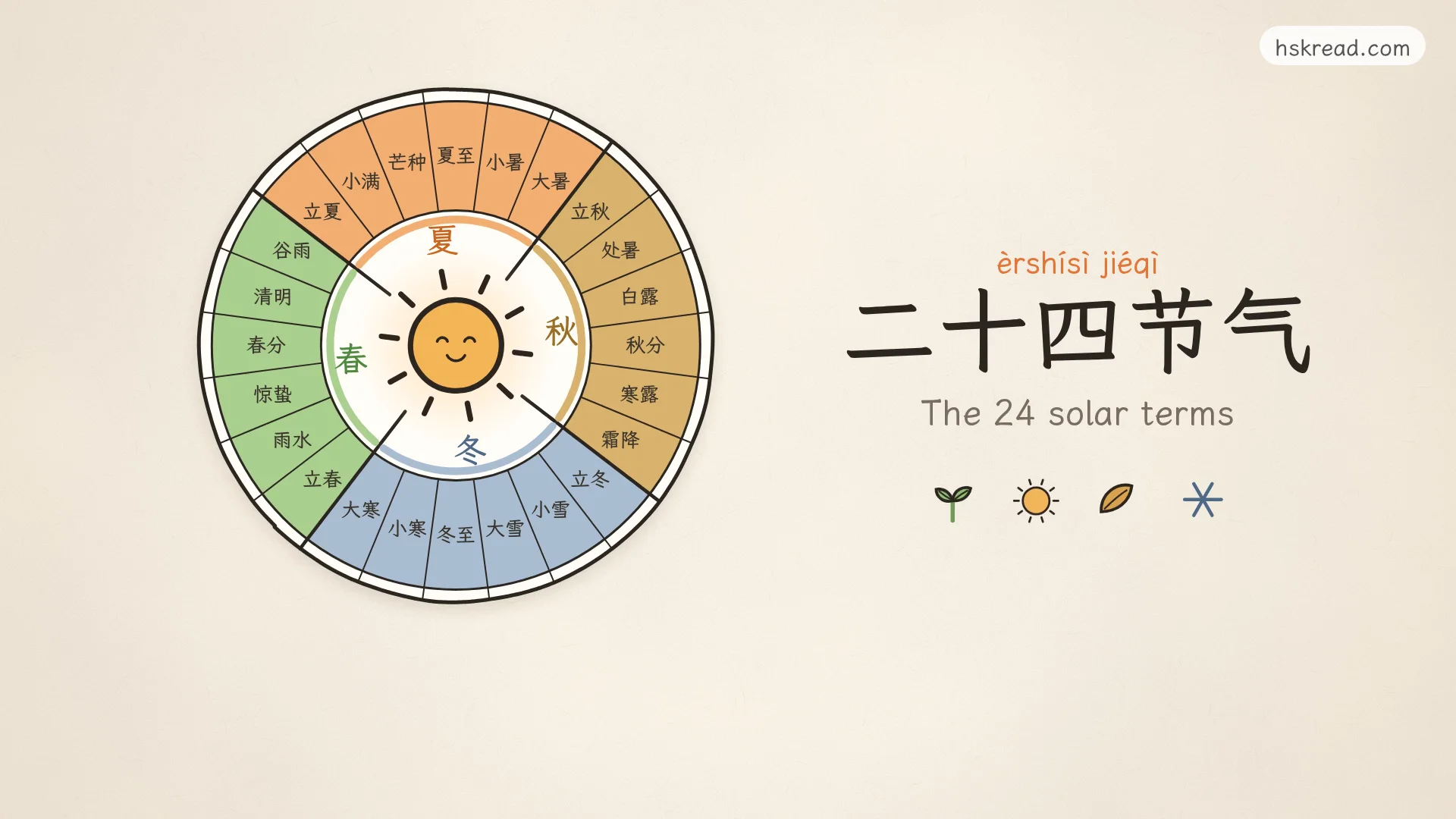
If the months follow the moon, how did farmers know when to plant? The moon tells you nothing about the seasons. For that, ancient Chinese astronomers divided the sun's yearly path into 24 equal parts, about 15 days apart. These are the 二十四节气 (èrshísì jiéqì, “24 solar terms”).
Because they follow the sun, the solar terms fall on almost the same Western dates every year. Each one has a name that describes the weather or farm life at that time:
| Season | Solar term | Pinyin | English name | In 2026 |
|---|---|---|---|---|
| Spring | 立春 | lìchūn | Start of Spring | Feb 4 |
| 雨水 | yǔshuǐ | Rain Water | Feb 18 | |
| 惊蛰 | jīngzhé | Awakening of Insects | Mar 5 | |
| 春分 | chūnfēn | Spring Equinox | Mar 20 | |
| 清明 | qīngmíng | Clear and Bright | Apr 5 | |
| 谷雨 | gǔyǔ | Grain Rain | Apr 20 | |
| Summer | 立夏 | lìxià | Start of Summer | May 5 |
| 小满 | xiǎomǎn | Grain Buds | May 21 | |
| 芒种 | mángzhòng | Grain in Ear | Jun 5 | |
| 夏至 | xiàzhì | Summer Solstice | Jun 21 | |
| 小暑 | xiǎoshǔ | Minor Heat | Jul 7 | |
| 大暑 | dàshǔ | Major Heat | Jul 23 | |
| Autumn | 立秋 | lìqiū | Start of Autumn | Aug 7 |
| 处暑 | chǔshǔ | End of Heat | Aug 23 | |
| 白露 | báilù | White Dew | Sep 7 | |
| 秋分 | qiūfēn | Autumn Equinox | Sep 23 | |
| 寒露 | hánlù | Cold Dew | Oct 8 | |
| 霜降 | shuāngjiàng | Frost's Descent | Oct 23 | |
| Winter | 立冬 | lìdōng | Start of Winter | Nov 7 |
| 小雪 | xiǎoxuě | Minor Snow | Nov 22 | |
| 大雪 | dàxuě | Major Snow | Dec 7 | |
| 冬至 | dōngzhì | Winter Solstice | Dec 22 | |
| 小寒 | xiǎohán | Minor Cold | Jan 5 | |
| 大寒 | dàhán | Major Cold | Jan 20 |
The dates are for 2026. In other years, a solar term can move by a day or so.
Chinese children learn all 24 with a short rhyme. Each character stands for one term, in order:
春雨惊春清谷天,夏满芒夏暑相连,
秋处露秋寒霜降,冬雪雪冬小大寒。
Farming wisdom in the solar terms
For farmers, the solar terms were a practical guide. Many old sayings link them to farm work and food:
Some solar terms are festivals in their own right. 清明 is also Tomb-Sweeping Day, when families visit their ancestors' graves, and 冬至 is a family day when many northern families eat dumplings and southern families eat sweet rice balls (汤圆). In 2016, UNESCO added the 24 solar terms to the list of the Intangible Cultural Heritage of Humanity.
The 60-year cycle and the zodiac
Heavenly Stems and Earthly Branches
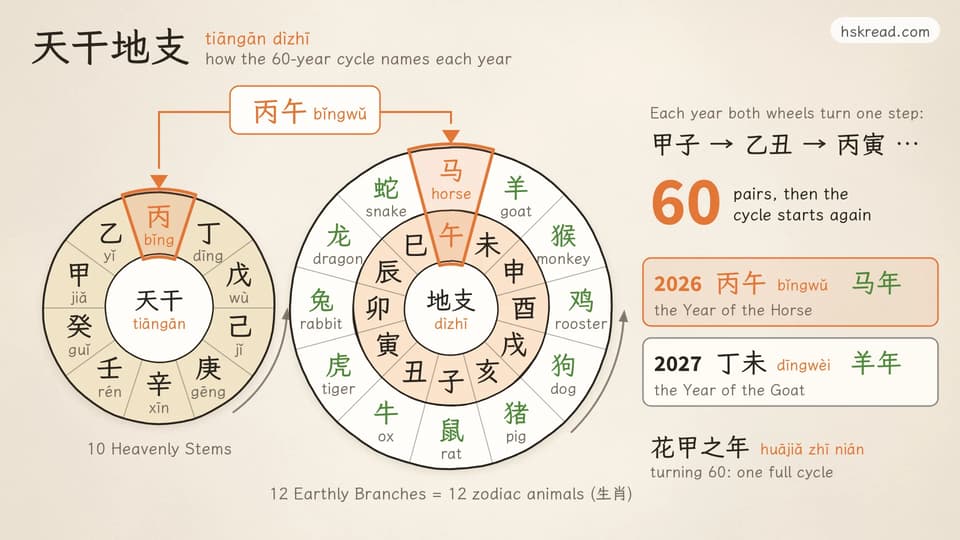
农历 years do not only have numbers. They also have names from an ancient counting system called 天干地支 (tiāngān dìzhī, “Heavenly Stems and Earthly Branches”):
- 10 Heavenly Stems (天干): 甲 乙 丙 丁 戊 己 庚 辛 壬 癸
- 12 Earthly Branches (地支): 子 丑 寅 卯 辰 巳 午 未 申 酉 戌 亥
One stem and one branch are paired to name each year: 甲子, 乙丑, 丙寅… After 60 combinations, the cycle starts again. The year that began on February 17, 2026 is a 丙午 (bǐngwǔ) year, and 2027 will be a 丁未 (dīngwèi) year.
Many famous events in modern Chinese history are named by this system:
| Event | Year | Meaning |
|---|---|---|
| 甲午战争 (Jiǎwǔ Zhànzhēng) | 1894 | the war of the 甲午 year |
| 戊戌变法 (Wùxū Biànfǎ) | 1898 | the reform movement of the 戊戌 year |
| 辛亥革命 (Xīnhài Gémìng) | 1911 | the 1911 Revolution, in the 辛亥 year |
Because the cycle is 60 years long, turning 60 is special. A 60-year-old is said to have reached 花甲之年 (huājiǎ zhī nián), “the year of the flowery cycle.”
The 12 zodiac animals
The 12 Earthly Branches match the 12 animals of the Chinese zodiac, 生肖 (shēngxiào):
| Branch | Pinyin | Animal | Pinyin | English |
|---|---|---|---|---|
| 子 | zǐ | 鼠 | shǔ | rat |
| 丑 | chǒu | 牛 | niú | ox |
| 寅 | yín | 虎 | hǔ | tiger |
| 卯 | mǎo | 兔 | tù | rabbit |
| 辰 | chén | 龙 | lóng | dragon |
| 巳 | sì | 蛇 | shé | snake |
| 午 | wǔ | 马 | mǎ | horse |
| 未 | wèi | 羊 | yáng | goat |
| 申 | shēn | 猴 | hóu | monkey |
| 酉 | yǒu | 鸡 | jī | rooster |
| 戌 | xū | 狗 | gǒu | dog |
| 亥 | hài | 猪 | zhū | pig |
Since 2026 is a 午 year, it is the Year of the Horse (马年). 2027, a 未 year, will be the Year of the Goat (羊年). Most people treat the new zodiac year as starting at Spring Festival, although traditional fortune-telling starts it at 立春.
Your own zodiac year, which comes back every 12 years, is your 本命年 (běnmìngnián). Many people wear something red that year for good luck.
Festivals that follow 农历
Most traditional Chinese festivals are set by the lunar calendar, so their Western dates change every year:
| Festival | Chinese | Lunar date | In 2026–27 |
|---|---|---|---|
| Spring Festival (Chinese New Year) | 春节 | 正月初一 | Feb 17, 2026 |
| Lantern Festival | 元宵节 | 正月十五 | Mar 3, 2026 |
| Dragon Boat Festival | 端午节 | 五月初五 | Jun 19, 2026 |
| Qixi (Chinese Valentine's Day) | 七夕 | 七月初七 | Aug 19, 2026 |
| Mid-Autumn Festival | 中秋节 | 八月十五 | Sep 25, 2026 |
| Double Ninth Festival | 重阳节 | 九月初九 | Oct 18, 2026 |
| Laba Festival | 腊八节 | 腊月初八 | Jan 15, 2027 |
| New Year's Eve | 除夕 | the last day of 腊月 | Feb 5, 2027 |
Notice that 除夕 is not always 腊月三十. It is simply the last night of the year. When 腊月 is a small month with 29 days, 除夕 falls on 腊月廿九—as it does in early 2027.
Two important days follow the solar terms instead: 清明 (around April 5) and 冬至 (around December 22).
A short history of 农历
- Ancient roots: One of China's oldest calendar texts, the Xia Xiaozheng (《夏小正》), lists the stars, weather and farm work for each month of the year.
- 104 BCE, the Taichu Calendar (太初历): Under Emperor Wu of the Han dynasty, astronomers created a new official calendar. It fixed the start of the year in the month we still call 正月 and built the 24 solar terms into the calendar.
- Many reforms: Over the next two thousand years, astronomers in each dynasty improved their calculations again and again.
- 1645, the Shixian Calendar (时宪历): In the early Qing dynasty, a calendar based on more precise astronomy, with help from the German Jesuit Adam Schall von Bell (汤若望), became official. Today's 农历 is built on its methods.
- 1912: The new Republic of China adopted the Western calendar for official use, but people kept using 农历 for festivals and daily life.
- Today: China uses 公历 for work, school and government, and 农历 for festivals, birthdays and tradition. The Purple Mountain Observatory (紫金山天文台) calculates the calendar under a national standard.
农历 in daily life today
- Calendars and phones: Chinese wall calendars and phone calendars show both dates, often with the solar term or festival of the day.
- Lunar birthdays: Many older people still celebrate their birthday on its 农历 date.
- The almanac: Some families check the 黄历 (huánglì, traditional almanac) before a wedding or a move. For each day, it lists things that are 宜 (yí, “good to do”) and 忌 (jì, “best avoided”), such as 宜嫁娶 (“good for weddings”).
- An expression: Because almanacs go out of date every year, 老黄历 (lǎo huánglì, “an old almanac”) also means “outdated rules” or “old news.”
Useful vocabulary
| Chinese | Pinyin | English |
|---|---|---|
| 农历 | nónglì | the Chinese (farming) calendar |
| 阴历 | yīnlì | the lunar calendar (everyday name) |
| 公历 | gōnglì | the Gregorian calendar |
| 阳历 | yánglì | the solar calendar (everyday name) |
| 初一 | chūyī | the 1st day of a lunar month |
| 十五 | shíwǔ | the 15th day of a lunar month; full moon |
| 正月 | zhēngyuè | the first lunar month |
| 腊月 | làyuè | the twelfth lunar month |
| 闰月 | rùnyuè | leap month |
| 节气 | jiéqì | solar term |
| 二十四节气 | èrshísì jiéqì | the 24 solar terms |
| 天干地支 | tiāngān dìzhī | Heavenly Stems and Earthly Branches |
| 生肖 | shēngxiào | Chinese zodiac animal |
| 本命年 | běnmìngnián | the year of your own zodiac animal |
| 黄历 | huánglì | traditional almanac |
| 宜 / 忌 | yí / jì | good to do / best avoided |
Next time you look at a Chinese calendar, look for the small characters under each date. Now you can read them—and you will know when the next full moon and the next festival are coming.
Check your understanding
01What is 农历?
农历 (nónglì), “the farming calendar,” is China's traditional calendar. Its months follow the moon, while leap months and the 24 solar terms keep it in step with the sun and the seasons.
02Is the Chinese calendar lunar or solar?
Both. It is a lunisolar calendar. Each month begins on a new moon, but an extra leap month is added about seven times every 19 years so that the calendar stays in line with the solar year.
03Why does Chinese New Year change every year?
Chinese New Year is the first day of the first lunar month (正月初一). Because 12 lunar months are about 11 days shorter than a solar year, the date moves on the Western calendar. It always falls between January 21 and February 20.
04What are the 24 solar terms?
二十四节气 are 24 points in the solar year, about 15 days apart, such as 立春 (Start of Spring) and 冬至 (Winter Solstice). Farmers used them to know when to plant and harvest. They were added to UNESCO's intangible cultural heritage list in 2016.
05What is a leap month in the Chinese calendar?
A leap month (闰月, rùnyuè) is an extra month added to some years so that the lunar calendar does not drift away from the seasons. It repeats the name of the month before it, such as 闰六月, “leap sixth month.”
06How do you say lunar dates in Chinese?
Months are 正月, 二月 … 十月, 冬月 and 腊月. Days 1–10 use 初 (初一 to 初十), then 十一 to 二十, then 廿一 to 廿九 (also said as 二十一 to 二十九), and 三十.