Comprehensible Input for Chinese: The Science of Learning by Reading
What research says about learning Chinese through reading and listening, from i+1 and the 98% rule to quizzes and spaced review, turned into seven simple principles and a daily routine.
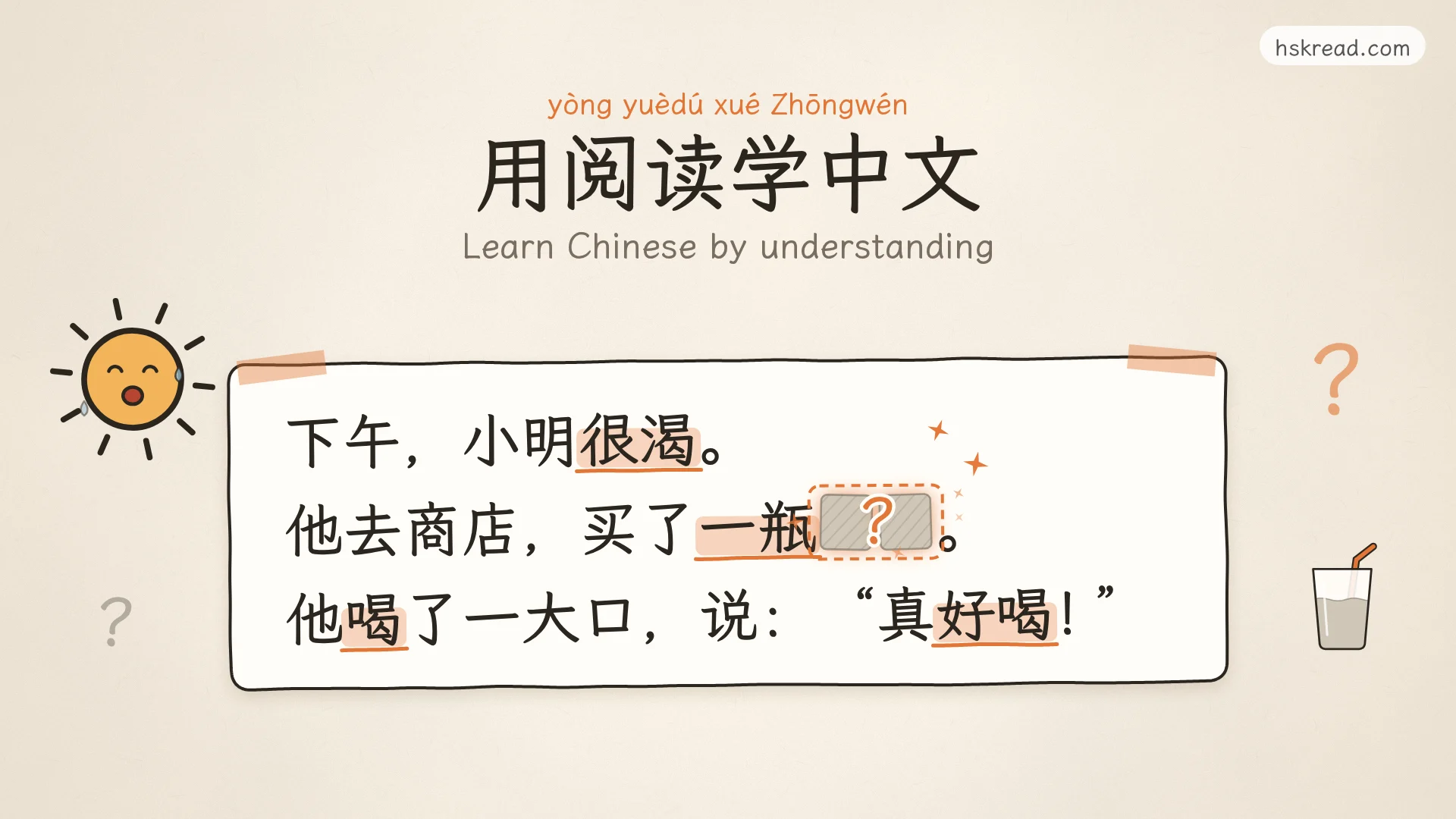
Everyone has an opinion about the best way to learn Chinese. Memorize fifty characters a day. Watch dramas without subtitles. Speak from day one. Never speak until you are ready. It is hard to know whom to believe.
The good news is that language researchers have studied these questions for more than forty years, and on a few big points they mostly agree. This guide turns that research into seven simple principles, shows how to use each one on HSK Read, and clears up a few popular myths. No jargon, we promise.
Key takeaways
- Try it: a text where you know 80% of the words feels surprisingly hard.
- Comprehensible input: you learn a language by understanding lots of it.
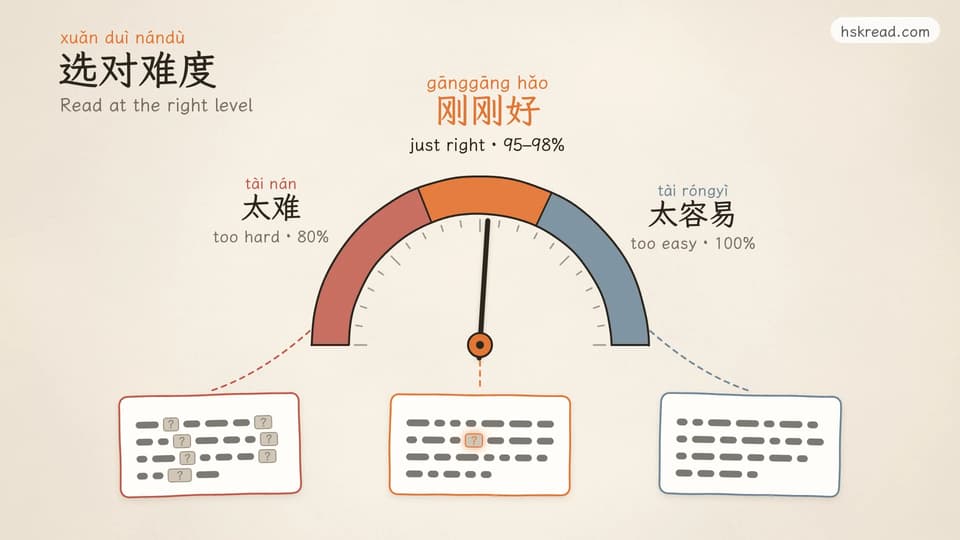
- Principle 1: read at the right level, where you know about 95–98% of the words.
- Principle 2: read a lot of easy stories, not a few hard ones.
- Principle 3: listen while you read, and practice tones on their own.
- Principle 4: look words up, and let pinyin fade over time.
- Principle 5: quiz yourself after reading.
- Principle 6: review new words before you forget them.
- Principle 7: use what you learn by speaking and writing.
- Myths to skip: five popular ideas that research does not support.
- Daily routine: a 15–30 minute plan that puts it all together.
Try it: what 80% understanding feels like
Read this short story. About one word in five is made up, so you know roughly 80% of the words:
Last Brindsday, Mia took the plome train to vosk her grandmother in a small town by the drell. The sky was fenn and the sarp was cold, so she trimbled a hot lusk at the station. When she arrived, her grandmother was pazzing at the door with a big quell and a plate of warm dorbins.
Tiring, right? You can tell it is about a trip, but what did Mia buy? Why was she going? Now read the same story with just one made-up word, which is about 98% known words:
Last Saturday, Mia took the early train to visit her grandmother in a small town by the sea. The sky was gray and the wind was cold, so she bought a hot tea at the station. When she arrived, her grandmother was waiting at the door with a big smile and a plate of warm dorbins.
This time the story is easy, and you can probably guess that dorbins are some kind of food. That is the whole idea of this guide in one example: with a few unknown words, your brain fills the gaps from context and learns the new words along the way. With too many, it simply gives up.
This demo is inspired by John Pasden, co-founder of the Mandarin Companion graded readers, who made a famous Chinese version with invented characters for intermediate learners.
What is comprehensible input?
In the 1980s, the linguist Stephen Krashen summed up his theory in one sentence: we acquire language by understanding messages. Not by memorizing rules, not by repeating drills, but by understanding what people say and write. He called this comprehensible input.
He wrote it as i+1. The i is what you already know, and the +1 is a little bit more. A story at i+1 is mostly familiar, with a few new words or patterns you can work out from the situation. Each time you understand one, it becomes part of your i, and the next story can go a little further.
In this famous talk, Krashen shows the difference in a fun way, speaking German first without any context and then with it:
Researchers have argued about Krashen's ideas for decades. Today most agree on the core: understanding lots of input is the foundation of learning any language. Most also agree that it is not the whole story. Noticing new words, testing yourself and using the language yourself all speed things up. That is the approach of this guide: lots of input first, with a few smart extras.
Principle 1: Read at the right level
How many new words are too many? In a well-known experiment, learners read a story where some of the words had been replaced. When they knew 80% of the words, almost nobody understood the story well enough. Comfortable reading started at around 98%, which is about one new word in every fifty.
Later studies found that the more words you know, the better you understand, with no magic line. So treat 95–98% as a rough target, not a strict rule. In practice, a good text at your level feels easy to follow, with just a few new words in each paragraph.
On HSK Read, three things help you find that level:
- The level test estimates how many words you know and suggests where to start.
- Level bands group the stories from HSK 1 to HSK 9, so you can stay in your zone.
- Your taps are a simple signal. If you are tapping several words in every line, the story is too hard. Go down a level. Starting easy is never a mistake.
Principle 2: Read a lot of easy stories
Teachers call this extensive reading: reading lots of easy, interesting texts for the story, not for the grammar. It is the opposite of studying one hard article line by line for an hour.
It works. Large reviews that pooled dozens of classroom studies found that learners who read a lot improved their reading more than those who did not, and adult learners gained the most. Reading also brings back the same common words again and again in new sentences, which is how words slowly become yours.
The key word is easy. Ten stories you enjoy will usually do more for you than one article you have to decode with a dictionary. And because you read for the story, it does not feel like homework.
How to do it on HSK Read:
- Open the reading library and pick stories that look interesting. If one is boring, stop and choose another.
- Read for the main idea first. Do not stop at every new word.
- When stories at your level start to feel very easy, move up a level.
Principle 3: Listen while you read
Reading with audio is one of the best habits you can build. Studies with graded readers found that learners who read along with a recording improved their reading speed and comprehension more than silent readers, and their listening got better too. For Chinese, the audio also connects each character with its sound, which a page of characters cannot do on its own.
One detail matters: the benefit is strongest when the audio sets the pace. If you pause after every word, you are back to slow, silent reading. So let it play, and try to keep up.
On HSK Read, turn on Listen mode. The sentence being read is highlighted, so your eyes and ears stay together. Listen once all the way through, then go back to the parts you missed.
Tones need their own practice
Reading with audio helps you hear tones in real sentences, but research suggests it will not fix them alone. Even advanced learners who can tell the tones apart often struggle to remember which tone belongs to which word. Short, focused tone practice works well, and its effects last. Spend a few minutes now and then with the pinyin chart with audio, comparing syllables like mā, má, mǎ and mà.
Principle 4: Look words up, and let pinyin fade
Guessing from context is great, but it is not always right. Studies on reading with glosses, the short translations shown next to a word, found that readers who could check meanings learned clearly more new words than readers who had to guess. Translations into your own language worked best.
On HSK Read, tap any word to see its pinyin, meaning and example sentences, and save the useful ones to your Word Book. Just do not look up everything: read once for the main idea, then tap the words that matter for the story.
Pinyin is a set of training wheels
Pinyin is a huge help when you start, because it tells you how each character sounds. But when it is always on, your eyes go straight to the letters and skip the characters. An eye-tracking study with Chinese learners found that weaker readers spent most of their time looking at the pinyin. Research also finds that support which helps beginners can get in the way as you improve.
A simple plan:
| Your level | Pinyin habit |
|---|---|
| HSK 1–2 | Read with pinyin, then once more without it |
| HSK 3–4 | Read without pinyin first, turn it on only when stuck |
| HSK 5+ | Leave it off, and tap a single word when you need its sound |
Each time you need a little less pinyin, you are reading more Chinese.
Principle 5: Quiz yourself after reading
Here is one of the most reliable findings in learning science: trying to remember something helps you learn it far more than reading it again. Psychologists call it the testing effect. In one classic study, students who practiced recalling a text remembered much more a week later than students who simply reread it, even though rereading felt easier.
That is why every story on HSK Read ends with a short reading quiz. It only takes a minute, and it turns "I think I understood" into real memory.
Two tips make it more useful:
- Answer before you look back. The effort of remembering is what does the work.
- When you miss a question, find the sentence with the answer. That second, focused look at the text is great practice.
Principle 6: Review words before you forget them
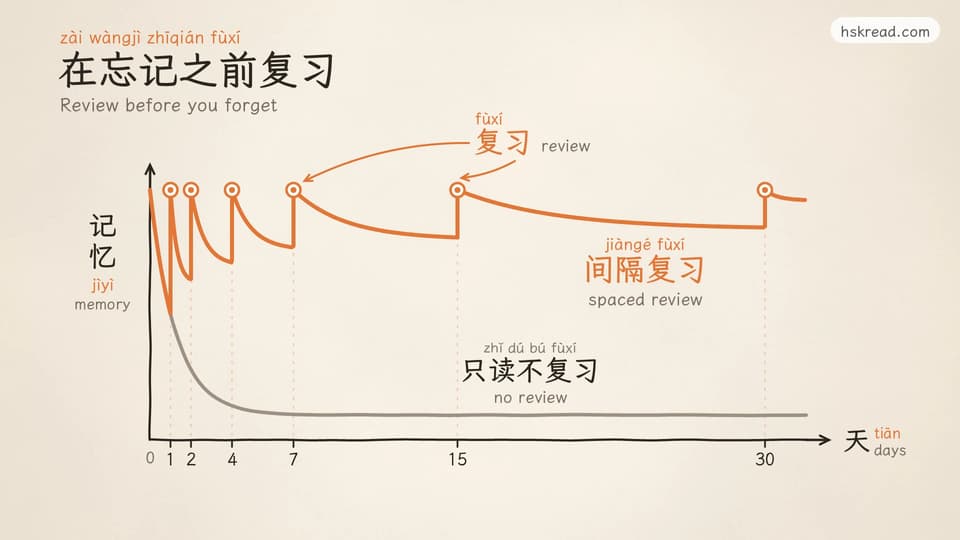
Reading teaches you words, but it is a slow teacher. In one study, learners read a graded reader with new words in it. Three months later, they could still remember the meaning of only about one of them. Most words need many meetings, often ten or twenty or more, before they stick.
The fix is spaced review: seeing a word again just before you would forget it, with a longer gap each time. It is one of the best-tested ideas in all of learning science, and it works for vocabulary in any language.
On HSK Read, the words you save go into your Word Book, and the vocabulary page brings them back when they are due. You can review them four ways:
- Flashcards: see the word and pick its meaning.
- Typing: type the word in pinyin.
- Sentence builder: put an example sentence back in order.
- Dictation: listen and type what you hear.
A few minutes a day is enough. Think of it this way: reading finds new words, and review keeps them.
Principle 7: Use what you learn
Input builds what you know. Output, speaking and writing, shows you what you can actually use. When you try to say something and get stuck, you notice the gap, and the next time you read, that word or pattern jumps out at you.
You do not need to wait until you are "ready." Start small, with things that grow straight out of your reading:
- Retell the story out loud in two or three sentences.
- Shadow the audio: play a sentence and repeat it right after, copying the tones.
- Type it: use typing practice or the sentence builder to produce words, not just recognize them.
- Talk to people: a language partner or tutor, even once a week, turns the words you have read into words you can say.
Myths to skip
"Just watch Chinese TV and you will become fluent." Input is the foundation, but most dramas are far above a learner's level. Without help they become background noise. Start with input you can understand, and add native shows as you grow.
"Speaking too early will damage your Chinese." Some online communities warn about this, but there is no good research behind it. Speak when you want to.
"98% is a magic number." It is a useful rough target that comes mostly from research with English learners. Aim for "easy to follow, a few new words," not an exact count.
"Read the same story at every level." In one study, reading the same story at three levels was the least effective and most boring option. On HSK Read, use the other levels of a story to move up when you are ready, or to check a hard passage, then go and read something new.
"I am a visual learner, so I should only read." The idea of learning styles has been tested many times and is not supported. Everyone learns more from reading and listening together.
A simple daily routine
Put the seven principles together and you get a routine of 15–30 minutes a day:
- Read: a new story at your level, once for the main idea.
- Listen: turn on Listen mode and read along without stopping.
- Look up: tap the words that matter and save three to five of them.
- Quiz: answer the questions before looking back.
- Review: clear the words that are due in your Word Book.
- Use: retell the story in a few sentences out loud.
For a step-by-step tour of every tool on the site, see How to Learn Chinese by Reading.
Be patient with yourself. The US Foreign Service Institute, which trains American diplomats, puts Mandarin in its hardest group of languages, needing about three times the class hours of Spanish or French. That is not a reason to worry. It is a reason to make the hours enjoyable and to build a habit you can keep.
People who learn many languages say the same. In her popular TED talk, polyglot Lýdia Machová explains that what they share is not talent but enjoyment, methods that work, a system they stick to and plenty of patience:
Useful vocabulary
| Chinese | Pinyin | English |
|---|---|---|
| 阅读 | yuèdú | reading; to read |
| 听力 | tīnglì | listening; listening skills |
| 理解 | lǐjiě | to understand; understanding |
| 生词 | shēngcí | new word |
| 复习 | fùxí | to review |
| 记住 | jìzhù | to remember |
| 水平 | shuǐpíng | level; standard |
| 拼音 | pīnyīn | pinyin |
| 声调 | shēngdiào | tone |
| 练习 | liànxí | to practice; exercise |
Pick a story at your level today, press play, and enjoy understanding Chinese one story at a time.
The research behind this guide
- Krashen, S. (1982). Principles and Practice in Second Language Acquisition. Pergamon.
- Hu, M., & Nation, P. (2000). Unknown vocabulary density and reading comprehension. Reading in a Foreign Language, 13(1).
- Jeon, E.-Y., & Day, R. (2016). The effectiveness of extensive reading on reading proficiency: A meta-analysis. Reading in a Foreign Language, 28(2).
- Chang, A., & Millett, S. (2015). Improving reading rates and comprehension through audio-assisted extensive reading for beginner learners. System, 52.
- Yanagisawa, A., Webb, S., & Uchihara, T. (2020). How do different forms of glossing contribute to L2 vocabulary learning from reading? Studies in Second Language Acquisition, 42(2).
- Roediger, H., & Karpicke, J. (2006). Test-enhanced learning: Taking memory tests improves long-term retention. Psychological Science, 17(3).
- Waring, R., & Takaki, M. (2003). At what rate do learners learn and retain new vocabulary from reading a graded reader? Reading in a Foreign Language, 15(2).
Check your understanding
01What is comprehensible input?
Comprehensible input is language you can understand, mostly from context, even if it contains a few words you do not know yet. The idea, made famous by linguist Stephen Krashen, is that we pick up a language by understanding many messages in it, not by memorizing rules first.
02Does comprehensible input work for Chinese?
Yes, the same principles apply. Research on Chinese learners is still smaller than research on English learners, but the early studies point the same way. Chinese characters add one extra challenge, so regular word review matters even more than in other languages.
03Can complete beginners learn Chinese with comprehensible input?
Yes. Start with very short HSK 1 stories, keep pinyin and audio on, and learn the sounds with a pinyin chart at the same time. Easy texts with lots of support are exactly what comprehensible input means for a beginner.
04Do I need to memorize vocabulary before I start reading?
No. You can learn most of your first words while reading. Save the words you meet in stories and review them for a few minutes a day. A short list of the most common words can help in the very first weeks, but it should not replace reading.
05When should I turn off pinyin?
Turn it off as soon as you can. A good habit is to read a story once with pinyin and a second time without it. From around HSK 3, try reading without pinyin first and only tap a word when you are stuck.
06Can I learn to speak Chinese just by reading?
Reading gives you the words and grammar that speaking needs, and listening while you read trains your ear. But speaking is its own skill. Retell stories out loud, shadow the audio and talk with a partner or tutor when you feel ready.