How to Learn Chinese by Reading: A Beginner's Guide to HSK Read
A simple five-step routine for learning Chinese through graded stories, from finding your HSK level to reviewing new words, plus the free tools on HSK Read that help along the way.
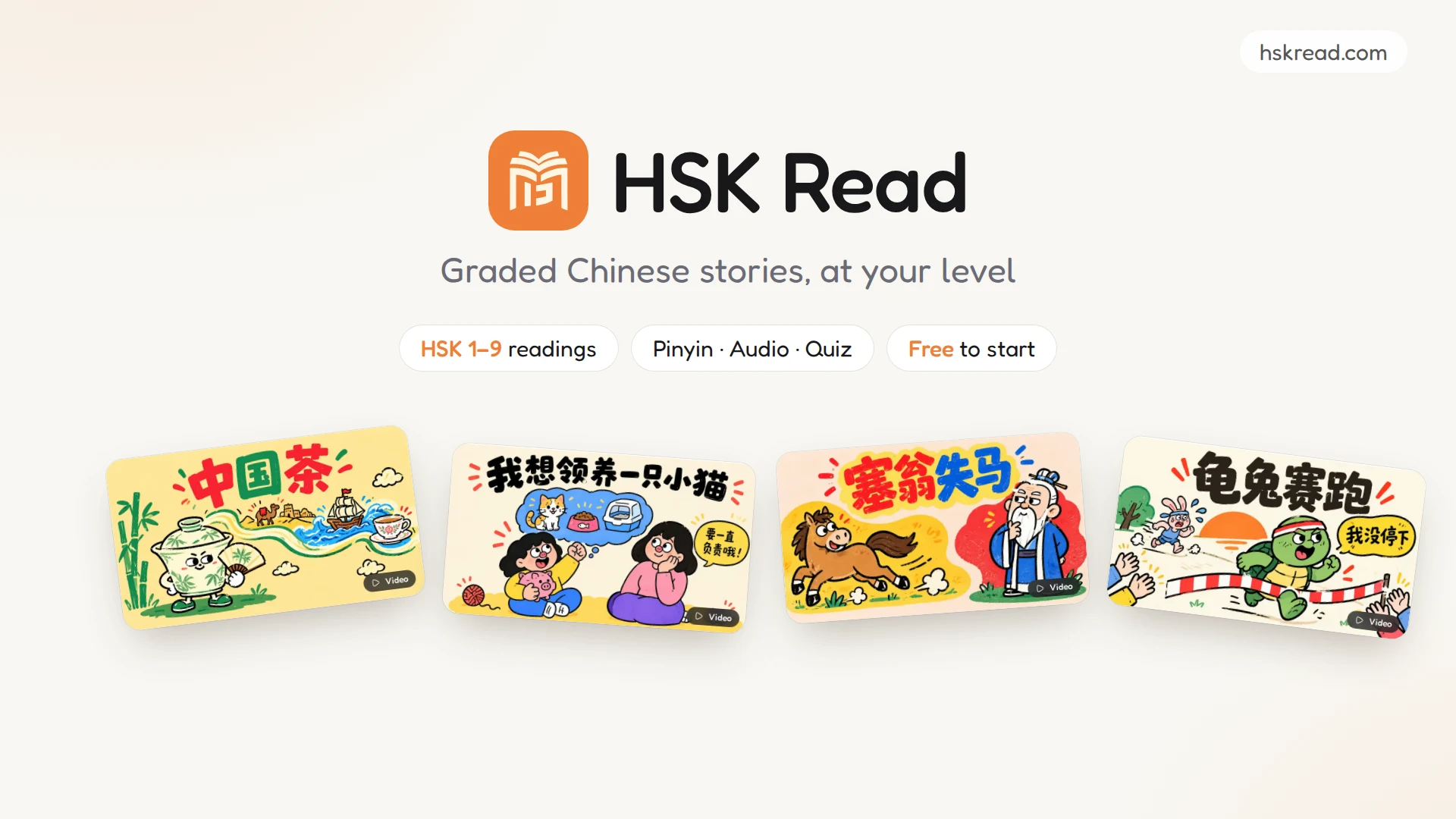
Here is a little secret about learning Chinese: reading a lot is one of the best-studied ways to make steady progress. Not textbooks full of drills, but short, real stories that are just a little bit above your level.
The hard part is finding those stories. Most Chinese texts are either too easy to be interesting or so hard that you look up every second word. HSK Read was built to fix that. It gives you short Chinese stories written for each HSK level, with all the help you need one tap away. This guide shows you a simple routine for using it, and the free tools that make each step easier.
Key takeaways
- Why reading works: stories teach you words in context, so they stay in your memory.
- Step 1: take the free level test to find your starting point.
- Step 2: pick a story at your level, from HSK 1 to HSK 9.
- Step 3: read for the main idea first, then use pinyin, translation, word lookup and audio.
- Step 4: check yourself with a short quiz after every story.
- Step 5: review your saved words before you forget them.
- Free tools cover pinyin, stroke order, worksheets, grammar, typing and more.
- Teachers can use the same story at different levels in a mixed class.
Watch: the HSK Read learning path in 90 seconds
Why learn Chinese by reading?
When you meet a new word in a story, you also meet the people, the place and the reason it was used. That context is what makes a word stick. A word list tells you that 每天 (měi tiān) means "every day." A story about a child who promises to feed a kitten every day shows you how people actually use it.
Reading also builds all your other skills quietly. You see grammar patterns again and again, you learn characters by recognizing them in real sentences, and if you listen while you read, your listening improves too.
The key is the right level. Research suggests reading feels comfortable when you already know about 95–98% of the words, so you meet only a few new ones on each page. That is what "graded" reading means, and it is how every story on HSK Read is written. Curious about the science behind it? Read our guide to comprehensible input for Chinese.
Step 1: Find your level
Not sure if you are HSK 2 or HSK 4? Start with the free HSK level test. You see sets of words from the official HSK lists and simply tap the ones you know. After up to three short rounds, which take about three minutes, you get your estimated vocabulary size and a recommended level to start reading.
The test is a learning tool, not the official HSK exam. Its job is to save you from starting too high or too low. You need a free account to take it, and you can take it again whenever you feel you have moved up.
If a story feels too hard after the test, just go down one level. Starting easy is never a mistake.
Step 2: Pick a story at your level
All stories live in the reading library. They are grouped into four bands:
| Band | HSK levels | What you can expect |
|---|---|---|
| Beginner | HSK 1–2 | Short, clear stories about everyday life |
| Intermediate | HSK 3–4 | Longer stories and useful real-world topics |
| Advanced | HSK 5–6 | Richer language and more nuance |
| Expert | HSK 7–9 | Natural, demanding Chinese |
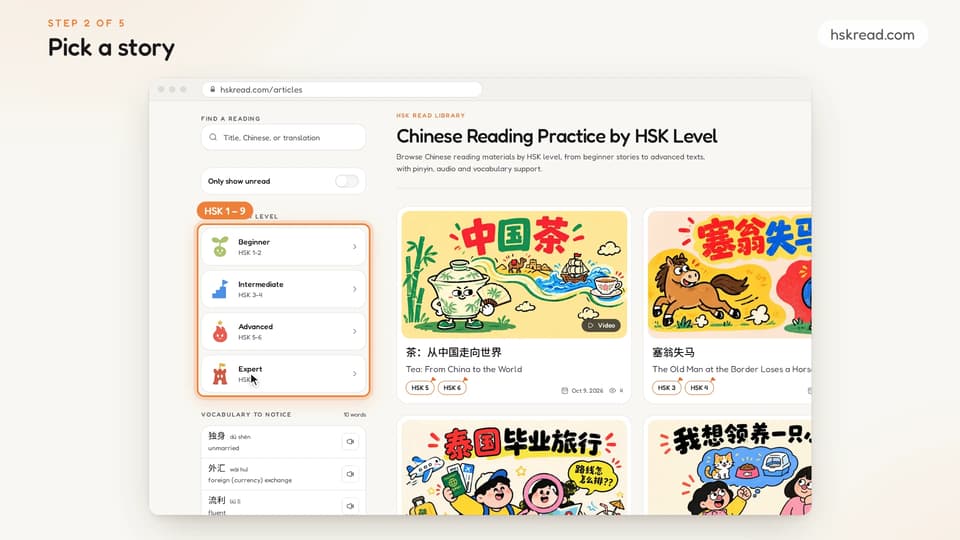
Many stories are written in more than one version. For example, I Want to Adopt a Kitten has an HSK 1 version and a slightly longer HSK 2 version. Read the easy one first, and when it feels comfortable, switch to the next level with one tap. New stories are added all the time, many of them with a colorful cover and a short video.
Step 3: Read, then use the help you need
Open a story and read it once for the main idea. Who is it about? What happens? Do not stop at every new word. You will be surprised how much you can guess from context.
Then fill the gaps with the support tools. Everything can be switched on and off, so you only use the help you need:
- Pinyin: show 拼音 above every character, with the correct tones.
- Translation: show a translation under each sentence.
- Tap a word: tap any word to see its pinyin, meaning, a Chinese explanation and example sentences, then save it to your Word Book.
- Listen: play natural audio. In Listen mode, the sentence being read is highlighted, so you can read along.
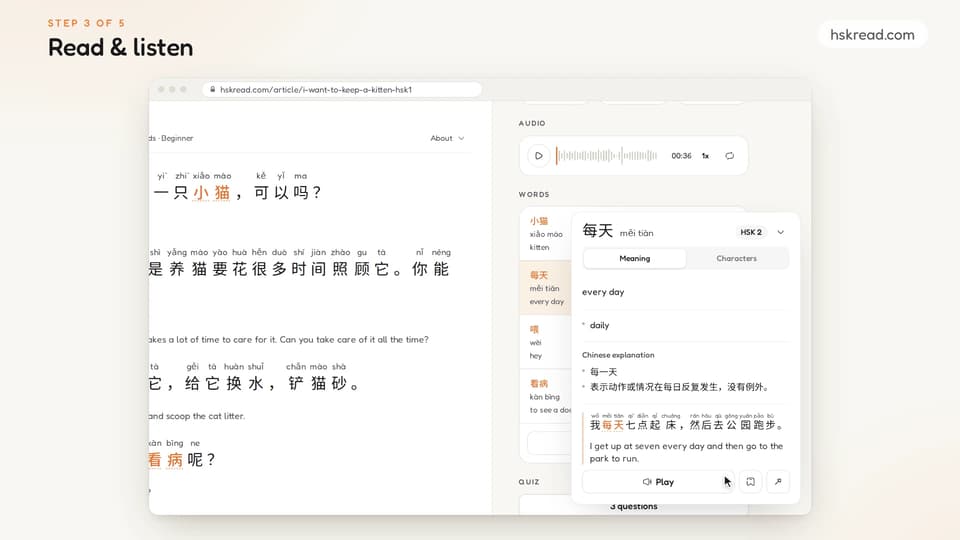
Try reading the story once more with less help at the end. Each time you need less pinyin, you know you are making progress.
Step 4: Check yourself with a quiz
Every story ends with a short reading-comprehension quiz. The questions are in Chinese with a translation underneath, so even beginners can answer them. For example, after the kitten story you might see:
Quizzes are a quick way to check that you really understood the story, not just the words. If you get a question wrong, go back and find the sentence with the answer. That second look is great practice.
Step 5: Review your words
Reading gives you new words. Review makes them yours. Every word you save goes into your Word Book, and the vocabulary page brings them back for review right before you are likely to forget them.
You can choose how to review:
| Mode | What you do |
|---|---|
| Flashcards | See the word and pick its meaning |
| Typing | Type each word with pinyin |
| Sentence builder | Put the words of an example sentence back in order |
| Dictation | Listen and type the word you hear |
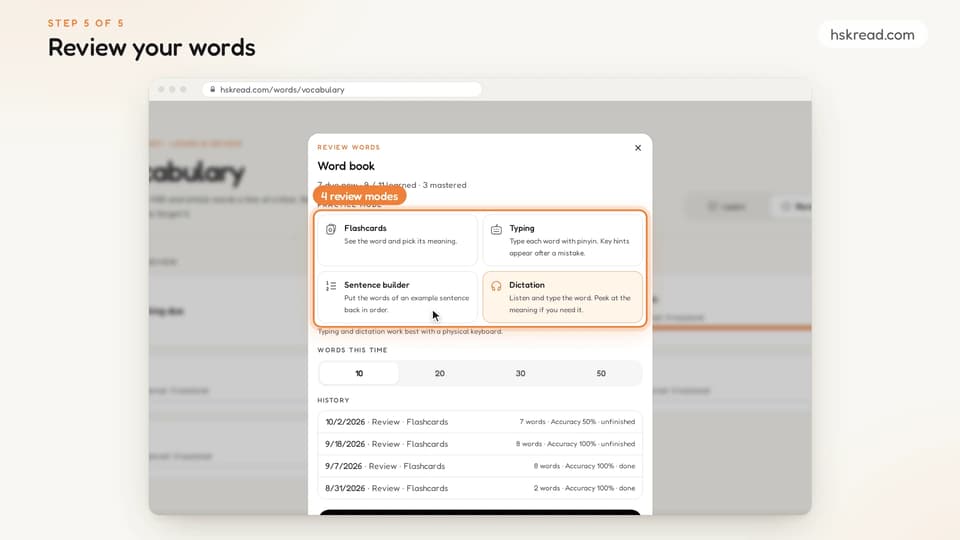
A few minutes a day is enough. Your home page shows a daily streak and simple statistics, such as days learned, words saved and articles read, so you can see your habit grow.
Free tools for every part of learning Chinese
Stories are the heart of HSK Read, but you also get a set of free tools for the skills around reading.
Sounds and characters
- Pinyin chart with audio: tap any syllable to hear it, and practice the four 声调.
- Stroke order dictionary: look up any 汉字, watch it being written stroke by stroke, then practice writing it yourself. Try 猫 on its character page.
- Character worksheets: type your own characters and download a printable PDF with pinyin, stroke order and practice grids.
Grammar and vocabulary
- Grammar guides: more than 90 short guides that explain a pattern with simple structures and real examples, such as the 把 sentence.
- HSK word lists: browse the official HSK 词汇 level by level, with pinyin, meaning, audio and stroke order.
Typing, listening and translation
- Typing practice: learn to type Chinese with pinyin using HSK words, your Word Book or example sentences. No input method needed.
- Pinyin converter: paste any Chinese text and get pinyin with tone marks over every character.
- Text to speech: turn Chinese text into natural audio you can download.
- Translate with pinyin: see word by word how a Chinese sentence maps to its translation.
And you can use the whole site in English, Spanish, French, Japanese, Korean, Russian, Thai or Vietnamese.
For teachers and classes
HSK Read works well in the classroom too, including at Chinese schools and Confucius Institutes.
- Mixed-level classes: many stories come in several HSK levels. Students can read the same story at their own level, then talk about it together.
- In class: put a story on the screen, turn pinyin and audio on or off, and use the quiz questions to start a discussion.
- Handouts: print character worksheets, use the pinyin converter to prepare texts, and make listening material with text to speech.
- Homework: ask students to read one story a day and save five new words.
We would love to hear how you use HSK Read with your students. You can reach us through the feedback page.
A simple daily routine
If you only remember one thing from this guide, make it this 15-minute routine:
- 5 minutes: read one story for the main idea.
- 5 minutes: turn on pinyin and audio, tap the words you do not know and save three to five of them.
- 5 minutes: answer the quiz, then review your saved words.
When you understand a story without pinyin, move up a level. One short story a day adds up faster than you think.
Useful vocabulary
| Chinese | Pinyin | English |
|---|---|---|
| 阅读 | yuèdú | reading; to read |
| 故事 | gùshi | story |
| 水平 | shuǐpíng | level; standard |
| 拼音 | pīnyīn | pinyin |
| 声调 | shēngdiào | tone |
| 汉字 | hànzì | Chinese character |
| 生词 | shēngcí | new word |
| 复习 | fùxí | to review |
| 语法 | yǔfǎ | grammar |
| 练习 | liànxí | to practice; exercise |
Ready to start? Take the level test or open the Beginner stories, and read your first story today.
Check your understanding
01Is HSK Read free?
Yes. Reading every published story with pinyin, translation and audio, looking up words, saving them to your Word Book, reviewing them and answering the quizzes are all free. A Pro plan adds extras such as full article videos and AI feedback on your translations.
02Which HSK levels does HSK Read cover?
Stories go from HSK 1 to HSK 9, grouped into four bands. Beginner covers HSK 1–2, Intermediate HSK 3–4, Advanced HSK 5–6 and Expert HSK 7–9.
03Do I need to know pinyin before I start?
No. You can show pinyin above every character, listen to the audio and tap any word for its meaning. The pinyin chart with audio is a good place to learn the sounds and tones alongside your first stories.
04Is the HSK Read level test the official HSK exam?
No. It is a quick vocabulary check that estimates your reading level so you know where to start. It does not replace the official HSK exam and does not give a certificate.
05Can teachers use HSK Read in class?
Yes. Many stories come in several HSK levels, so a mixed-level class can read the same story at different levels. Teachers can also print character worksheets and make listening material with the text-to-speech tool.
06Which languages can I use HSK Read in?
The site can be used in English, Spanish, French, Japanese, Korean, Russian, Thai and Vietnamese. You can switch the language at any time from the menu at the top of the page.