Ancient Chinese Inventions: The Four Great Inventions (四大发明) and More
A fun, learner-friendly guide to ancient Chinese inventions—paper, printing, gunpowder and the compass, the stories behind them, and other inventions such as silk, porcelain, the abacus, paper money and Zhang Heng's dragon-and-toad earthquake detector.
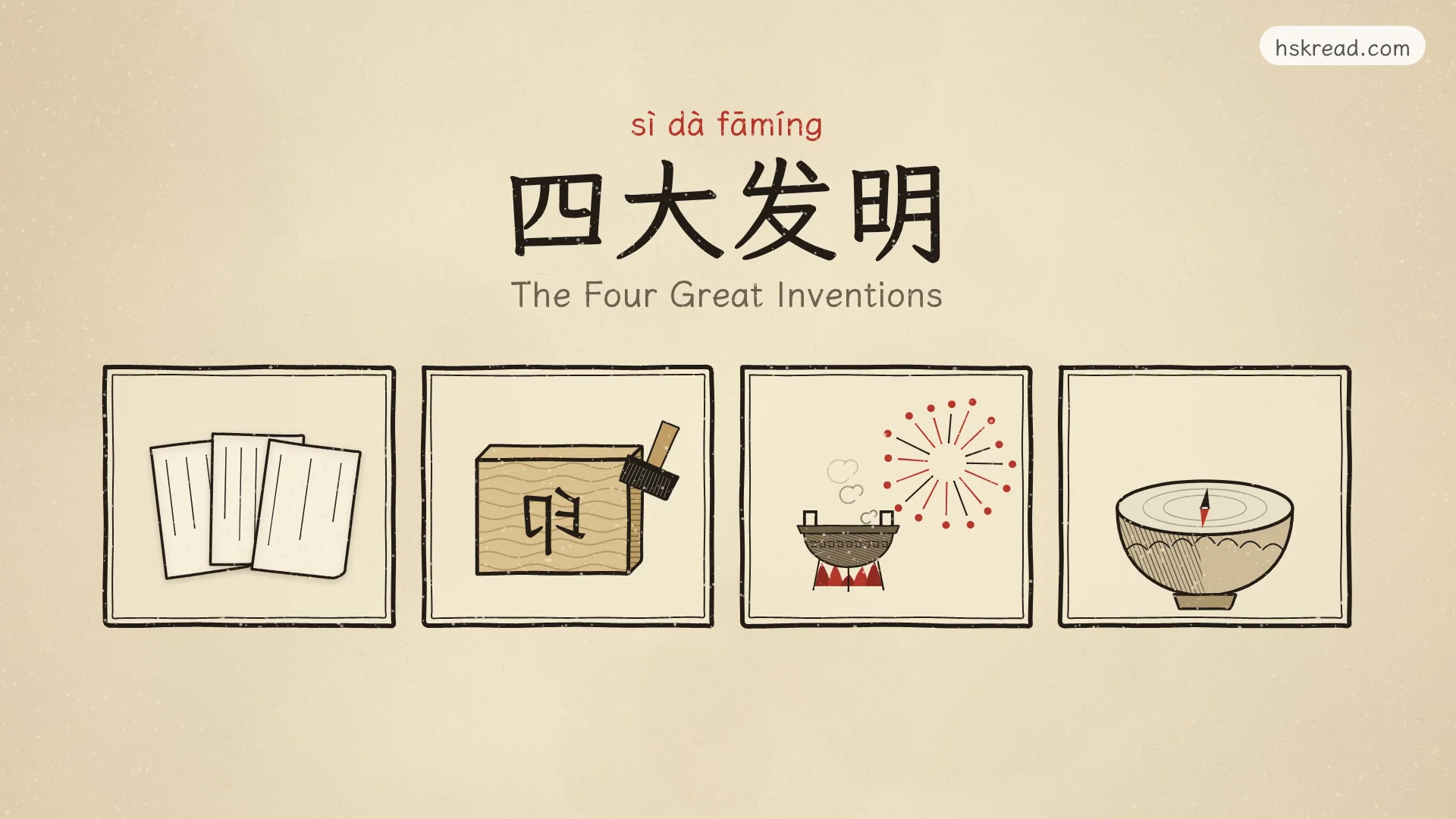
Look around you. The paper in your notebook, the money in your wallet, the fireworks on New Year's Eve, the compass app on your phone—all of them have roots in ancient China. Chinese students learn about these early discoveries in school as the 四大发明 (sì dà fāmíng), the "Four Great Inventions."
In this guide, you will meet the people and the happy accidents behind them: an official who turned old fishing nets into paper, alchemists who almost burned their houses down, a craftsman who baked words in an oven, and a scientist who built a bronze machine with eight dragons. Along the way, you will pick up the Chinese words for each one.
Key takeaways
- The list: the Four Great Inventions are papermaking, printing, gunpowder and the compass.
- Paper: 蔡伦 (Cai Lun) is the traditional hero of paper, in 105 AD.
- Printing: 毕昇 (Bi Sheng) made clay movable type in the 1040s, about 400 years before Gutenberg.
- Gunpowder: it is 火药, "fire medicine," because alchemists found it while making medicines.
- Compass: a Chinese compass points south: it is a 指南针, a "south-pointing needle."
- And more: China also gave the world silk, porcelain, tea culture, the abacus, an earthquake detector with eight dragons and the earliest known government paper money.
- Today: high-speed rail, mobile payment, bike sharing and online shopping have been nicknamed the "new four great inventions."
What are the Four Great Inventions?
Start here for the quick list: four inventions, their Chinese names and one handy character that ties them together.
The Chinese name, 四大发明 (sì dà fāmíng), is easy to break down:
| Part | Pinyin | Meaning |
|---|---|---|
| 四 | sì | four |
| 大 | dà | big; great |
| 发明 | fāmíng | invention; to invent |
And here are the four inventions:
| Invention | Chinese | Pinyin | Literal meaning | Best-known date |
|---|---|---|---|---|
| Papermaking | 造纸术 | zàozhǐshù | the technique of making paper | 105 AD (Cai Lun's improved paper) |
| Printing | 印刷术 | yìnshuāshù | the technique of printing | 868 (oldest dated book); 1040s (movable type) |
| Gunpowder | 火药 | huǒyào | fire medicine | 1044 (oldest written recipes) |
| Compass | 指南针 | zhǐnánzhēn | south-pointing needle | 11th century (first clear needle compass) |
Notice the character 术 (shù) in 造纸术 and 印刷术. It means "technique" or "art," as in 技术 (jìshù, technology) and 美术 (měishù, fine arts). The Chinese names stress that these were skills and methods, not single objects.
Who decided there were "four"?
Here is a fun twist: the idea of exactly "four" did not start in China. In 1620, the English thinker Francis Bacon wrote that printing, gunpowder and the compass had changed the whole world—without knowing that all three came from China.
Later writers added paper, and the British historian 李约瑟 (Lǐ Yuēsè, Joseph Needham), who spent his life studying Chinese science, helped make the list famous around the world. Of course, "four" is just a handy number. Ancient China produced many more inventions.
1. Papermaking (造纸术)
Imagine doing your homework on a turtle shell. The earliest Chinese writing was carved on 甲骨 (jiǎgǔ), turtle shells and animal bones. Later, people wrote on 竹简 (zhújiǎn), strips of bamboo tied together with string, and on silk.
Bamboo was cheap but heavy—a long book filled a whole cart. The First Emperor, Qin Shi Huang, is said to have read his bamboo reports by weight—about 30 kilograms a day—and he would not rest until he finished. Silk was light but far too expensive.
The traditional hero of paper is 蔡伦 (Cài Lún), an official at the court of the Eastern Han dynasty. In 105 AD, he presented the emperor with a new kind of paper made from tree bark, hemp, old rags and worn-out fishing nets. Everything was beaten into a mushy pulp, spread thin on a screen and dried. People loved it and called it 蔡侯纸, "Marquis Cai's paper."
There is one twist: archaeologists have found even older pieces of paper in China. So today people usually say that Cai Lun improved papermaking and made it practical, rather than inventing it from nothing. In Chinese: 蔡伦改进了造纸术.
Over the following centuries, the secret of 造纸 (zàozhǐ, making paper) spread to Korea and Japan, then west through Central Asia and the Arab world, and finally to Europe.
2. Printing (印刷术)
How did China print books about 400 years before Gutenberg? It took two big steps: carved wooden blocks, then movable type.
Once paper was cheap, people wanted a faster way to copy books than writing them out by hand.
Woodblock printing
The first answer was 雕版印刷 (diāobǎn yìnshuā), woodblock printing. A craftsman carved a whole page of text into a block of wood—backward, like a mirror image. Then he covered it with ink, laid paper on top and rubbed. One block could print hundreds of copies.
The world's oldest printed book with a date is the Diamond Sutra (《金刚经》, Jīngāng Jīng), a Buddhist text printed in 868. It was hidden in a sealed cave near Dunhuang for about 900 years, until a Taoist priest stumbled on it in 1900. Today it is in the British Library in London.
Bi Sheng's movable type
Carving a new block for every page took forever, and one mistake could ruin a whole block. In the Song dynasty, a craftsman named 毕昇 (Bì Shēng) had a clever idea: make one small piece of type for each character, then arrange the pieces into any page you need.
This is 活字印刷 (huózì yìnshuā), movable-type printing. 活字 literally means "living characters"—characters that can move around.
We know about Bi Sheng because the scholar 沈括 (Shěn Kuò) wrote down his method in a famous notebook of curious facts, Dream Pool Essays (梦溪笔谈). Here is how it worked:
- Carve each character on a small piece of soft clay.
- Bake the pieces in a fire until they are hard.
- Set them side by side in an iron frame on a plate covered with wax.
- Warm the plate so the wax melts, press the type flat and let it cool.
- Print the page—then warm the plate again, pop the characters out and use them for the next page.
Shen Kuo even says Bi Sheng kept several copies of common characters, like 之 and 也, so they would never run out.
This was about 400 years before Johannes Gutenberg's printing press in Europe. Still, because Chinese has thousands of characters, carving woodblocks stayed the more common way to print books in China for a long time.
3. Gunpowder (火药)
Gunpowder was found by people trying to make medicine—and the Chinese name still tells that surprising story: 火药 (huǒyào) means "fire medicine." 药 (yào) is the same character as in 中药 (Chinese medicine) and 吃药 (to take medicine).
Most historians believe gunpowder was discovered by Chinese alchemists—people who mixed minerals to make medicines, some of them hoping to find a pill for eternal life. Instead, they found something that went boom.
They were working with saltpeter, sulfur and charcoal, the three ingredients of gunpowder. A Tang-dynasty text from around the 9th century already warns that mixing these things could burn your hands and face—and even burn your house down. Not exactly the long life they were hoping for!
By the Song dynasty, a military handbook from 1044 wrote down the oldest known gunpowder recipes, and armies were using it in fire arrows and bombs. Over the next centuries, it led to early guns and cannons, and it later spread across Asia to Europe.
Gunpowder also had a much happier use. 烟花 (yānhuā, fireworks) and firecrackers (鞭炮, biānpào) became the sound of Chinese celebrations, especially at New Year, when people say the noise scares away bad luck (see our guide to Chinese traditional festivals).
4. The compass (指南针)
Did you know a Chinese compass points south, not north? Here is why, and how sailors came to rely on it.
The everyday Chinese word for a compass is 指南针 (zhǐnánzhēn), literally "south-pointing needle." In Chinese thinking, a compass points south. Even today, the Chinese word for a guidebook or a how-to guide is 指南 (zhǐnán), "point south."
司南: the spoon that points south
Ancient texts mention a 司南 (sīnán), "south controller." In museums and textbooks, it is shown as a spoon carved from lodestone (a naturally magnetic rock) that spins on a smooth bronze plate until its handle points south. It is a lovely picture—but it is a modern reconstruction, and nobody has ever dug up a real one.
The needle compass
The first clear description of a magnetic needle compass comes from the Song-dynasty scholar Shen Kuo (沈括) and his notebook of curious facts, Dream Pool Essays.
He explained how to magnetize a needle by rubbing it on lodestone, and how to float it on water, balance it on a fingernail or hang it from a silk thread. He even noticed something sailors would care about for centuries: the needle points slightly east of true south.
Early compasses were used for feng shui, to choose the direction of houses and tombs. (Read more about the feng shui compass, the 罗盘, in our guide to feng shui.) By the early 12th century, sailors near Guangzhou were using the compass at sea when the sky was dark or cloudy—the earliest known record of a compass used for navigation anywhere in the world.
More ancient Chinese inventions: silk, porcelain, the abacus and more
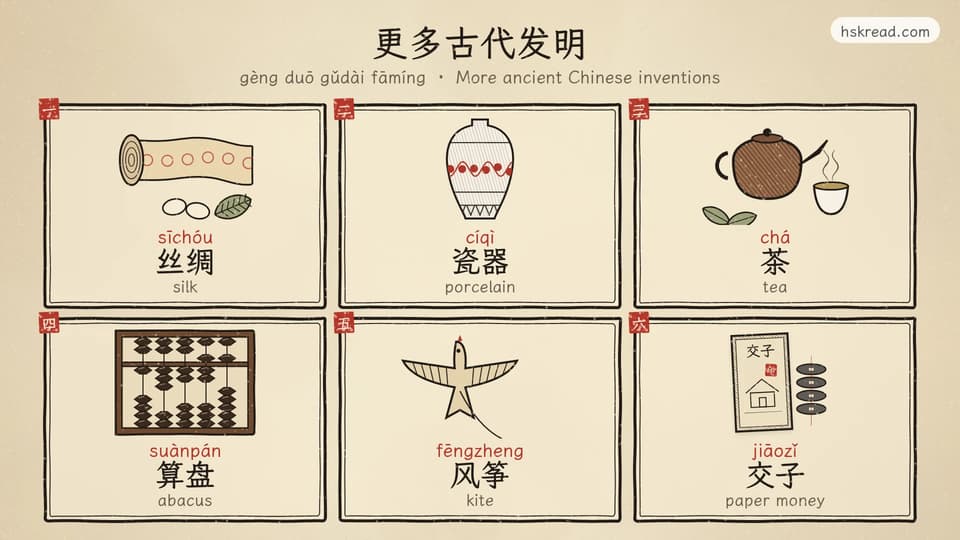
Paper, printing, gunpowder and the compass are only the start. Here are other famous inventions and early developments from ancient China:
| Invention | Chinese | Pinyin | What to know |
|---|---|---|---|
| Silk | 丝绸 | sīchóu | silk about 5,500 years old has been found in China |
| Porcelain | 瓷器 | cíqì | so loved abroad that in English it is simply called "china" |
| Tea | 茶 | chá | the world's oldest book about tea was written in the Tang dynasty |
| Abacus | 算盘 | suànpán | the "pocket calculator" of old China—now on UNESCO's heritage list |
| Earthquake detector | 地动仪 | dìdòngyí | eight bronze dragons and eight toads, built in 132 AD |
| Kite | 风筝 | fēngzheng | tradition says the philosopher Mozi made a flying wooden bird |
| Paper money | 交子 | jiāozǐ | invented because iron coins were too heavy to carry |
| Chopsticks | 筷子 | kuàizi | bronze chopsticks have been found in tombs over 3,000 years old |
Silk and porcelain
For centuries, 丝绸 (sīchóu, silk) was China's most famous export.
Legend says Leizu (嫘祖), wife of the Yellow Emperor, was drinking tea under a mulberry tree when a silkworm cocoon fell into her cup. As it softened in the hot water, she pulled out a long, shiny thread—and taught people to raise silkworms. The trade routes that carried silk west became known as the Silk Road, 丝绸之路 (Sīchóu zhī Lù).
瓷器 (cíqì, porcelain) is a hard, white, shiny ceramic fired at very high temperatures. Chinese porcelain was so loved around the world that in English, fine porcelain is still called "china."
算盘: the abacus
The Chinese 算盘 (suànpán) has beads on rods: two beads worth five on the top, and five beads worth one on the bottom. Skilled users could add, subtract, multiply and even divide faster than you might expect, and before electronic calculators, the click-clack of the abacus was the sound of every shop and bank.
In Chinese, a person who plans everything carefully to gain an advantage is said to be good at 打算盘 (dǎ suànpán), "playing the abacus."
Two great stories: the earthquake detector and the first paper money
A bronze machine with eight dragons, and money invented because coins were too heavy—two ancient Chinese inventions with stories worth telling.
张衡 and the earthquake detector
In 132 AD, the scientist and astronomer 张衡 (Zhāng Héng) built the 地动仪 (dìdòngyí), an instrument to detect earthquakes. It was a bronze vessel with eight dragons around the top, each holding a ball in its mouth. Below each dragon sat a toad with its mouth wide open.
When the ground shook far away, one dragon dropped its ball into a toad's mouth—clang!—showing the direction of the earthquake.
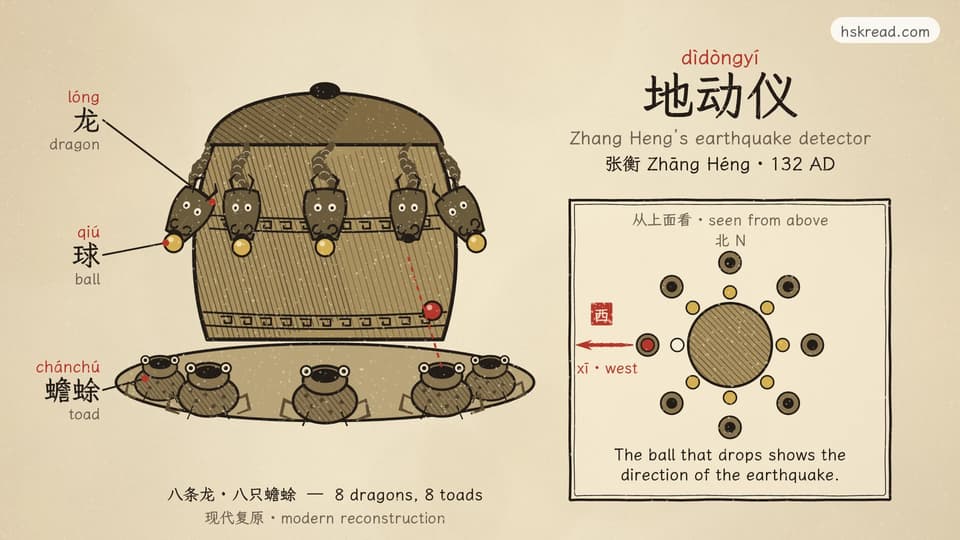
The best story: one day a ball fell, but no one in the capital, Luoyang, felt anything. The scholars at court said the machine must be wrong. A few days later, a messenger galloped in with news of an earthquake hundreds of kilometers to the west.
The original was lost long ago, so the model you see in museums is a modern guess, and scientists still wonder how it worked inside.
交子: the first government paper money
In the Northern Song dynasty, people in Sichuan used iron coins—and iron coins are heavy. Buying a roll of silk could mean carrying a sack of metal. So merchants began issuing paper notes, called 交子 (jiāozǐ), that could be exchanged for coins. In 1023, the Song government took over and began issuing 交子 itself—the earliest known government-issued paper money in the world.
The "new four great inventions"
China has a cheeky modern version of the list—and if you visit, you will probably use all four in your first week.
In 2017, a survey asked young people from 20 countries which part of Chinese life they would most like to take back home. Their top four—high-speed rail (高铁), mobile payment (移动支付, such as Alipay), bike sharing (共享单车) and online shopping (网购)—were quickly nicknamed China's 新四大发明 (xīn sì dà fāmíng), the "new four great inventions."
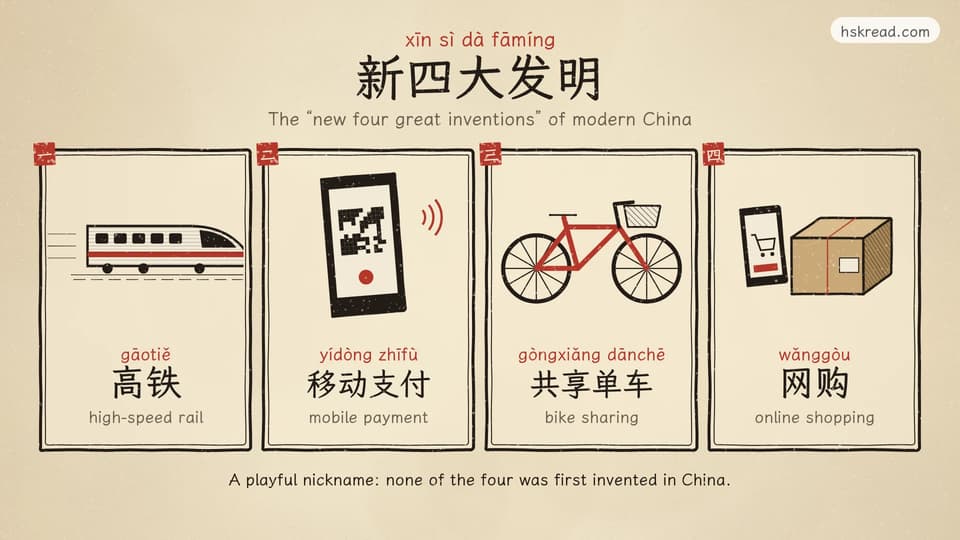
The name is a playful one: none of the four was first invented in China. But anyone who has visited China knows the feeling—you scan a QR code to pay for street food, unlock a bike with your phone and ride a train at 300 km/h. And the nickname shows how proud people are of the old 四大发明, the original Four Great Inventions.
Useful vocabulary
| Chinese | Pinyin | English |
|---|---|---|
| 发明 | fāmíng | invention; to invent |
| 四大发明 | sì dà fāmíng | the Four Great Inventions |
| 造纸术 | zàozhǐshù | papermaking |
| 印刷术 | yìnshuāshù | printing |
| 活字印刷 | huózì yìnshuā | movable-type printing |
| 火药 | huǒyào | gunpowder |
| 指南针 | zhǐnánzhēn | compass |
| 纸 | zhǐ | paper |
| 改进 | gǎijìn | to improve |
| 技术 | jìshù | technology; technique |
| 烟花 | yānhuā | fireworks |
| 方向 | fāngxiàng | direction |
| 丝绸 | sīchóu | silk |
| 瓷器 | cíqì | porcelain |
| 算盘 | suànpán | abacus |
| 风筝 | fēngzheng | kite |
| 地动仪 | dìdòngyí | Zhang Heng's earthquake detector |
From the paper you write on to the fireworks you watch at New Year, ancient Chinese inventions are all around you—and now you can name them in Chinese.
Check your understanding
01What are the Four Great Inventions of ancient China?
They are papermaking (造纸术), printing (印刷术), gunpowder (火药) and the compass (指南针). In Chinese, they are called 四大发明 (sì dà fāmíng).
02Who invented paper in China?
Tradition credits Cai Lun (蔡伦), an official of the Eastern Han court, who presented an improved way of making paper to the emperor in 105 AD. Older pieces of paper have been found, so today people usually say Cai Lun improved papermaking rather than inventing it.
03Who invented movable type printing?
A craftsman named Bi Sheng (毕昇) made movable type from baked clay in the 1040s, during the Song dynasty—about 400 years before Gutenberg. Woodblock printing is older; the oldest dated printed book, the Diamond Sutra, was printed in 868.
04Why did the Chinese invent gunpowder?
Gunpowder seems to have been discovered by Chinese alchemists who were mixing substances to make medicines, possibly while searching for long life. That is why it is called 火药, "fire medicine."
05What are the "new four great inventions" of China?
It is a popular nickname for four things that make daily life in modern China easy—high-speed rail (高铁), mobile payment (移动支付), bike sharing (共享单车) and online shopping (网购). None of them was first invented in China; the name is a playful nod to the old 四大发明.
06What other things did ancient China invent?
Other famous inventions and early developments include silk, porcelain, tea drinking, the abacus, kites, paper money (交子) and Zhang Heng's earthquake detector (地动仪) from 132 AD.