Jianzi (毽子): The Chinese Shuttlecock Kicking Game—History, Rules and How to Play
A friendly guide to jianzi, the feathered shuttlecock Chinese kids and grandparents kick in schoolyards and parks—what a 毽子 is, its long history, the four basic kicks, the net sport 毽球, and how it compares with badminton and hacky sack.
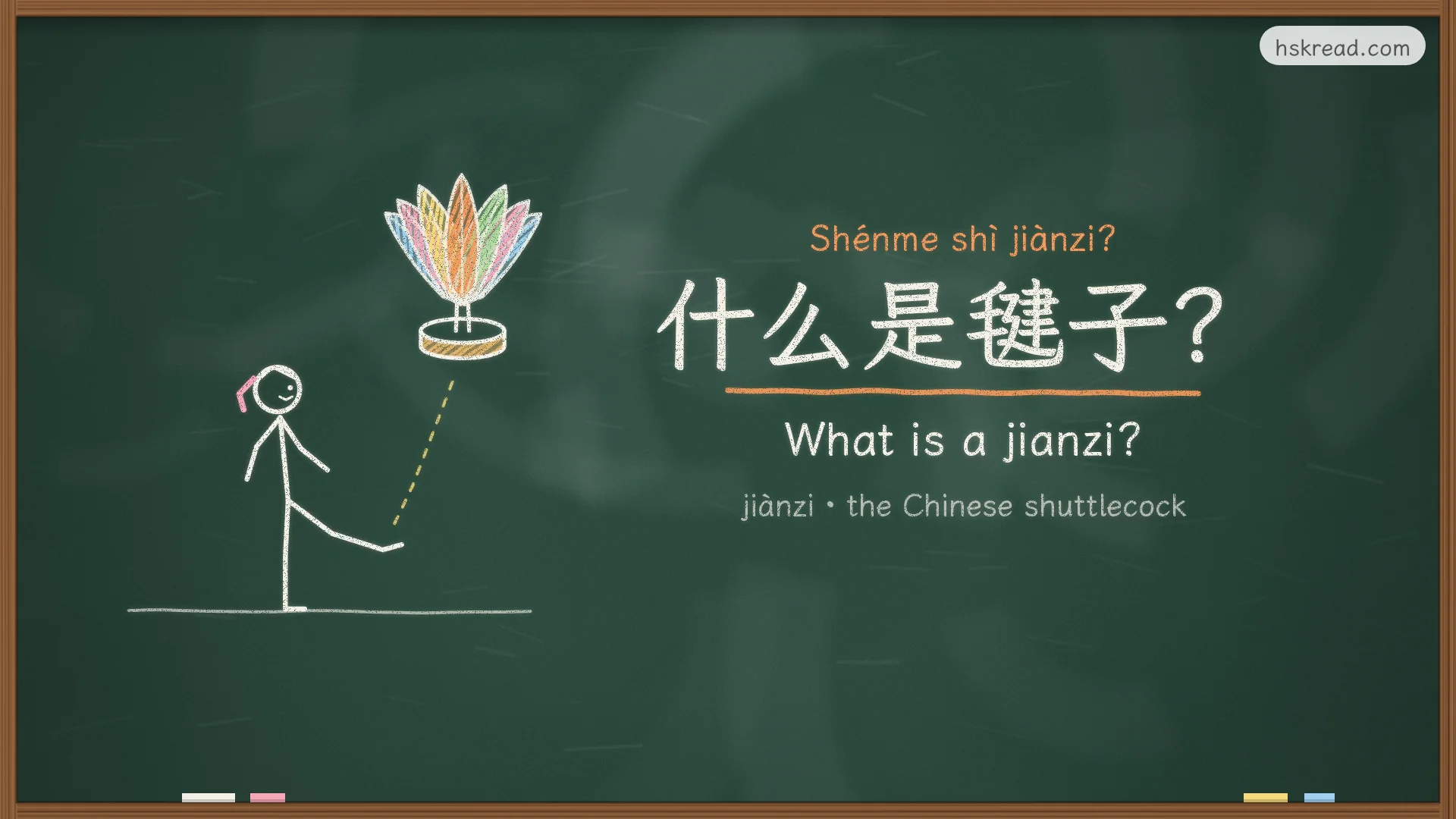
Walk past a Chinese primary school at recess, or through a park on a cold winter morning, and you may hear a soft tock, tock, tock. Look closer and you will see someone hopping on one foot, kicking a small bundle of bright feathers into the air again and again. The feathers flutter up, drop down, and are kicked back up before they touch the ground.
This is 踢毽子 (tī jiànzi), the Chinese shuttlecock game. The toy (玩具, wánjù) itself is a 毽子 (jiànzi), and in English you will often see it called jianzi, a Chinese shuttlecock or even a Chinese hacky sack.
It costs only a few yuan, needs no court and no special shoes, and people have been playing it in China for well over a thousand years. In this guide, you will learn what a jianzi is, how to play, where it came from, and the Chinese words you need to join in. Each section stands on its own, so jump to whatever interests you.
Key takeaways
- What it is: a 毽子 is a shuttlecock made of feathers attached to a small weighted base.
- How to play: 踢毽子 means “to kick the shuttlecock.” The one rule everyone knows: no hands. Beginners learn four basic kicks: 盘踢, 磕踢, 拐踢 and 绷踢.
- History: the game is well over 1,000 years old—one famous boy kicked a jianzi 500 times in a row about 1,500 years ago. In old Beijing, it was the classic winter game.
- The sport: since 1984, a net version called 毽球 (jiànqiú) has been an official sport in China.
- Cousins: it is related to hacky sack, Vietnam's đá cầu and Korea's jegichagi.
- Today: you will still see it at school during recess and in parks during morning exercise.
What is a jianzi?
A jianzi is a bundle of feathers on a weighted base—and even its Chinese character is built from the word "feather." Here is how it is made and why it flies the way it does.
The name is simple:
| Chinese | Pinyin | Meaning |
|---|---|---|
| 毽 | jiàn | shuttlecock (the character has 毛, “feather; fur,” on the left) |
| 子 | zi | a noun suffix, said in the neutral tone |
| 毽子 | jiànzi | a shuttlecock for kicking |
| 踢 | tī | to kick |
| 踢毽子 | tī jiànzi | to play jianzi; to kick the shuttlecock |
Look at the left side of 毽: it is 毛 (máo), “feather” or “fur.” The right side, 建 (jiàn), gives the sound. So the character itself tells you what the toy is: something made of feathers, pronounced jiàn.
A jianzi has two main parts:
- The feathers (毽毛, jiànmáo). Traditionally these were rooster feathers (鸡毛, jīmáo)—and many Chinese grandparents laugh about chasing the family rooster as kids to pull out the best tail feathers. Today they are often dyed duck or goose feathers (羽毛, yǔmáo) in bright colors.
- The base (毽托, jiàntuō). In the past, many families made the base by wrapping an old copper coin (铜钱, tóngqián)—the kind with a square hole in the middle—in cloth or leather, then pushing a feather tube through the hole. Today, most bases are rubber (橡胶, xiàngjiāo) or plastic (塑料, sùliào), sometimes with a few metal washers to add weight.
The weight sits at the bottom and the feathers stand up on top, so a jianzi always falls base-first. That is what makes it possible to kick it again and again: it lands on your foot the same way every time.
How to play jianzi
All you need is one jianzi (毽子, a kicking shuttlecock) and one rule. Here is the basic game, the four kicks every Chinese kid learns, and tips for your first try.
The basic game
The simplest way to play needs only one jianzi and one rule: don't let it touch the ground, and don't use your hands. You toss the jianzi up with your hand, kick it, and keep kicking. Everyone counts out loud—一、二、三……—and the person with the most kicks in a row (连续, liánxù) wins.
Friends also play in a circle (围成一圈, wéi chéng yì quān), passing the jianzi from one person to the next with their feet, like a feathered game of keep-up.
The four basic kicks
Chinese PE teachers usually teach four basic kicks. Every fancy move is built on these:
| Kick | Pinyin | Part of the body | Notes |
|---|---|---|---|
| 盘踢 | pántī | inside of the foot | the first kick everyone learns; the base of the game |
| 磕踢 | kētī | knee (膝盖, xīgài) or thigh | for when the jianzi falls close to your body |
| 拐踢 | guǎitī | outside of the foot, kicked behind you | for when it drops to the side or behind |
| 绷踢 | bēngtī | top of the foot (the instep) | for low saves and many fancy tricks |
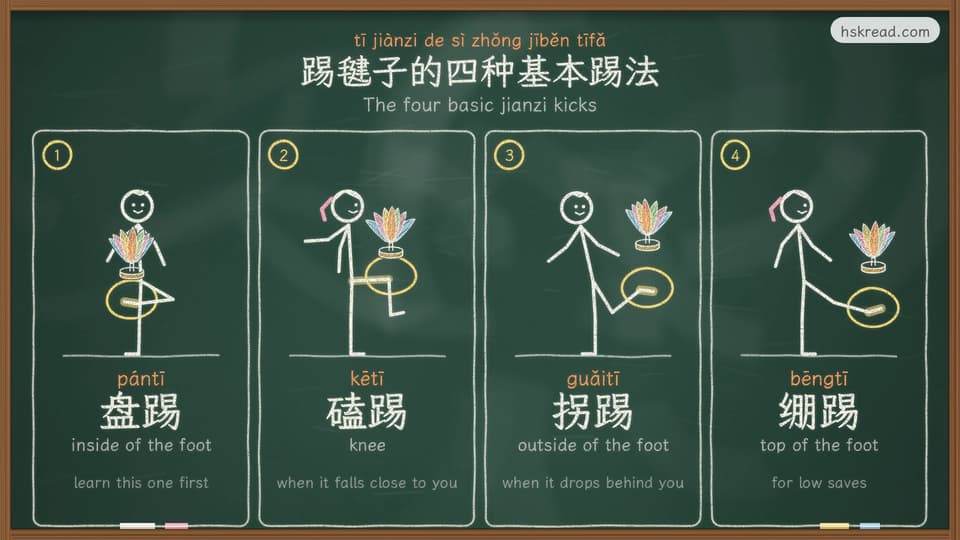
The inside-of-the-foot kick, 盘踢, is the heart of the game. Your knee turns out, your foot comes up like a small tray, and you tap the jianzi straight up—usually no higher than your chin.
The outside-of-the-foot kick, 拐踢, is the kick behind the most famous jianzi story: about 1,500 years ago, a 12-year-old boy named Huiguang (慧光) used it to kick a shuttlecock 500 times in a row while balancing on the edge of a well.
Tips for beginners
- One kick, one catch. Toss the jianzi up with your hand, kick it once, then catch it. Teachers call this 一踢一接 (yì tī yì jiē). When that feels easy, try two kicks and a catch, then three.
- Start with 盘踢. 练习 (liànxí, practice) it with both feet before you try the other kicks.
- Keep it low. Small, soft kicks are easier to control than big ones.
- Watch the base, not the feathers. The base is what touches your foot.
A short history of jianzi
From ancient ball games to a boy who became a monk, jianzi (毽子, the Chinese kicking shuttlecock) has a long and colorful past.
Older than you think
People in China were kicking things into the air long before anyone wrote the rules down. Many Chinese sources trace jianzi back to the Han dynasty (206 BC–AD 220), when 蹴鞠 (cùjū), an ancient ball-kicking game, was a favorite pastime. Exactly when someone first thought, "Let's kick feathers instead of a ball," nobody knows—but the idea of "keep it up with your feet" is very old.
The boy who kicked 500 times
The most famous jianzi story comes from about 1,500 years ago, in the city of Luoyang. An Indian Buddhist monk (和尚, héshang), the man who founded the famous 少林寺 (Shàolín Sì, Shaolin Temple), was walking down the street when he saw a crowd.
In the middle stood a 12-year-old boy named 慧光 (Huìguāng). He was balancing on the narrow edge of a well (井, jǐng)—and kicking a shuttlecock backward with the outside of his foot, 500 times in a row.
The monk was so impressed by the boy's skill and focus that he took him as a student on the spot. The boy grew up to become a famous monk himself. Not a bad result for a game of kick-the-feathers!
Coins, chicken feathers and shops
About a thousand years ago, in the Song dynasty, the jianzi already looked a lot like the one you can buy today. Children tied chicken feathers to small metal coins, kicked them in groups of three or four, and gave fancy names to their best tricks. There were even shops in the capital that made and sold shuttlecocks, so city kids did not have to make their own.
Jianzi in old Beijing and modern China
Why was jianzi a winter game? An old children's rhyme has the answer—and the game later moved from the street into PE class.
A winter game in old Beijing
In Beijing, jianzi (毽子, the kicking shuttlecock) became the classic winter game. An old Beijing children's rhyme matches games to the seasons, using the willow tree (柳树, liǔshù) as a calendar:
杨柳儿活,抽陀螺。杨柳儿青,放空钟。杨柳儿死,踢毽子。
"When the willows wake, spin the top. When the willows turn green, play the 空钟. When the willows die, kick the shuttlecock."
When the willow leaves fell and the cold wind blew in, it was time for 踢毽子—a perfect way to stay 暖和 (nuǎnhuo, warm) outdoors. (The 陀螺 is a spinning top, and the 空钟 (kōngzhōng) is the ancestor of today's Chinese yo-yo; read more in our guide to 空竹, the Chinese yo-yo.)
From the street to the sports hall
In the 1960s, jianzi became part of primary school PE (体育, tǐyù) lessons. In 1984, the net version, 毽球 (jiànqiú), became an official competition sport. And fancy shuttlecock kicking, 花毽 (huājiàn)—with spins, jumps and kicks behind the back—is now on China's national list of 非物质文化遗产 (fēiwùzhì wénhuà yíchǎn, intangible cultural heritage).
毽球: jianzi as a modern sport
Jianzi has a competitive side too: a fast net game that looks like volleyball played with soccer moves.
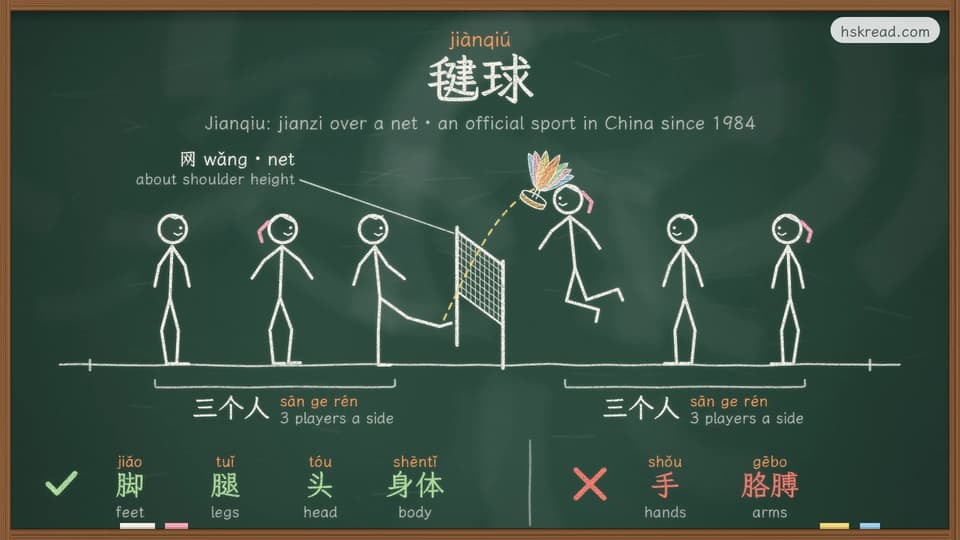
In 1984, China turned the 民间 (mínjiān, folk) street game “net jianzi” into an official 比赛 (bǐsài, competition) sport and named it 毽球 (jiànqiú, “shuttlecock ball”). People often describe it as a mix of three sports:
- the court of badminton,
- the rules of volleyball (排球, páiqiú),
- the skills of 足球 (soccer).
Two teams stand on either side of a net about as high as an adult's shoulder. In the main event, each team has three players.
Players may use their feet, legs, head and body, but never their hands or arms. Matches are fast, with high jumps and overhead kicks that look a lot like soccer bicycle kicks.
Jianzi, badminton and hacky sack
Shopping for a jianzi in China? Don't ask for a "shuttlecock"—in Chinese, the kicking kind and the badminton kind have different names.
In English, “shuttlecock” can mean two different things, and Chinese uses two different words:
| 毽子 jiànzi | 羽毛球 yǔmáoqiú | Hacky sack | |
|---|---|---|---|
| What it is | a kicking shuttlecock | badminton; also the badminton shuttlecock | a small bean bag |
| How you play | kick it | hit it with a racket (球拍) | kick it |
| Base | heavy: rubber, plastic or an old coin | light cork | none |
| Flight | slow fall, straight down | very fast off the racket | drops quickly |
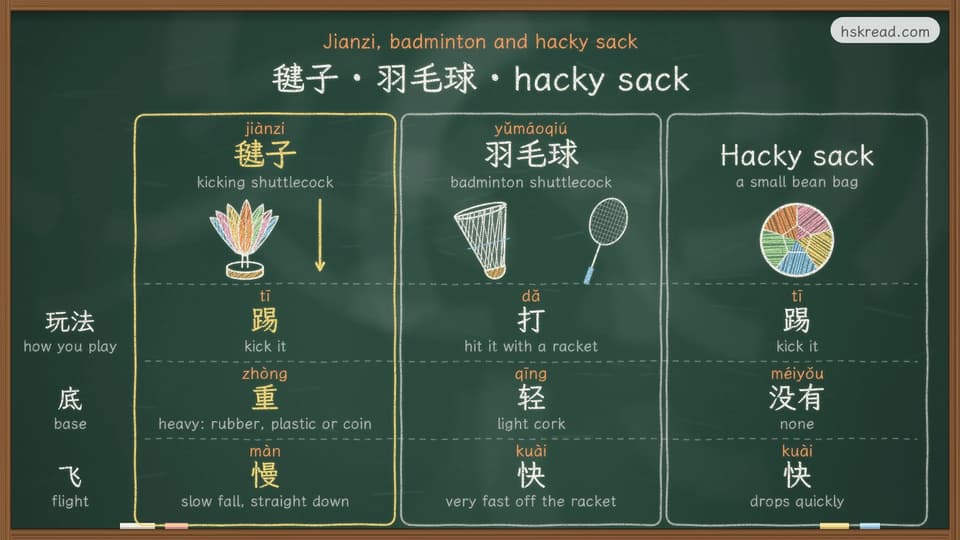
So if you want to buy a jianzi in China, ask for a 毽子, not a 羽毛球. A badminton shuttlecock is too light to kick—it would just float away.
Asian cousins and the hacky sack
Shuttlecock kicking is popular across Asia. In Vietnam it is called đá cầu, and Vietnamese players are among the strongest in the world.
In Korea, children traditionally play jegichagi around the Lunar New Year with a jegi made of paper and a coin. If you watched season 2 of Squid Game, the jegi-kicking challenge in the “Six-Legged Pentathlon” is this Korean cousin of jianzi.
The hacky sack, created in the United States in the 1970s, is a younger relative that uses a small bean bag instead of feathers.
Jianzi at school and in the park
Where can you see jianzi today? Mostly in two places: the schoolyard at recess and the park early in the morning.
For many Chinese adults, jianzi is a 童年 (tóngnián, childhood) 回忆 (huíyì, memory). During 课间 (kèjiān, the break between classes), schoolyards used to fill with games that cost almost nothing:
| Game | Pinyin | What it is |
|---|---|---|
| 踢毽子 | tī jiànzi | kicking a shuttlecock |
| 跳绳 | tiàoshéng | jumping rope |
| 跳皮筋 | tiào píjīn | jumping and dancing over a stretched rubber band |
| 丢沙包 | diū shābāo | throwing small cloth bean bags (沙包) at other players |
| 抽陀螺 | chōu tuóluó | spinning a top with a whip |
Today, many schools still use jianzi in 体育课 (tǐyùkè, PE class) and hold kicking contests.
And jianzi is not only for kids. In parks across northern China, you will often see groups of older people standing in a circle in the morning, passing a jianzi with smooth, elegant kicks—some of them can keep it up for minutes without a drop. Like tai chi, it is part of the morning exercise culture, or 晨练 (chénliàn).
Why do people love it? It is cheap, it fits in a pocket, and you can play almost anywhere. It also trains balance (平衡, pínghéng), coordination and quick reactions (反应, fǎnyìng), and a few minutes of kicking will warm you up on a cold day—which is exactly why an old Beijing children's rhyme saves it for winter.
Useful vocabulary
| Chinese | Pinyin | English |
|---|---|---|
| 毽子 | jiànzi | shuttlecock (for kicking) |
| 踢毽子 | tī jiànzi | to play jianzi; to kick a shuttlecock |
| 踢 | tī | to kick |
| 毽球 | jiànqiú | shuttlecock ball (the net sport) |
| 花毽 | huājiàn | fancy shuttlecock kicking |
| 鸡毛 | jīmáo | chicken feather |
| 铜钱 | tóngqián | copper coin (with a square hole) |
| 蹴鞠 | cùjū | ancient Chinese ball-kicking game |
| 羽毛球 | yǔmáoqiú | badminton; badminton shuttlecock |
| 连续 | liánxù | in a row; continuously |
| 课间 | kèjiān | break between classes; recess |
| 跳绳 | tiàoshéng | to jump rope |
| 晨练 | chénliàn | morning exercise |
Next time you see a bright little bundle of feathers flying up in a Chinese park, don't be shy—ask if you can join, and start counting: 一、二、三……
Check your understanding
01What is jianzi?
Jianzi (毽子, jiànzi) is a Chinese shuttlecock made of feathers fixed to a small weighted base. The game of kicking it, 踢毽子 (tī jiànzi), means keeping it in the air with your feet and body, without using your hands.
02How do you pronounce jianzi?
It is pronounced jiànzi, with a falling fourth tone on 毽 and a light neutral tone on 子. “To kick jianzi” is 踢毽子, tī jiànzi.
03How old is the game of jianzi?
Many Chinese sources trace shuttlecock kicking back to the Han dynasty (206 BC–AD 220). A famous story from about 1,500 years ago tells of a 12-year-old boy who kicked one 500 times in a row, and by the Song dynasty, about 1,000 years ago, children were kicking feathered coins very much like today's jianzi.
04What are the rules of jianzi?
In the simple version, you kick the shuttlecock up again and again and count how many kicks you can do before it falls. You can use your feet, knees and body, but not your hands. In the net sport 毽球, two teams of three players kick it over a net, a bit like volleyball played with the feet.
05Is jianzi the same as badminton?
No. Both use a feathered shuttlecock, but in badminton (羽毛球) you hit it with a racket, while in jianzi you kick it. A jianzi is also heavier and sturdier than a badminton shuttlecock.
06Is jianzi the same as hacky sack?
They are close cousins. Both are about keeping an object in the air with your feet. A hacky sack is a small bean bag, while a jianzi has feathers, so it falls more slowly and flies in a straighter line.