The Chinese Yo-Yo (空竹): History, Sound and How to Play Kongzhu
A fun guide to the Chinese yo-yo, or kongzhu (空竹)—why it is called “empty bamboo,” where its humming whistle comes from, single- and double-wheel types, how it traveled from old Beijing to become the Western diabolo, famous trick names, and how to start playing.
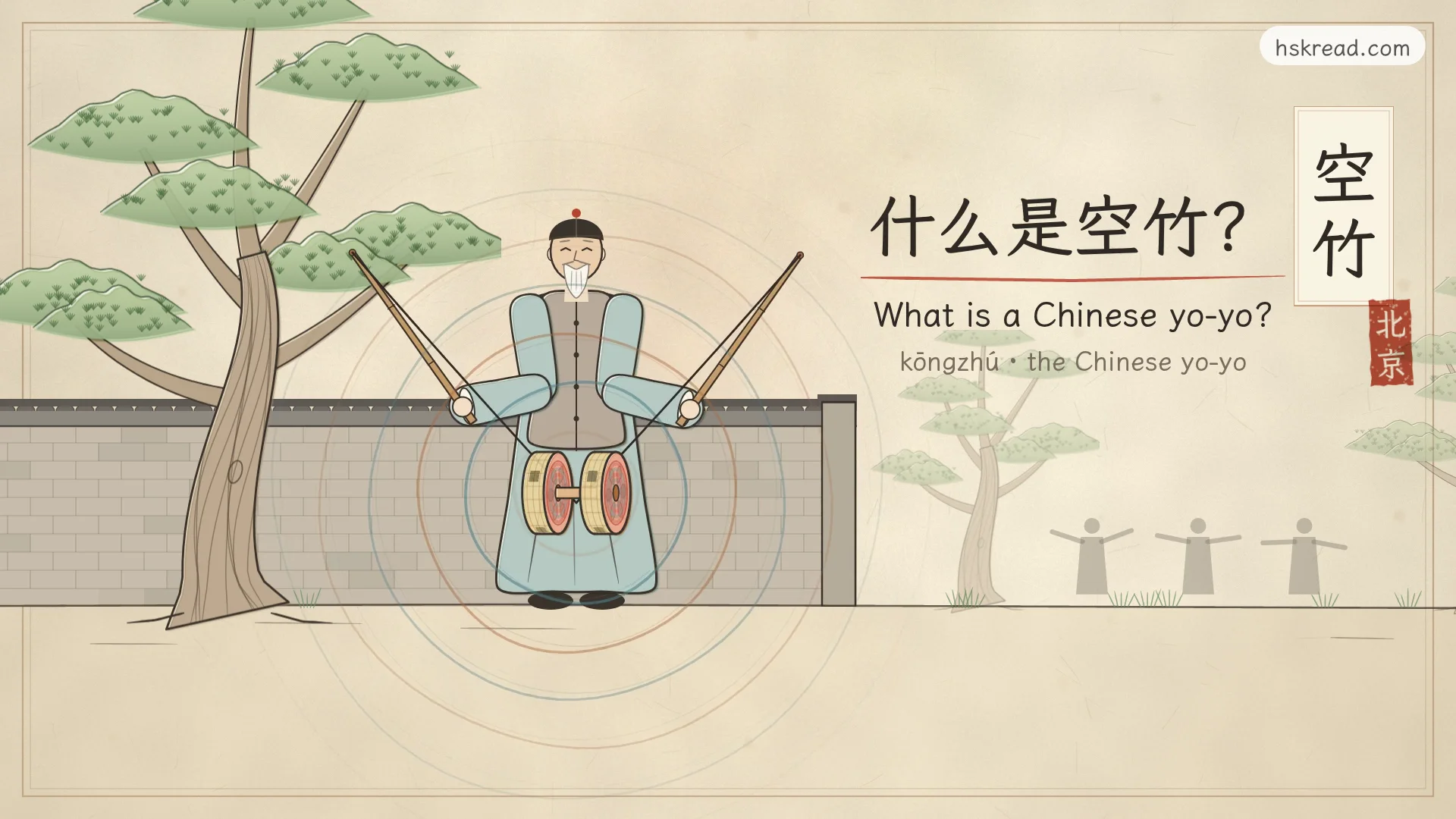
Walk into a park in Beijing early in the morning and listen. Among the birdsong and the music from the dance groups, you may hear a deep wooo—wooo— sound (Chinese writes it 嗡嗡, wēngwēng), like a tiny jet engine or a bottle being blown.
Follow the sound (声音, shēngyīn) and you will find someone holding two sticks joined by a string. On the string, a wheel-shaped toy (玩具, wánjù) spins so fast that it sings.
This is a 空竹 (kōngzhú), known in English as the Chinese yo-yo. Playing it is called 抖空竹 (dǒu kōngzhú). In the West, its close cousin is called the diabolo. In this guide, you will learn what the name means, why it whistles, how to play, where it came from, and the Chinese words that go with it. Each section stands on its own, so jump to the part you want.
Key takeaways
- What it is: 空竹 means “empty bamboo.” It is a hollow spinning toy played on a string between two sticks. Playing it is 抖空竹, literally “to shake the kongzhu.”
- The whistle: small whistle holes (哨口) in the wheels make it hum as it spins.
- How to play: one hand pulls, one hand follows—then learn tricks with names like “ants climb the tree.”
- Two types: there are single-wheel (单轮) and double-wheel (双轮) kongzhu.
- In Beijing today: it is a morning-exercise favorite, and 抖空竹 became a national intangible cultural heritage item of China in 2006.
- History: a Beijing guidebook from 1635 describes its likely ancestor, the humming 空钟 (“empty bell”); in Europe it became the diabolo.
What is a kongzhu?
Two sticks, one string and a hollow wheel: here is what a kongzhu is, what its name means and how it differs from a yo-yo.
The name has two characters:
| Character | Pinyin | Meaning |
|---|---|---|
| 空 | kōng | empty; hollow |
| 竹 | zhú | bamboo |
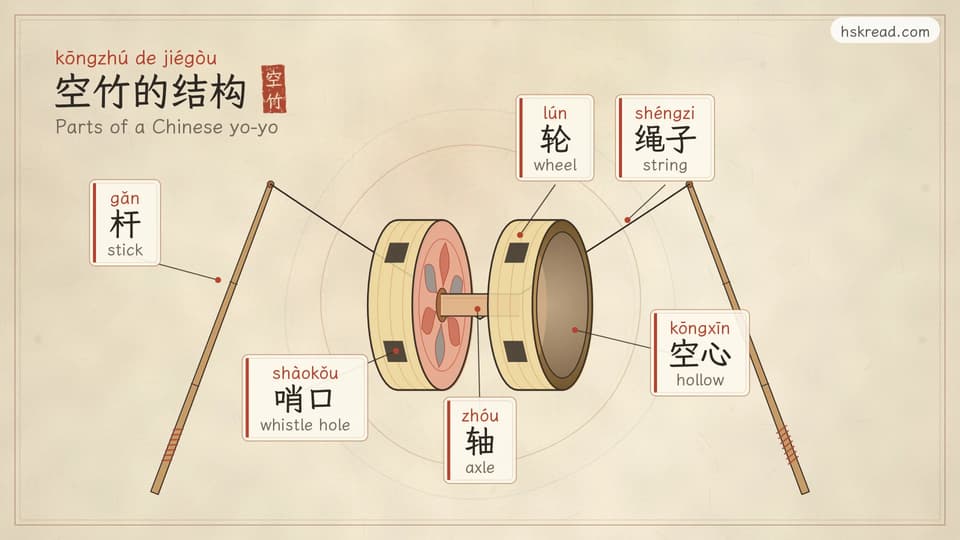
So 空竹 is “empty bamboo”—a good description, because the traditional kongzhu is made of bamboo and wood and is hollow inside. It looks like one or two round wheels joined by a short wooden axle.
You hold a stick (杆, gǎn) in each hand. A string (绳子, shéngzi, or 线, xiàn) ties the two sticks together, and the kongzhu sits on the string, spinning (旋转, xuánzhuǎn) around its axle (轴, zhóu).
A tip for learners: 空 has two pronunciations. In 空竹 it is kōng (first tone), “empty.” In 有空 (yǒu kòng, “to have free time”), it is kòng (fourth tone), “free time.”
The verb is 抖 (dǒu), “to shake” or “to jerk.” You don't throw a kongzhu or roll it—you 抖 it, with quick up-and-down movements of the sticks.
It is the same 抖 you see in 抖音 (Dǒuyīn), the Chinese version of TikTok, literally “shaking sound.” So yes—every time you scroll 抖音, you are "shaking sounds" too.
Chinese yo-yo or diabolo?
In English, you will see both names. The Chinese yo-yo is the traditional Chinese toy, usually with flat round wheels made of bamboo and wood. The diabolo is the Western version, usually shaped like two cups or cones joined at the tip and made of plastic and rubber. They are played in the same way.
A kongzhu is also quite different from an ordinary yo-yo (悠悠球, yōuyōuqiú). A yo-yo is tied to one string and goes up and down from one hand. A kongzhu is not tied to anything: it rolls freely on a string held by two sticks, so you can toss it high into the air and catch it again.
Why does the Chinese yo-yo whistle?
That deep wooo—wooo you hear in Beijing parks has a simple secret: holes. Around the edge of each wheel, there are small slots called 哨口 (shàokǒu, whistle holes)—哨 is the 哨 in 哨子 (shàozi, a whistle).
When the kongzhu (空竹, the Chinese yo-yo) spins fast, air rushes through these holes, just like when you blow across the top of a bottle. The hollow (空心, kōngxīn) wheel makes the sound louder, so the whole toy hums.
- Big holes make a low sound.
- Small holes make a high sound.
- The faster it spins, the louder it sings.
A kongzhu is often named by how many whistles it has: 双响 (shuāngxiǎng, two whistles), 四响 (four), 六响 (six), and so on. The biggest ones can have as many as 36 whistles.
When all of them sound together, people describe the noise as “high and powerful, rising into the clouds”—you can hear it from across the park.
The word 响 (xiǎng) means “to make a sound” or “loud” (as in 响声, a loud sound), so a 六响空竹 is literally a “six-sound kongzhu.”
How to play the Chinese yo-yo
Want to make it hum yourself? Here are the first five steps most teachers use.
You need a kongzhu (空竹, a Chinese yo-yo) and a pair of sticks with a string, usually sold together. Here is how most teachers explain the first steps:
- Start on the ground. Put the kongzhu on the ground and lay the string under its axle. Hold one stick in each hand.
- Roll and lift. Pull the sticks to one side so the kongzhu rolls along the string, then lift it up off the ground.
- 抖: one hand pulls, one hand follows. Pull your strong hand up quickly, then let it drop slowly, while your other hand moves gently. Each pull makes it spin faster.
- Keep it straight. If the kongzhu starts to tilt, move one stick a little forward or backward until it is level again.
- Listen. When it spins fast enough, it starts to hum. That sound means you are doing it right!
Famous Chinese yo-yo tricks and their poetic names
Golden roosters, the Weaver Girl, ants climbing a tree: kongzhu tricks have some of the best names in any sport.
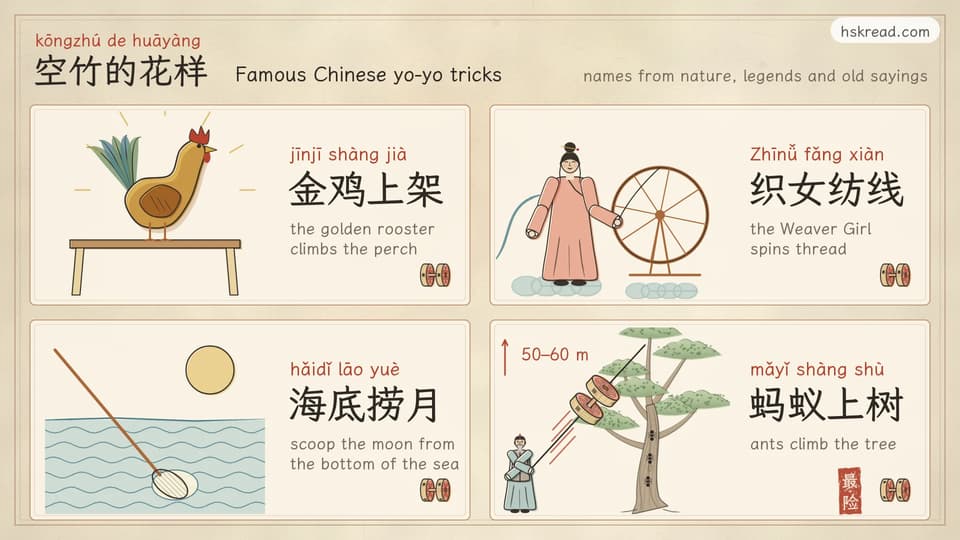
Once you can keep a kongzhu (Chinese yo-yo) spinning, you can learn tricks (技巧, jìqiǎo). After a lot of practice (练习, liànxí), some players can do dozens in a row. Like tai chi moves, kongzhu tricks have colorful names taken from nature, legends and old sayings. Here are some classic ones:
| Trick | Pinyin | English |
|---|---|---|
| 金鸡上架 | jīnjī shàng jià | the golden rooster climbs the perch |
| 翻山越岭 | fān shān yuè lǐng | cross mountains and hills |
| 织女纺线 | Zhīnǚ fǎng xiàn | the Weaver Girl spins thread |
| 二郎担山 | Èrláng dān shān | Erlang carries mountains on his pole |
| 鹞子翻身 | yàozi fānshēn | the sparrowhawk turns over |
| 海底捞月 | hǎidǐ lāo yuè | scoop the moon from the bottom of the sea |
| 青云直上 | qīngyún zhíshàng | rise straight into the blue clouds |
| 蚂蚁上树 | mǎyǐ shàng shù | ants climb the tree |
The Weaver Girl, 织女, is the heroine of the Qixi love story—read more in our guide to Chinese traditional festivals. Erlang is a god from Chinese legend; in one folk tale, he carries mountains on a shoulder pole to chase down the suns.
蚂蚁上树 is said to be the most daring of all. One end of a long rope is tied high up in a tree.
A partner throws the spinning kongzhu onto the rope, the person holding the rope pulls hard, and the kongzhu shoots up the rope, as high as 50 or 60 meters, before it falls back down to be caught on the string. (It is also the name of a popular Sichuan dish of noodles with minced pork—the “ants” are the little bits of meat.)
Single-wheel and double-wheel kongzhu
Buying your first Chinese yo-yo? Start by choosing between one wheel and two. There are two main types of kongzhu (空竹):
| Type | Chinese | Pinyin | What it looks like | Difficulty |
|---|---|---|---|---|
| Double-wheel | 双轮空竹 | shuānglún kōngzhú | a wheel at each end of the axle, like a dumbbell | stable; the usual choice to start |
| Single-wheel | 单轮空竹 | dānlún kōngzhú | one wheel at one end, a short axle at the other | harder to balance |
The word 轮 (lún) means “wheel,” the same 轮 as in 轮子 (lúnzi). A double-wheel kongzhu is much more stable, so most beginners start with it. A single-wheel kongzhu is heavier on one side, so the player must work hard to keep its balance (平衡, pínghéng). Watching an expert spin one is impressive for exactly that reason.
Besides these two, makers have created all kinds of unusual shapes, and the Beijing Kongzhu Museum, near Baoguo Temple, collects hundreds of them.
The Chinese yo-yo in Beijing today
Where can you see a kongzhu (空竹, Chinese yo-yo) today? Start with a Beijing park at dawn.
For many Beijingers, the sound of a kongzhu is the sound of a morning in the park (公园, gōngyuán). Retired people meet at the same spot every day for 晨练 (chénliàn, morning exercise), and some groups spin dozens of kongzhu together.
It is a full-body workout without feeling like one: your arms, shoulders, waist and legs all move, and you have to look up and stay focused.
A few more things to know:
- National heritage: In 2006, 抖空竹 was added to China's first list of national 非物质文化遗产 (fēi wùzhì wénhuà yíchǎn, intangible cultural heritage).
- A museum: Beijing even has a small Kongzhu Museum (空竹博物馆) near Baoguo Temple (报国寺), full of single-wheel, double-wheel and strangely shaped kongzhu.
- On the big stage: Kongzhu performances (表演, biǎoyǎn) are a classic part of Chinese 杂技 (zájì, acrobatics) and 杂耍 (záshuǎ, juggling and variety) shows, where performers spin several kongzhu at once or toss them to each other across the stage. According to Beijing media, a neighborhood kongzhu team even performed in the Bird's Nest stadium on the opening night of the 2008 Beijing Olympics.
- At school: Some schools in Beijing and other cities teach 抖空竹 in 体育课 (tǐyùkè, PE class) or after-school clubs, so this traditional (传统, chuántǒng) skill keeps passing to new generations.
If you want to try it in China, toy shops, tourist streets and online stores all sell kongzhu. A plastic (塑料, sùliào) double-wheel one for beginners is cheap. If you see a group playing in a park, just stop and watch for a while; many players are happy to show a curious visitor how to start.
A short history of the Chinese yo-yo
From a humming "empty bell" in Ming-dynasty Beijing to the "devil on two sticks" in Paris and London, the kongzhu (空竹, Chinese yo-yo) has traveled far.
The "empty bell" of old Beijing
Nobody knows exactly who made the first kongzhu. The oldest clear description comes from a guidebook to the sights and customs of Beijing, printed in 1635, near the end of the Ming dynasty.
It describes a toy called 空钟 (kōngzhōng), "empty bell": a piece of wood hollowed out inside, with an opening on the side, that hummed like a bell when it spun.
It may have spun on the ground, more like a whistling top, but the idea of a hollow, singing toy was already a popular folk (民间, mínjiān) pastime in Beijing. Chinese heritage experts say people have been playing this kind of game for at least 600 years.
Beijing children even had a rhyme about it:
杨柳儿青,放空钟。
"When the willows turn green, it's time to spin the empty bell."
When the willows (柳树, liǔshù) turn green, it is spring (春天, chūntiān)—so spring was kongzhu season. (Later in the same rhyme, when the willow leaves fall, it is time to kick the shuttlecock—read about that game in our guide to jianzi, the Chinese shuttlecock.)
A toy with many nicknames
By the Qing dynasty (1644–1912), the toy spinning on a string was everywhere, and every place seemed to have its own name for it. Some people called it a 响葫芦 (xiǎng húlu, "sounding gourd"), because its shape and hum reminded them of a 葫芦 (húlu), a bottle gourd.
South of the Yangtze River, it was 扯铃 (chělíng, "pull bell"; 铃 is a bell, as in 铃声, a ringtone). Beijing and Tianjin were famous for making the best ones, and a kongzhu was a favorite thing to buy at Beijing's Spring Festival temple fairs (庙会, miàohuì).
From China to Europe: the "devil on two sticks"
At the end of the 1700s, European visitors to Beijing saw the toy, and examples soon traveled west. In the 1800s it became a craze in France and England, where people called it "the devil on two sticks." In the early 1900s, a European engineer made a version with two cups and gave it a new name: the diabolo, which sounds a lot like the Italian word for "devil."
So the next time you see a street performer with a diabolo at a European festival, you are looking at a distant relative of the Beijing kongzhu.
Useful vocabulary
| Chinese | Pinyin | English |
|---|---|---|
| 空竹 | kōngzhú | Chinese yo-yo; diabolo |
| 抖空竹 | dǒu kōngzhú | to play the Chinese yo-yo |
| 抖 | dǒu | to shake; to jerk |
| 空 | kōng | empty; hollow |
| 竹 | zhú | bamboo |
| 空钟 | kōngzhōng | “empty bell,” an old name for the toy |
| 哨口 | shàokǒu | whistle hole |
| 响 | xiǎng | to make a sound; loud |
| 轮 | lún | wheel |
| 单轮 / 双轮 | dānlún / shuānglún | single-wheel / double-wheel |
| 杂技 | zájì | acrobatics |
| 庙会 | miàohuì | temple fair |
| 晨练 | chénliàn | morning exercise |
The next time you hear a strange humming in a Chinese park, follow the sound—someone is probably 抖空竹, and they might just hand you the sticks.
Check your understanding
01What is a Chinese yo-yo?
A Chinese yo-yo, or kongzhu (空竹, kōngzhú), is a hollow spinning toy made of bamboo and wood. You spin it on a string tied between two sticks. Small holes in its wheels make it hum or whistle as it spins.
02What does 空竹 mean?
空 (kōng) means “empty” or “hollow,” and 竹 (zhú) means “bamboo.” The name describes the toy itself, a hollow bamboo wheel. Playing it is called 抖空竹 (dǒu kōngzhú), “to shake the kongzhu.”
03Is the Chinese yo-yo the same as a diabolo?
They are close relatives. Europeans saw the Chinese toy in the late 1700s and called it “the devil on two sticks.” In the early 1900s a European engineer made a version with two cups and called it the “diabolo.” Today, many people use the two names for the same kind of toy.
04Why does a kongzhu make a whistling sound?
Its wheels are hollow and have small whistle holes (哨口) around the edge. When the kongzhu spins fast, air rushes through the holes and makes a humming sound. Big holes give a low sound and small holes a high one.
05How old is the Chinese yo-yo?
A Beijing guidebook from 1635 describes a hollow, humming toy called 空钟 (kōngzhōng), “empty bell,” which is often seen as the kongzhu's ancestor. Chinese heritage experts say the game has been popular for at least 600 years.
06Is it hard to learn the Chinese yo-yo?
The basic spin is easy to learn in an afternoon, especially with a double-wheel kongzhu, which is more stable. Fancy tricks like throwing it high and catching it on the string take much more practice.