China's 56 Ethnic Groups (民族): Names, Population, Festivals and Culture
A friendly guide to China's 56 ethnic groups—what 民族 means, how many people belong to the Han and the 55 ethnic minorities, where different groups live, and their colorful festivals, clothing, food and languages.
There is a song almost every Chinese person can sing. It is called 《爱我中华》 (Ài Wǒ Zhōnghuá, “Love My China”), and it starts like this: “Fifty-six constellations, fifty-six flowers, fifty-six brothers and sisters are one family.” Those 56 flowers are China's 56 民族 (mínzú), or ethnic groups.
China is often imagined as one big group of people who all eat, dress and speak the same. In fact, it is home to dozens of ethnic groups, each with its own 文化 (wénhuà, culture) and 传统 (chuántǒng, traditions).
One week you could be splashed with water at a New Year party in the tropical south; the next, you could be watching wrestlers and horse races on the grasslands of the north. In this guide, you will learn what 民族 means, meet the biggest groups, and discover the festivals, clothes and foods that make each one special—plus the Chinese words you need to talk about them.
Key takeaways
- China officially has 56 民族: the 汉族 (Han) and 55 少数民族 (ethnic minorities).
- About 91% of people are Han. The other 9% sounds small, but it is about 125 million people—more than the population of most countries.
- Five minority groups have more than 10 million people each: the Zhuang, Uyghur, Hui, Miao and Manchu.
- Famous festivals include 泼水节 (water-splashing), 那达慕 (wrestling and horse racing), 火把节 (torches and bonfires) and 三月三 (a singing festival).
- Lamb skewers, butter tea, Miao silver headdresses—and even the qipao, partly—come from China's ethnic groups.
- Five autonomous regions, like Inner Mongolia and Guangxi, are named after local groups, and Yunnan alone is home to about 25 minorities.
- You can see four minority scripts on every Chinese banknote.
- Together, all 56 groups form the 中华民族, “the Chinese nation.”
What does 民族 mean?
The word has two characters:
| Character | Pinyin | Meaning |
|---|---|---|
| 民 | mín | people; the public |
| 族 | zú | clan; family; group |
So 民族 is literally “a people group.” In English it is usually translated as ethnic group or ethnicity. You can add 族 to the name of a group: 汉族 (Han), 壮族 (Zhuang), 苗族 (Miao), 蒙古族 (Mongolian) and so on. When you ask someone about their ethnicity, the question is simple:
Three related words come up all the time:
| Word | Pinyin | Meaning |
|---|---|---|
| 汉族 | Hànzú | the Han, China's largest ethnic group |
| 少数民族 | shǎoshù mínzú | ethnic minority (literally “small-number ethnic group”) |
| 中华民族 | Zhōnghuá Mínzú | the Chinese nation, made up of all 56 groups |
Here is a fun detail: the word 民族 is so hard to translate that China's top university for ethnic studies, 中央民族大学, simply calls itself Minzu University of China in English. And on every Chinese ID card (身份证, shēnfènzhèng), there is a line for 民族, right next to gender.
How many ethnic groups are there in China?
The answer is 56: the Han plus 55 ethnic minorities. But the number has a story.
When China held its first national census in the 1950s, people wrote down more than 400 different names for their groups. Some were the same people under different local names; others were small branches of a larger group.
So researchers set off for villages in the mountains, the grasslands and the deserts. They listened to languages, watched weddings and festivals, and asked about customs (习俗, xísú) and family histories. Step by step, the list was sorted out. The very last group to be added was the Jino (基诺族) of Yunnan, in 1979—making 56.
How many people belong to each group?
China counts its 人口 (rénkǒu, population) every ten years in a big national census (人口普查, rénkǒu pǔchá).
In the most recent one, in 2020, about 91% of people on the Chinese mainland were Han—nearly 1.3 billion people. The remaining 9%, the ethnic minorities, added up to about 125 million. That is about as many people as the whole population of Japan! And the minority population has been growing a little faster than the Han population.
Meet the biggest groups
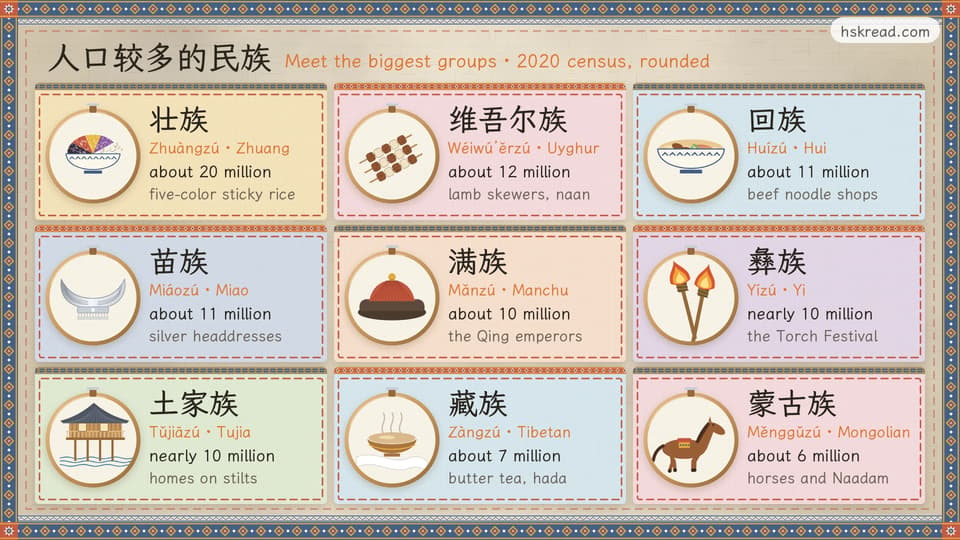
Here are some of the groups with the most people, with one thing each is famous for. Size is only a number: every group, large or small, is an equal member of the Chinese family.
| Group | Pinyin | English | About how many | Where most live | You might know them for |
|---|---|---|---|---|---|
| 壮族 | Zhuàngzú | Zhuang | 20 million | Guangxi | singing festivals and five-color sticky rice |
| 维吾尔族 | Wéiwú'ěrzú | Uyghur | 12 million | Xinjiang | lamb skewers, naan bread and lively dance |
| 回族 | Huízú | Hui | 11 million | Ningxia and all over China | halal restaurants and beef noodle shops |
| 苗族 | Miáozú | Miao | 11 million | Guizhou, Hunan, Yunnan | spectacular silver headdresses |
| 满族 | Mǎnzú | Manchu | 10 million | the northeast and Hebei | the emperors of the Qing dynasty |
| 彝族 | Yízú | Yi | nearly 10 million | Sichuan, Yunnan, Guizhou | the Torch Festival |
| 土家族 | Tǔjiāzú | Tujia | nearly 10 million | Hunan, Hubei, Chongqing | homes on stilts by the river |
| 藏族 | Zàngzú | Tibetan | 7 million | Tibet, Sichuan, Qinghai | butter tea and white welcome scarves |
| 蒙古族 | Měnggǔzú | Mongolian | 6 million | Inner Mongolia | horses, grasslands and Naadam |
Some groups are very small—a few have only a few thousand people. That is one reason China puts effort into recording their languages, songs and crafts.
A tip for learners: Many group names are one character plus 族, like 壮族 or 苗族. Others are longer because they come from the group's own language, like 维吾尔族 (Uyghur) or 蒙古族 (Mongolian). In conversation, people often drop 族 when the meaning is clear: 他是蒙古族 and 他是蒙古人 are both common.
Festivals of China's ethnic groups: water fights and grassland games
Many ethnic groups celebrate the Spring Festival like everyone else, but they also have their own big days. Here are four of the most famous 节日 (jiérì, festivals):
| Festival | Chinese | Pinyin | Main group(s) | When |
|---|---|---|---|---|
| Water-Splashing Festival | 泼水节 | Pōshuǐ Jié | Dai (and others) | usually April 13–15 |
| Naadam | 那达慕 | Nàdámù | Mongolian | summer, often July–August |
| Torch Festival | 火把节 | Huǒbǎ Jié | Yi (and others) | 24th day of the 6th lunar month |
| Sanyuesan | 三月三 | Sānyuèsān | Zhuang (and others) | 3rd day of the 3rd lunar month |
泼水节: the Water-Splashing Festival
The 泼水节 (Pōshuǐ Jié) is the New Year of the Dai people in Yunnan, especially in Xishuangbanna. It is usually held from April 13 to 15.
On the main day, the whole town turns into a giant water fight: locals and visitors splash each other with bowls, buckets and water guns. Being soaked is not bad luck; it is a blessing (祝福, zhùfú). The wetter you get, the more good wishes you receive—so don't bother trying to stay dry!
那达慕: games on the grassland
那达慕 (Nàdámù) comes from a Mongolian word for “games.” It is held on the 草原 (cǎoyuán, grasslands) of Inner Mongolia in summer. The heart of Naadam is the 男儿三艺 (nán'ér sān yì, “three manly skills”): wrestling, horse racing and archery (射箭).
Some of the jockeys in the horse races are kids, riding at full speed across the open grass. Around the games there are markets, singing and dancing, and plenty of milk tea and roast mutton.
Torches and love songs: the 火把节 and 三月三 festivals
Fire at night and singing by day: two more ethnic festivals where visitors are welcome to join in.
火把节: the Torch Festival
The 火把节 (Huǒbǎ Jié) is the biggest festival of the Yi people in Sichuan, Yunnan and Guizhou; the Bai, Naxi and other groups celebrate it too. It falls on the 24th day of the sixth lunar month—August 6 in 2026 and July 27 in 2027.
At night, people light huge torches and bonfires (篝火, gōuhuǒ), walk through the fields with fire, and dance in giant circles around the flames. Visitors are almost always pulled into the circle. In the daytime there are horse races, bullfights and wrestling.
三月三: the singing festival
三月三 (Sānyuèsān, “Third Day of the Third Month”) is a major festival of the Zhuang people in Guangxi. It falls on the third day of the third lunar month—April 19 in 2026 and April 9 in 2027.
It is also a singing festival: young people meet to sing to each other in call-and-response songs, a little like a musical conversation (and, traditionally, a way to flirt). Families make 五色糯米饭 (wǔsè nuòmǐfàn), sticky rice dyed five colors with plant juices. Best of all, everyone in Guangxi gets two days off for 三月三.
For the festivals that all of China celebrates, see our guide to Chinese traditional festivals.
Food from different ethnic groups
China's ethnic groups have given the country some of its favorite foods:
| Food | Chinese | Pinyin | Connected with |
|---|---|---|---|
| lamb skewers | 羊肉串 | yángròuchuàn | Xinjiang, Uyghur cooking |
| pilaf (hand-grabbed rice) | 抓饭 | zhuāfàn | Xinjiang, Uyghur cooking |
| naan bread | 馕 | náng | Xinjiang |
| milk tea | 奶茶 | nǎichá | Mongolian (salty, with milk) |
| butter tea | 酥油茶 | sūyóuchá | Tibetan |
| bamboo-tube rice | 竹筒饭 | zhútǒngfàn | Dai and other southern groups |
| pineapple rice | 菠萝饭 | bōluófàn | Dai |
| five-color sticky rice | 五色糯米饭 | wǔsè nuòmǐfàn | Zhuang |
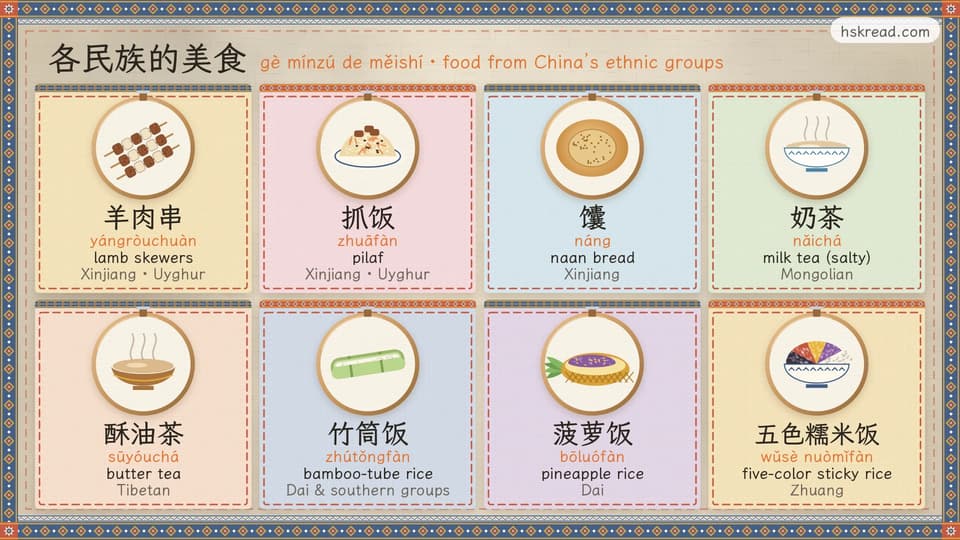
A fun warning about Mongolian milk tea: if you are used to sweet bubble tea, the first sip of salty milk tea is a big surprise. And Tibetan butter tea is rich, salty and very warming at high altitude.
You will also see the word 清真 (qīngzhēn, “halal”) on restaurant signs all over China, usually in green. Many of these restaurants are run by Hui families, and many of the Lanzhou beef noodle shops you find in almost every Chinese city are among them. Watching the cook pull a lump of dough into long noodles in seconds is half the fun.
Traditional clothing: silver headdresses, riding robes and the qipao
Silver horns, riding robes and a famous dress named after “banner people”—here is what people wear on festival days.
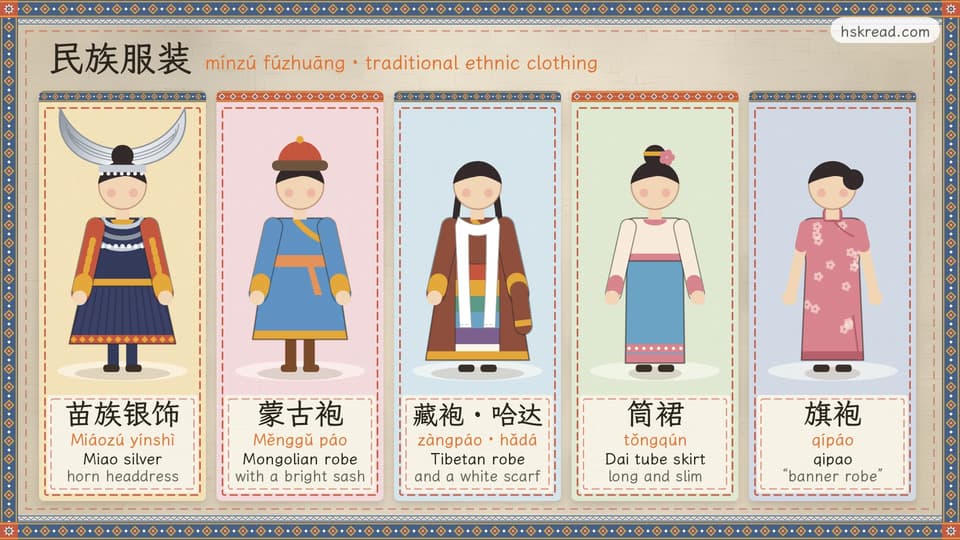
The everyday word for clothing is 服装 (fúzhuāng), and a group's traditional dress is called 民族服装 (mínzú fúzhuāng). On festival days, at weddings and on stage, many people wear it proudly. A few you may recognize:
- Miao silver: Miao women in Guizhou are famous for huge silver headdresses shaped like horns, plus necklaces and tiny bells that jingle when they dance. A full set can be very heavy, and it is often passed down in the family.
- The Mongolian robe (蒙古袍, Měnggǔ páo): a long, warm robe with a bright sash, made for riding horses on cold grasslands.
- The Tibetan robe (藏袍, zàngpáo) and the 哈达 (hǎdá), a long white scarf placed around a guest's neck as a sign of respect and welcome.
- The Dai sarong (筒裙, tǒngqún): a long, slim tube skirt, cool and practical for the warm south.
- The qipao (旗袍, qípáo): here is a surprise. The famous Chinese dress has a name that means “banner robe.” In the Qing dynasty, the Manchus were called 旗人 (qírén, “banner people”), and the modern qipao grew partly out of their style of dress.
Where do China's ethnic minorities live?
People of different groups live side by side all across China—in Beijing or Shanghai, your neighbor might be Hui, Manchu or Mongolian. But many groups also have home areas where they make up a big part of the population. In some of these places, China has set up autonomous areas named after the local group.
The biggest are the five province-level 自治区 (zìzhìqū, autonomous regions). Their full names tell you which group gave them their name:
- 内蒙古自治区 — Inner Mongolia
- 新疆维吾尔自治区 — Xinjiang Uyghur Autonomous Region
- 广西壮族自治区 — Guangxi Zhuang Autonomous Region
- 宁夏回族自治区 — Ningxia Hui Autonomous Region
- 西藏自治区 — Tibet Autonomous Region
There are also smaller ones, such as the 自治州 (zìzhìzhōu, autonomous prefecture). One you may hear about is Yanbian (延边) in Jilin, home to many people of the Korean ethnic group (朝鲜族)—food lovers go there for cold noodles and Korean-style barbecue. Want to know how these places fit with China's provinces and cities? See our guides to China's provinces and China's administrative divisions.
Yunnan: a province of many peoples
If you want to meet many groups in one trip, go to 云南 (Yúnnán). Besides the Han, Yunnan is home to about 25 ethnic minorities, and some of them live almost only there, like the Bai (白族) of Dali, the Naxi (纳西族) of Lijiang and the 傣族 (Dǎizú, Dai) of Xishuangbanna. Old towns, rice terraces, village markets with bright clothes—it is easy to see why so many travelers love it.
Languages and scripts: four extra scripts in your wallet
Chinese banknotes hide four extra scripts—and that is just the start of China's language variety.
China's national common language is 普通话 (Pǔtōnghuà, Mandarin), and everyone learns it at school. But most ethnic minorities also have their own 语言 (yǔyán, language)—not just a local dialect of Chinese, but a different language altogether. About twenty groups also have their own writing systems (文字, wénzì).
You can see four of these scripts in your wallet. Take out a Chinese 人民币 (Rénmínbì) banknote and look closely: next to the Chinese characters and pinyin, the bank's name is also written in Mongolian, Tibetan, Uyghur and Zhuang. Mongolian script is written from top to bottom—try to find it!
Ethnic music and folk songs (民歌, míngē) are part of this heritage too, and three of them are on UNESCO's intangible heritage list: the Grand Song of the Dong (侗族大歌), sung in many voices without any instruments; Tibetan opera (藏戏), with its colorful masks; and Mongolian khoomei (呼麦), a way of singing two notes at the same time. If you have never heard khoomei, look it up—it sounds almost impossible.
One big family: 中华民族
Chinese people often describe the 56 groups as one 大家庭 (dà jiātíng, big family)—中华民族大家庭 (Zhōnghuá Mínzú dà jiātíng). A popular way to say it is 多元一体 (duōyuán yìtǐ), “diversity in unity”: many groups with their own cultures, joined together into one nation over thousands of years.
That idea is in a song almost every Chinese person can sing, 《爱我中华》 (“Love My China”), which calls the 56 groups “fifty-six flowers.” It was written in 1991 for a national sports meeting of ethnic minorities' traditional games.
Here is a fun twist: the original lyric says 五十六个星座 (“56 constellations”), but many people sing 五十六个民族 instead—proof of how closely the number 56 is tied to the idea of China.
You will also meet the phrase 民族团结 (mínzú tuánjié, “unity among ethnic groups”) on posters, in schools and on TV; 团结 means “to unite.”
Useful vocabulary
| Chinese | Pinyin | English |
|---|---|---|
| 民族 | mínzú | ethnic group; nation |
| 汉族 | Hànzú | the Han |
| 少数民族 | shǎoshù mínzú | ethnic minority |
| 中华民族 | Zhōnghuá Mínzú | the Chinese nation |
| 人口 | rénkǒu | population |
| 人口普查 | rénkǒu pǔchá | census |
| 自治区 | zìzhìqū | autonomous region |
| 民族服装 | mínzú fúzhuāng | traditional ethnic clothing |
| 节日 | jiérì | festival |
| 泼水节 | Pōshuǐ Jié | Water-Splashing Festival |
| 火把节 | Huǒbǎ Jié | Torch Festival |
| 那达慕 | Nàdámù | Naadam |
| 清真 | qīngzhēn | halal |
| 普通话 | Pǔtōnghuà | Mandarin |
| 民族团结 | mínzú tuánjié | unity among ethnic groups |
Fifty-six groups, fifty-six flowers—every trip to a new corner of China is a chance to meet one more. 下次去云南,别忘了参加泼水节!
Check your understanding
01How many ethnic groups are there in China?
China officially recognizes 56 ethnic groups (民族, mínzú)—the Han (汉族) and 55 ethnic minorities (少数民族). The last group to be officially recognized was the Jino (基诺族) of Yunnan, in 1979.
02What is the largest ethnic group in China?
The Han (汉族). In China's 2020 census, about 91% of the people on the Chinese mainland were Han—nearly 1.3 billion people.
03What is the largest ethnic minority in China?
The Zhuang (壮族), with about 20 million people. Most Zhuang people live in Guangxi, with smaller communities in Yunnan and Guangdong.
04What does 民族 mean?
民族 (mínzú) is usually translated as “ethnic group.” 民 means “people” and 族 means “clan” or “group.” 中华民族 (Zhōnghuá Mínzú) means “the Chinese nation,” the big family that includes all 56 groups.
05What are China's five autonomous regions?
Inner Mongolia (内蒙古自治区), Xinjiang (新疆维吾尔自治区), Guangxi (广西壮族自治区), Ningxia (宁夏回族自治区) and Tibet (西藏自治区). There are also many smaller autonomous prefectures and counties.
06What are some famous ethnic minority festivals in China?
Popular ones include the Water-Splashing Festival (泼水节) of the Dai people, the Naadam Festival (那达慕) of the Mongolian people, the Torch Festival (火把节) of the Yi people and the Zhuang Sanyuesan Festival (三月三).